1876/5 G$1 BG-1129 (Regular Strike)
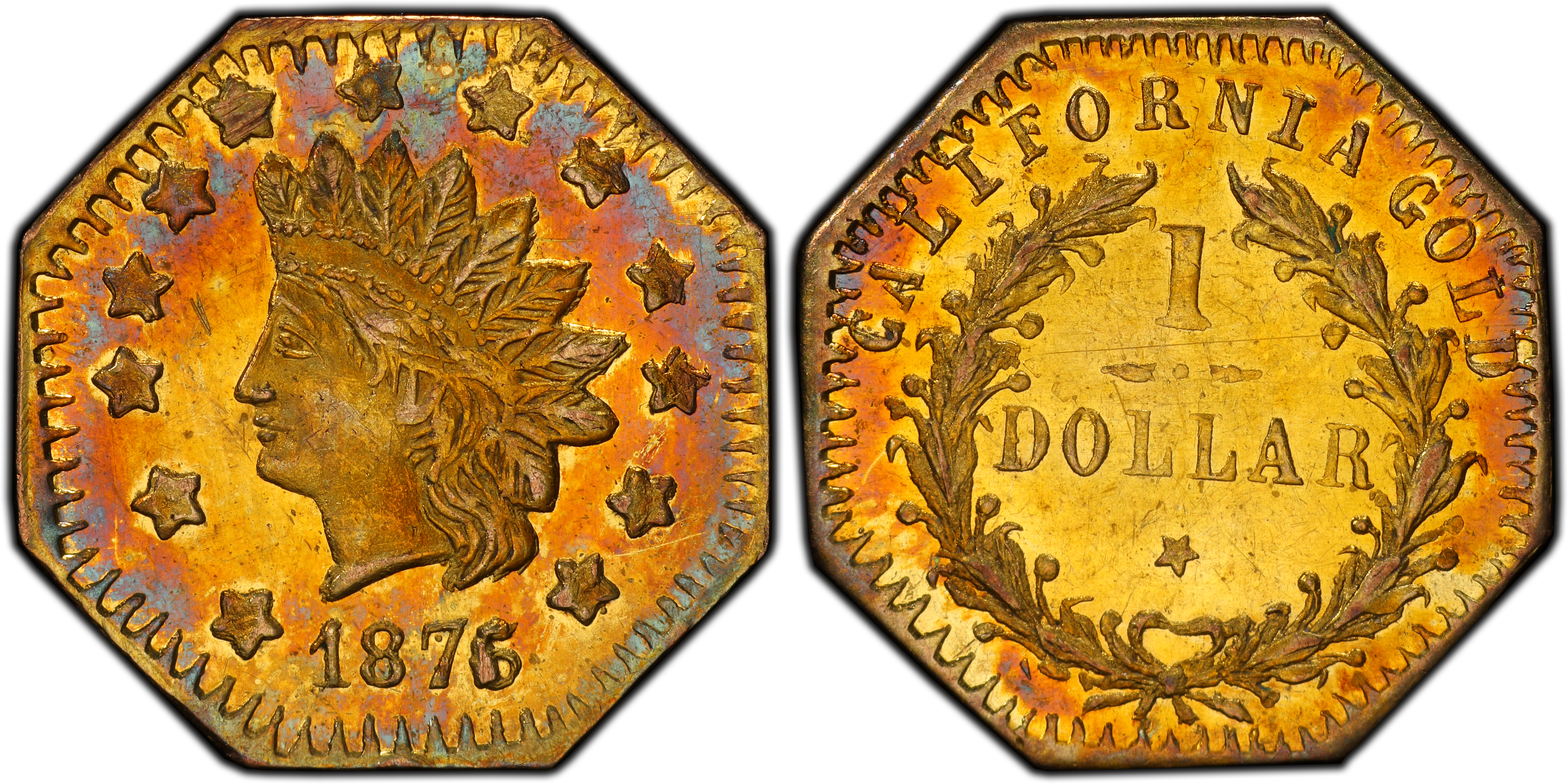
Obverse & Reverse
The 1876/5 G$1, cataloged as Breen-Gillio 1129, is a quintessential example of a 'Period Two' California Fractional Gold piece. These later issues (1859-1882) stand in contrast to the earlier 'Period One' (1852-1858) pieces, which were struck out of genuine commercial necessity to alleviate a severe shortage of small-denomination coinage during the initial chaos of the Gold Rush. By the mid-1870s, the United States Mint in San Francisco was in full operation, and the local economy was well-supplied with federal coinage. The raison d'être for fractional gold had shifted entirely from commerce to curiosity. San Francisco had transformed from a rugged boomtown into a major American city and a burgeoning tourist destination. Visitors, eager for a tangible memento of the romanticized Gold Rush, created a robust market for souvenirs. Local jewelers, many of whom were skilled engravers, stepped in to fill this demand. They produced a wide variety of beautifully crafted, yet often underweight and sometimes debased, gold tokens. These 'jeweler's issues' were not intended to circulate as money, but were sold as keepsakes, charms, and jewelry. The Private Coinage Act of 1864 had made such practices illegal, but federal enforcement was lax until the early 1880s. This legal gray area allowed producers like Herman J. Brand, the presumed minter of BG-1129, to operate openly for years. The 1876/5 overdate is a fascinating production detail, indicating the re-punching of an older '5' die to create the current date, a common money-saving practice among private minters. These pieces were never intended for circulation and were collected from the moment they were made, which accounts for the high average state of preservation seen today. Their eventual demise came when Secret Service Chief James J. Brooks cracked down on their production in 1883, viewing them as a potential avenue for fraud, bringing the era of denominated fractional gold to a definitive end.
Associated EventCalifornia Gold Rush Tourist & Souvenir Era
Reason For MintingTo serve the robust tourist and souvenir market in San Francisco for mementos of the Gold Rush.
Minter HistoryHerman J. Brand was one of several San Francisco jewelers active in the 1870s and 1880s who produced small gold tokens for the souvenir trade. While records are scarce, Breen and Gillio attribute this and several other Indian Head varieties to him. Brand's activities eventually drew the attention of the U.S. Secret Service, which was tasked with suppressing private coinage. To circumvent prosecution, he reportedly shifted his designs to a 'Miner' motif that was less coin-like, though this did not ultimately prevent the government from shutting down his and other similar operations by 1883.
Historical SignificanceBG-1129 is historically significant not as a coin, but as a cultural artifact. It represents the maturation of San Francisco and the commercialization of the Gold Rush legend. Unlike its Period One predecessors born of necessity, this piece was an object of nostalgia, a tangible token of a romanticized past sold to an eager tourist market, illustrating a key transition in the economic and social life of post-Gold Rush California.
BG-1129
Denomination$1
Minting Period1876
Assayer/MinterHerman J. Brand (Attributed)
Geographic OriginSan Francisco, California
Obverse DescriptionAn Indian Head profile facing left, wearing a feathered headdress. The portrait is surrounded by 13 six-pointed stars. The date, 1876, is below the bust and clearly shows a '5' under the final digit '6', which is the key diagnostic of this variety.
Obverse Inscription1876
Reverse DescriptionAn ornate wreath of leaves and berries tied with a bow at the bottom, encircling the denomination. The denomination is expressed with the numeral '1' over the word 'DOLLAR'.
Reverse Inscription1 DOLLAR
CompositionGold
Stated Fineness Actual FinenessVariable, but generally lower than federal standards for the period.
EdgePlain
Unknown
Survival Estimate76-200
Rarity ScaleR-4
This variety is highly popular due to its attractive octagonal shape, classic Indian Head design, and the clear 1876/5 overdate. As a Period Two issue, it is more accessible in high grades than its Period One counterparts, making it a favorite for type collectors and those seeking a high-quality example of fractional gold.
Key VarietiesThe primary variety is the 1876/5 overdate itself. No major sub-varieties from the original minting period are known. Unlike some territorial issues, there are no known official restrikes or patterns. Later-date reproductions and gold-plated tokens not cataloged by Breen-Gillio are common and should be avoided; they typically lack a denomination and have crude, non-standard designs (e.g., a bear on the reverse).
Authentication TipsAuthentic BG-1129 pieces must have the denomination '1 DOLLAR' on the reverse; later souvenir tokens without a denomination are not genuine Period Two items. The 1876/5 overdate must be clearly visible, with the underlying '5' apparent. Look for a somewhat crude but sharp overall appearance; many modern fakes are either too mushy or have a modern, tool-marked look. The gold should have the characteristic reddish-gold hue of native California alloy. Weakness in the strike, particularly on the stars, is common and not necessarily a sign of a fake.
Shopping ConsiderationsA premium quality example of BG-1129 is defined by a sharp strike, especially on the details of the headdress and the wreath. Many specimens, even in high Mint State grades, exhibit weakness on the peripheral stars, so a coin with fully struck stars commands a significant premium. Seek out examples with clean, original surfaces and minimal distracting contact marks. The most desirable pieces possess vibrant, prooflike or deep mirror prooflike (DMPL) fields, which create a beautiful cameo contrast with the devices and are highly prized by collectors. Avoid examples that have been cleaned, polished, or previously mounted in jewelry, as this severely impairs their value.
A coin's grade is its condition, rated on a 1-70 scale. For rare coins, this is the most critical factor in determining value, as a tiny difference in preservation can mean a huge difference in price.
Relevant Grade TypesAll original examples of BG-1129 are business strikes. Because they were made as souvenirs and did not circulate extensively, they are most commonly found in Circulated grades of AU-50 to AU-58 and, more frequently, in Mint State (MS, 60-70) grades. No true Proofs were struck during the original period of issue. The term 'Prooflike' (PL) or 'Deep Mirror Prooflike' (DMPL) is a designation added to high-grade business strikes that exhibit deeply mirrored fields, a characteristic these souvenir pieces sometimes possess due to the use of polished dies.
Mint State CharacteristicsIn Mint State, BG-1129 typically displays a bright, satiny luster, though many exhibit desirable prooflike surfaces. The overall strike is generally sharp on the central devices (Indian head, wreath), but as noted by numismatic experts, weakness on the stars is a common characteristic of the variety and should be expected. Bag marks are less common than on federal coinage due to their limited handling, but small, shallow contact marks from jeweler storage are sometimes seen. The tiny size makes any imperfection appear magnified.
Circulated Wear PatternsOn circulated examples, wear first appears on the highest points of the design. For the obverse, this includes the Indian's cheekbone, the eyebrow, and the feathers of the headdress. On the reverse, the highest points of the leaves in the wreath and the bow will show the first signs of friction and flattening. In lower grades (VF and below), the date and stars will begin to lose their sharpness.
Key Factors For ValueBeyond the numerical grade, value is driven by three key factors. First, surface quality: an example with original, uncleaned surfaces and minimal marks is paramount. Second, strike: a specimen with a bold strike on the date and headdress, and especially on the typically weak stars, will command a strong premium. Third, eye appeal: pieces with deep, prooflike fields and attractive cameo contrast are the most sought-after and valuable. A CAC sticker for this issue confirms premium quality for the grade and adds a significant premium.
PCGS Price Guide
| Grade | Price | Population |
|---|---|---|
| 53 | $700.00 | 1 |
| 53+ | $725.00 | N/A |
| 55 | $750.00 | 5 |
| 55+ | $775.00 | N/A |
| 58 | $800.00 | 20 |
| 58+ | $825.00 | N/A |
| 60 | $925.00 | 2 |
| 61 | $1,000.00 | 4 |
| 62 | $1,200.00 | 31 |
| 62+ | $1,400.00 | N/A |
| 63 | $1,750.00 | 17 |
| 63+ | $2,150.00 | N/A |
| 64 | $3,000.00 | 15 |
| 64+ | $3,250.00 | N/A |
| 65 | $3,750.00 | N/A |
| 65+ | $4,250.00 | N/A |
| 66 | $5,250.00 | 1 |
| 66+ | $6,000.00 | N/A |
| 67 | $7,500.00 | 1 |