(No Date) G50C BG-1078 (Regular Strike)
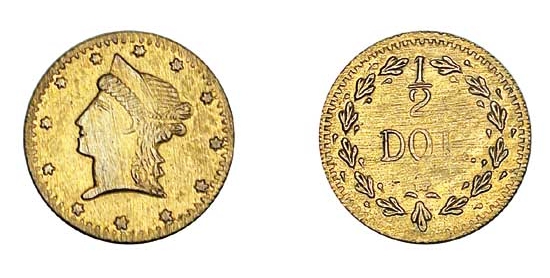
Obverse & Reverse
The (No Date) G50C BG-1078 is a fascinating and enigmatic issue from the second period of California Fractional Gold production. Struck circa 1870-1876, it emerged long after the initial, desperate need for small change during the Gold Rush had subsided. The San Francisco Mint, established in 1854, was by this time producing ample federal coinage, rendering private issues for circulation obsolete. Consequently, Period Two fractionals, including BG-1078, were primarily created as souvenirs and curiosities for tourists and collectors eager for a tangible piece of the Gold Rush legend. These 'jeweler's issues,' often made by French artisans in San Francisco, were typically underweight and sometimes of debased fineness, reflecting their non-monetary purpose. The history of BG-1078 is particularly compelling due to its numismatic evolution. In the first edition of their seminal work, 'California Pioneer Fractional Gold,' experts Walter Breen and Ronald J. Gillio listed this variety as a counterfeit. Its somewhat crude style and unusual characteristics led to this initial assessment. However, upon further study, its legitimacy was established, and it was reclassified as a genuine, albeit unofficial, issue in the second edition of the reference. This re-attribution speaks to the complexities of a series where private manufacture blurred the lines between currency, token, and souvenir. The dies used to strike BG-1078 are unique and cannot be linked to any of the known, more prolific producers of fractional gold, adding to its mystery. Its very existence is a testament to the lingering romanticism of the Gold Rush and the entrepreneurial spirit of jewelers who met a continuing demand for pocket-sized golden mementos of the Wild West.
Associated EventPost-Gold Rush California Tourism
Reason For MintingTo serve as a souvenir or collectible token for tourists and merchants rather than to alleviate a shortage of circulating coinage.
Minter HistoryThe specific minter of BG-1078 remains unknown. Analysis of the dies has failed to connect them to any of the identified San Francisco jewelers who produced other fractional gold varieties during this era. This anonymity is common for Period Two issues, as the Coinage Act of 1864 made private minting illegal, forcing many producers to operate clandestinely and without identifying marks.
Historical SignificanceBG-1078 is significant not as a circulating coin but as a numismatic artifact that bridges the gap between utilitarian pioneer gold and souvenir tokens. Its reclassification from counterfeit to genuine in numismatic literature highlights the scholarly detective work required to understand this complex series. It represents the commercialization of the Gold Rush mythos in the decades following the initial stampede.
BG-1078
DenominationG50C
Minting PeriodCirca 1870-1876
Assayer/MinterUnknown
Geographic OriginSan Francisco, California
Obverse DescriptionA crudely rendered bust of Liberty faces left, her hair tied in a tight bun. The portrait is surrounded by a circle of thirteen five-pointed stars. The engraving is shallow, and examples are almost universally characterized by significant weakness in the center of the planchet.
Obverse Inscription Reverse DescriptionA simple wreath, composed of two olive branches, is tied at the bottom with a small bow. Within the wreath, the denomination '1/2' is displayed. Like the obverse, the reverse typically shows pronounced striking weakness, particularly on the central denomination and the details of the wreath.
Reverse Inscription1/2
CompositionGold
Stated Fineness Actual Fineness EdgePlain
Unknown
Survival Estimate7 to 9 known
Rarity ScaleR-7
This variety is highly sought after due to its extreme rarity (R-7) and intriguing backstory, having been once condemned as a counterfeit before being recognized as genuine. Its unattributed origin adds a layer of mystery, making it a prized possession for specialists in the California Fractional Gold series.
Key VarietiesThere are no known sub-varieties of BG-1078 from its period of issue. Its most significant characteristic is its historical re-attribution. Numismatic scholar Mike Locke has noted that BG-1078 and the related BG-1079 give 'some of the appearance of being Period One California Fractional Gold but in other ways appear to be of later origin,' classifying it as a uniquely challenging piece to categorize. No special collector restrikes or patterns are known to exist.
Authentication TipsAuthentic examples of BG-1078 are characterized by a distinctively soft, weak strike in the centers of both the obverse and reverse. The engraving style is somewhat crude. Any example with a sharp, full strike should be viewed with extreme suspicion. Given its history of being considered a counterfeit and its high rarity, third-party certification by PCGS or NGC is virtually mandatory for establishing authenticity.
Shopping ConsiderationsFor a potential buyer, the most important factor is simply locating an example for sale. As noted by auction houses, 'condition is a secondary consideration when an item this rare is offered.' A premium quality example would be one that is free from damage such as holes, heavy scratches, or evidence of having been mounted in jewelry. While central striking weakness is expected and acceptable, look for an example with as much peripheral detail in the stars and wreath as possible. Faint hairlines are common, but deep, distracting marks will detract from the value. Original, uncleaned surfaces with a hint of greenish-gold or reddish toning are highly desirable.
A coin's grade is its condition, rated on a 1-70 scale. For rare coins, this is the most critical factor in determining value, as a tiny difference in preservation can mean a huge difference in price.
Relevant Grade TypesAll original examples of BG-1078 are business strikes, produced for souvenir purposes and not intended for rigorous circulation. They can be found in Circulated (1-58) grades, though they are more often encountered in Mint State (MS, 60-70) grades due to their status as collectibles from the time of issue. No Proof (PR/PF) examples were struck during the original period, and no later-date Proof restrikes are known to exist.
Mint State CharacteristicsAn uncirculated (MS) BG-1078 is defined by its characteristic weakness. The centers are invariably soft, with Liberty's cheek and the '1/2' on the reverse showing little to no detail. Luster is typically subdued and satiny rather than flashy. The quality of a Mint State piece is judged by the sharpness of the peripheral devices (stars and wreath) and the cleanliness of the surfaces. Small planchet flaws or adjustment marks are not uncommon for these private issues.
Circulated Wear PatternsOn circulated examples, wear first appears on the highest points of the design. For the obverse, this is the cheek and the hair above the ear. The peripheral stars will then begin to lose their sharpness. On the reverse, the high points of the wreath's leaves and the bow will show friction first. In lower grades (VF and below), the central details, already weak from the strike, may become entirely obliterated.
Key Factors For ValueWith an R-7 variety, rarity is the paramount factor. Any certified, problem-free example is a major numismatic prize. Beyond that, value is determined by surface preservation. An example with original, uncleaned 'skin' will command a significant premium over one that has been cleaned or polished, even if the latter is technically in a higher grade. The absence of planchet problems, distracting marks, or edge damage is critical. Eye appeal, driven by attractive original color and the maximum possible detail for the variety, will always drive spirited bidding among specialists.
PCGS Price Guide
| Grade | Price | Population |
|---|---|---|
| 45 | $3,350.00 | N/A |
| 45+ | $3,500.00 | N/A |
| 50 | $4,000.00 | 2 |
| 50+ | $4,100.00 | N/A |
| 53 | $4,250.00 | N/A |
| 53+ | $4,350.00 | N/A |
| 55 | $4,500.00 | N/A |
| 55+ | $4,750.00 | N/A |
| 58 | $5,000.00 | N/A |
| 58+ | $5,250.00 | N/A |
| 60 | $6,000.00 | N/A |
| 61 | $6,500.00 | N/A |
| 62 | $6,750.00 | N/A |
| 62+ | $7,250.00 | N/A |
| 63 | $8,500.00 | 1 |