1868 G50C BG-1074 (Regular Strike)
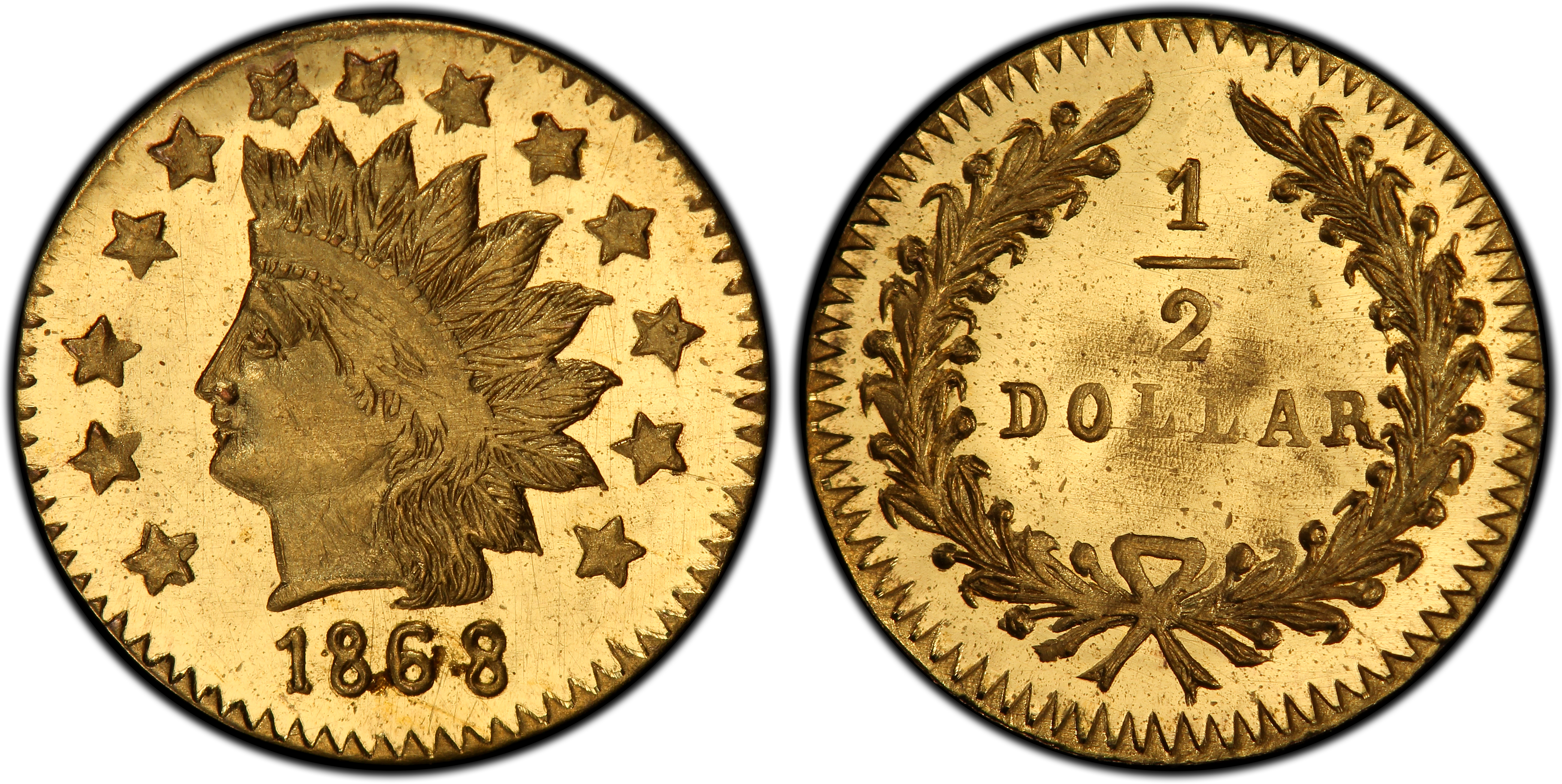
Obverse & Reverse
The 1868 G50C BG-1074 is a quintessential example of a 'Period Two' California Fractional Gold piece, a series of privately issued coins that emerged in the shadow of the great Gold Rush. By the late 1860s, the initial, frantic need for small denomination coinage that characterized the early 1850s had largely subsided. The establishment and full-scale operation of the San Francisco Mint had supplied the region with ample federal coinage. Consequently, the motivation for producing fractional gold shifted from necessity to novelty. These later issues, struck from 1859 to 1882, were primarily created by jewelers as souvenirs and curiosities for tourists and locals nostalgic for the Gold Rush era. Christopher Ferdinand Mohrig, a San Francisco jeweler, was a prolific minter of these pieces. Though this coin bears the date 1868, it was almost certainly struck later, likely between 1871 and Mohrig's arrest in 1876. This backdating was a common practice to circumvent the Private Coinage Act of June 8, 1864, which prohibited private issues. The U.S. Secret Service, under the direction of the zealous James J. Brooks, began a crackdown on these private minters in the 1870s. Mohrig was ultimately arrested on August 10, 1876, and his dies and equipment were confiscated and destroyed, instantly rendering his extant work scarce. The BG-1074 was not a coin of commerce; its low intrinsic gold value and the abundance of federal silver coinage meant it never truly circulated. Instead, it was a memento of California's golden age, a tiny, glittering souvenir from a city that had transformed from a chaotic boomtown into a major American metropolis. Its numismatic significance lies in its connection to this fascinating transitional period in California history and to the legal battles that ended the long tradition of private coinage in the United States.
Associated EventPost-Gold Rush Economic Expansion
Reason For MintingPrimarily struck as a souvenir or charm for the tourist trade, not for general circulation.
Minter HistoryChristopher Ferdinand Mohrig was a San Francisco-based jeweler and one of the most significant producers of 'Period Two' California Fractional Gold. He created a wide variety of designs, including the BG-1074. His operations ceased abruptly on August 10, 1876, when he was arrested by the Secret Service for violating the 1864 Private Coinage Act. The confiscation and destruction of his minting equipment explains the rarity of many of his issues.
Historical SignificanceThis coin represents the final phase of American private minting, a period when such issues transitioned from essential circulating media to commercially produced souvenirs, ultimately leading to federal intervention and the end of the practice.
N/A
DenominationG50C
Minting Period1868
Assayer/MinterChristopher Ferdinand Mohrig
Geographic OriginSan Francisco, California
Obverse DescriptionA stylized Indian Head facing left, with a feathered headdress. The portrait is surrounded by thirteen six-pointed stars, seven to the left and six to the right.
Obverse Inscription[Date 1868 below portrait, surrounded by 13 stars]
Reverse DescriptionThe reverse features the denomination '50 CENTS' within a wreath composed of two branches tied together with a bow at the bottom.
Reverse Inscription50 CENTS
CompositionGold
Stated Fineness Actual FinenessTypically debased, often 14 to 21 karats.
Weight0.25 grams
Diameter10.50 mm
EdgePlain
Unknown
Survival Estimate13-30
Rarity ScaleR-6
The BG-1074 is highly sought after due to its rarity (R-6), connection to the well-documented minter C.F. Mohrig, and its attractive Indian Head design. The typically prooflike or deeply mirrored surfaces add significant eye appeal.
Key VarietiesThe primary issue is the business strike, though many examples exhibit prooflike (PL) or deep mirror prooflike (DMPL) surfaces from being struck with polished dies. No known restrikes or patterns exist, as Mohrig's dies were confiscated and destroyed by the Secret Service in 1876.
Authentication TipsGenuine examples often exhibit a characteristic soft strike, particularly on the high points of the Indian's cheek and the center of the wreath on the reverse. The fields should be deeply mirrored or prooflike, not granular or porous. The style of the engraving, particularly the stars and numerals, should be compared to known genuine examples. Modern counterfeits often have incorrect luster, weight, or a mushy overall appearance. Look for sharp, well-defined die polish lines on authentic pieces.
Shopping ConsiderationsA premium quality BG-1074 will possess deeply reflective, 'black and white' cameo contrast between the fields and the devices. While central softness is expected, look for examples with the sharpest possible strike on the peripheral stars and wreath details. Avoid coins that have been harshly cleaned, which will show hairline scratches that disrupt the mirrored fields. Specimens with original, untouched butter-gold surfaces command a significant premium. Given the typically weak centers, any example with above-average detail in the hair and feathers is highly desirable.
A coin's grade is its condition, rated on a 1-70 scale. For rare coins, this is the most critical factor in determining value, as a tiny difference in preservation can mean a huge difference in price.
Relevant Grade TypesOriginal period issues were business strikes intended for the souvenir market, not circulation. They are found almost exclusively in Mint State (MS, 60-70) grades. Despite their business strike status, many were struck with polished dies and exhibit prooflike characteristics; these are designated as PL or DMPL by grading services. No true Proofs were struck, and as Mohrig's dies were destroyed, no legitimate restrikes exist.
Mint State CharacteristicsUncirculated examples of BG-1074 are defined by their surface quality. The highest quality pieces have deeply mirrored fields with frosty devices, creating a strong cameo effect. The strike is characteristically weak in the center, so a fully struck cheek and wreath is virtually unknown and not expected. Luster is typically flashy and reflective rather than satiny. Small planchet flaws or die polish lines are common and do not necessarily detract from the grade unless they are severe.
Circulated Wear PatternsAs these coins were not intended for circulation, significant wear is almost never encountered. If a specimen were to show friction, it would first appear as a dulling of the mirrored fields and slight flattening on the highest points of the design: the Indian's cheekbone, the eyebrow, the highest feather tips, and the high points of the wreath leaves and bow on the reverse.
Key Factors For ValueThe primary value driver for BG-1074 is the quality of its surfaces and the degree of cameo contrast. A specimen graded MS-64 DMPL will be worth substantially more than an MS-62 with subdued fields. Eye appeal is paramount; coins with clean, reflective surfaces and a sharp visual contrast are prized. While central strike weakness is normal, examples that are sharper than average command a premium. A CAC sticker is highly beneficial for this issue, as it confirms the quality of the coin for the assigned grade, particularly concerning the pristine nature of the mirrored fields.
PCGS Price Guide
| Grade | Price | Population |
|---|---|---|
| 58 | $350.00 | 1 |
| 58+ | $400.00 | N/A |
| 60 | $500.00 | N/A |
| 61 | $550.00 | N/A |
| 62 | $625.00 | 4 |
| 62+ | $675.00 | N/A |
| 63 | $725.00 | 4 |
| 63+ | $800.00 | N/A |
| 64 | $1,000.00 | 4 |
| 64+ | $1,250.00 | N/A |
| 65 | $2,750.00 | 1 |
| 65+ | $3,250.00 | 2 |
| 66 | $3,750.00 | N/A |
| 66+ | $5,000.00 | 1 |