1852 G50C BG-1076 (Regular Strike)
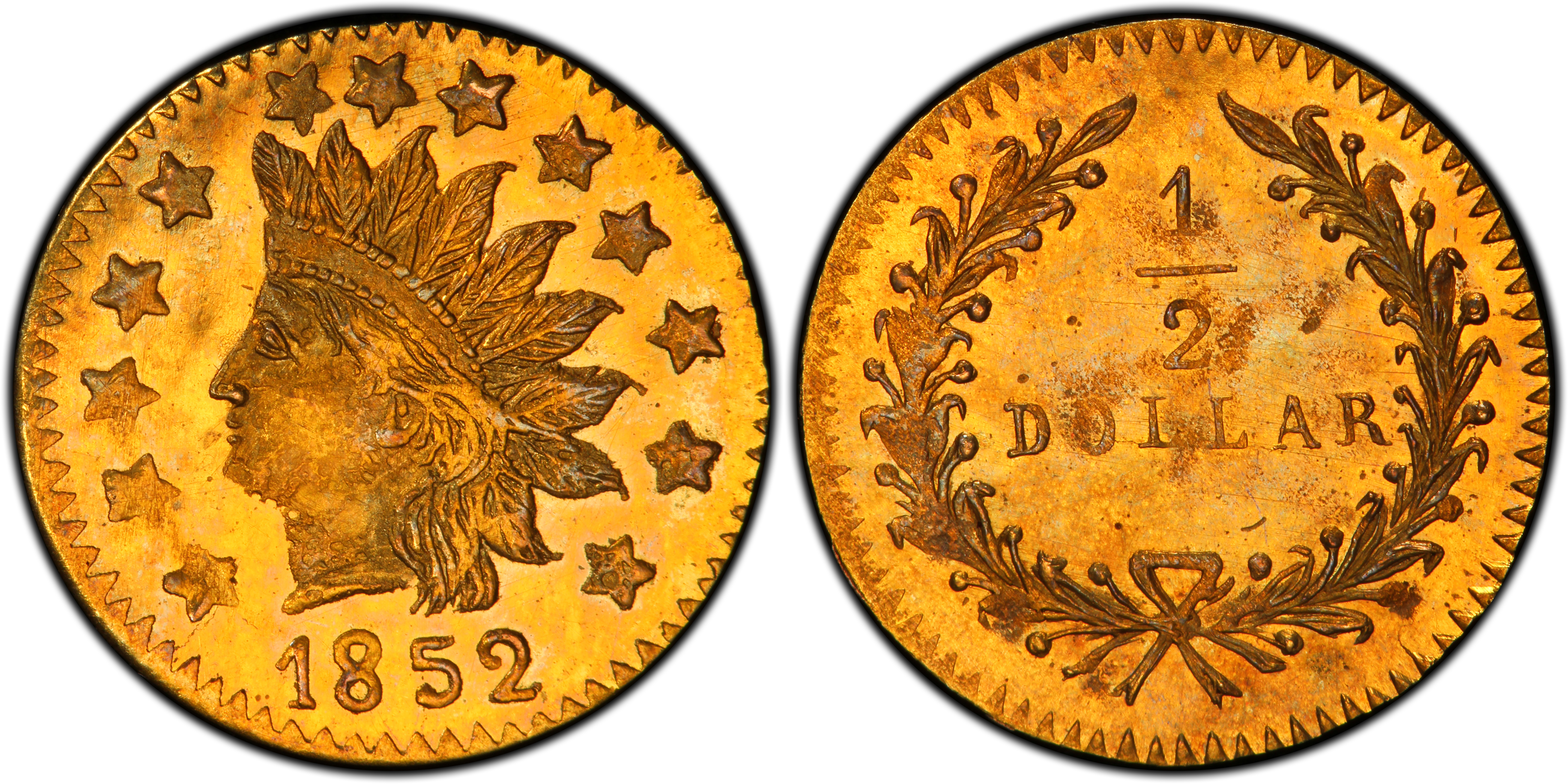
Obverse & Reverse
The 1852 BG-1076 Gold 50 Cents piece is a quintessential artifact from the chaotic, formative years of the California Gold Rush. Following the discovery of gold at Sutter's Mill in 1848, a massive influx of over 300,000 people descended upon California, creating a vibrant but tumultuous economy. While vast quantities of gold dust and nuggets were being extracted, the region suffered from a severe, chronic shortage of circulating small-denomination coinage. Daily transactions for necessities like food, tools, or a drink were incredibly cumbersome, often reverting to the imprecise system of paying with a 'pinch' of gold dust. This created a perfect opportunity for private enterprise to fill the void left by the distant federal government, whose mints were on the other side of the continent. San Francisco jewelers, assayers, and businessmen began striking their own coins in 25-cent, 50-cent, and dollar denominations. These pieces, now categorized as 'Period One' (1852-1857) California Fractional Gold, were created expressly for commerce and were intended to circulate. The BG-1076 is an early and important example of this phenomenon. Struck by an unknown but skilled hand, its creation reflects the desperate need for a standardized medium of exchange. Unlike the later 'Period Two' issues, which were often made as souvenirs, these early coins were utilitarian. However, they were not without controversy; most were significantly underweight for their stated value, making them a highly profitable venture for the minters but a subject of public debate. Despite this, their convenience ensured their acceptance in local trade until the establishment of the San Francisco Mint in 1854, which gradually produced enough federal coinage to render the private issues obsolete. Most fractional gold pieces were eventually withdrawn from circulation, melted for their bullion content, making surviving examples like the BG-1076 rare and historically significant relics of American westward expansion.
Associated EventCalifornia Gold Rush
Reason For MintingTo alleviate a severe shortage of small-denomination coinage for daily commercial transactions in Gold Rush-era California.
Minter HistoryThe identity of the specific private minter or jeweler who produced the BG-1076 variety is unknown, a common trait for many Period One California Fractional Gold issues. These coins were often produced by small, competing firms or individual craftsmen in San Francisco who saw a commercial opportunity. They operated without direct government oversight, and their marks, if any, were often simple initials or symbols. The dies were hand-cut, and the coins were typically struck using manual screw presses or even by the hammer method, resulting in crude but functional coinage.
Historical SignificanceThe BG-1076 represents a tangible solution to a critical economic problem on the American frontier, embodying the ingenuity and quasi-legal enterprise that characterized the Gold Rush. It is a key piece of the 'Period One' issues, which are considered the most historically important of the fractional gold series as they were created out of necessity and saw genuine circulation, unlike many later souvenir pieces. Its existence is a direct testament to the economic conditions that prevailed before federal infrastructure could be fully established in the West.
N/A
Denomination50 Cents
Minting Period1852
Assayer/MinterUnknown Private Minter
Geographic OriginSan Francisco, California
Obverse DescriptionFeatures a stylized male portrait facing left, commonly referred to as an 'Indian Head,' though the design is more likely a generic representation of Liberty with a feathered headdress, inspired by federal coinage motifs. The portrait is surrounded by thirteen six-pointed stars, representing the original colonies.
Obverse Inscription[None - Stars only]
Reverse DescriptionThe central device is the denomination '50 CENTS' arranged in two lines. This is enclosed within a wreath of leaves and berries. The date '1852' appears below the wreath, positioned between the wreath's lower stems.
Reverse Inscription50 CENTS 1852
CompositionGold
Stated Fineness Actual FinenessVariable, but typically ranges from .800 to .880 fine gold, often containing native silver as a natural alloy.
Diameter11.00 mm
EdgePlain
Unknown
Survival EstimateFewer than 75 known
Rarity ScaleR-6-
The BG-1076 is highly prized as a genuine 'Period One' circulating issue from the first year of fractional gold production. Its appeal lies in its direct connection to the Gold Rush, its classic 'Indian Head' design, and its high rarity. Collectors value these pieces as foundational items in the territorial gold series.
Key VarietiesThe primary variety is the regular strike business issue of 1852. No proof strikings from the original period are known to exist. There are no major, recognized varieties of BG-1076 itself, though minute die state differences may exist. It is crucial to distinguish genuine Period One issues like BG-1076 from the plethora of later souvenir issues and modern replicas, which often lack a denomination or have fantasy designs.
Authentication TipsGenuine BG-1076 coins exhibit characteristic die work with a somewhat crude but sharp overall appearance. Look for the specific style of the portrait and the font used for the denomination and date. Counterfeits are common; many are brass or gilt base metal and will have the wrong weight and specific gravity. Others are modern gold copies that often have a mushy or soapy look from being cast or transfer-die struck. Diagnostics for BG-1076 include the precise positioning of the date relative to the wreath and the specific shape of the portrait's features. All genuine Period One pieces must have a stated denomination (e.g., 'CENTS' or 'DOLLAR').
Shopping ConsiderationsFor a premium quality BG-1076, look for a sharp strike, especially on the high points of the portrait's cheek and headdress, and on the wreath's leaves. Original, undisturbed surfaces with some remaining mint luster are highly desirable and command significant premiums. Due to the soft gold, contact marks are common, but examples with minimal, well-scattered marks are preferred. Avoid coins that have been harshly cleaned, which strips the original patina and imparts hairline scratches. Also, be wary of tooling or smoothing in the fields to hide marks, and check the rim for evidence of jewelry mounting, as these tiny coins were often used in adornments.
A coin's grade is its condition, rated on a 1-70 scale. For rare coins, this is the most critical factor in determining value, as a tiny difference in preservation can mean a huge difference in price.
Relevant Grade TypesOriginal BG-1076 coins were business strikes intended for circulation, and are found in Circulated (1-58) and, more rarely, Mint State (MS, 60-70) grades. The vast majority of surviving examples are circulated. No proofs were struck during the original minting period. Any piece described as a 'Proof' is either a later fabrication or a misattribution of a prooflike business strike.
Mint State CharacteristicsAn uncirculated BG-1076 will exhibit frosty or satiny mint luster in the protected areas around the stars and lettering. The strike is often uneven due to the crude minting process; a well-struck example with full detail on the portrait and wreath is rare and desirable. Planchet quality can be inconsistent, with minor striations or adjustment marks sometimes present from the manufacturer. Bag marks, even on Mint State examples, are common and should be evaluated for their severity and location.
Circulated Wear PatternsWear first appears on the highest points of the design. On the obverse, this includes the cheek, the ear, and the feathers of the headdress. On the reverse, the highest points of the wreath leaves and the numerals of the denomination will show the first signs of friction. On lower grade examples (VG and below), the stars will begin to merge with the field and the finer details of the wreath will be completely worn away.
Key Factors For ValueThe primary value drivers for a BG-1076 are grade and surface quality. An example with original, uncleaned surfaces and a sharp strike will always command a premium. Eye appeal is critical; coins with a pleasing, original reddish-gold or mellow yellow-gold patina are favored over those that are unnaturally bright from cleaning or dipping. Given the prevalence of counterfeits and underweight pieces in the series, certification by a top-tier grading service (PCGS or NGC) is virtually essential for establishing authenticity and market liquidity. A CAC sticker for this issue indicates superior quality for the grade and will add a significant premium.
PCGS Price Guide
| Grade | Price | Population |
|---|---|---|
| 58 | $500.00 | 1 |
| 58+ | $515.00 | N/A |
| 60 | $525.00 | N/A |
| 61 | $550.00 | N/A |
| 62 | $575.00 | 5 |
| 62+ | $600.00 | N/A |
| 63 | $650.00 | 14 |
| 63+ | $725.00 | N/A |
| 64 | $875.00 | 6 |
| 64+ | $1,000.00 | N/A |
| 65 | $1,250.00 | N/A |
| 65+ | $1,500.00 | N/A |
| 66 | $2,150.00 | 1 |