1858 G$1 BG-1306 (Regular Strike)
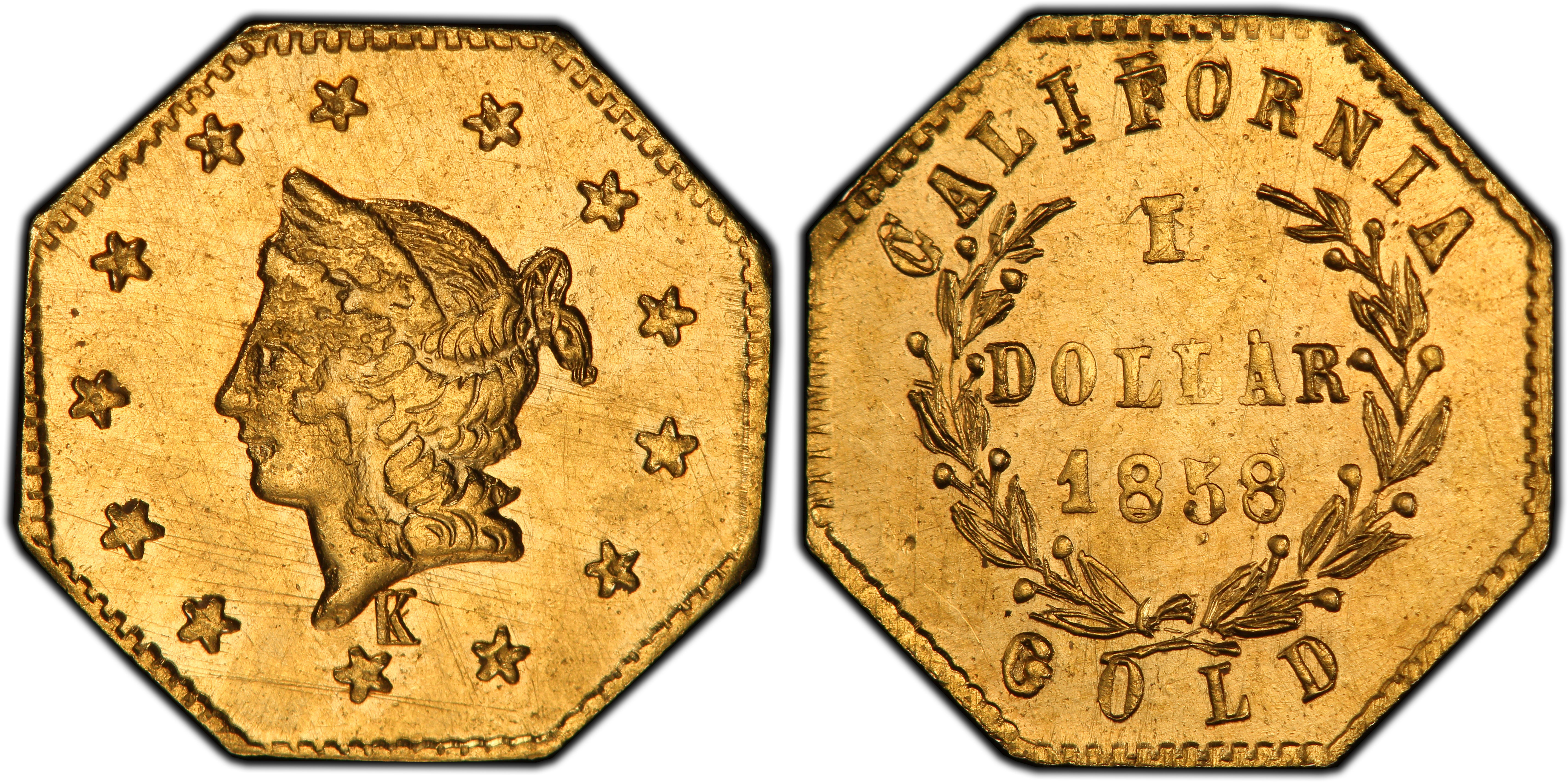
Obverse & Reverse
The 1858 G$1 BG-1306 is a fascinating artifact from the second period of California's private gold minting era. The initial 'Period One' (1852-1857) issues were born of pure necessity, created to alleviate a severe shortage of small-denomination coinage for daily commerce in the gold fields. By 1858, the San Francisco Mint was in full operation, and the pressing need for fractional gold as a circulating medium had subsided. This shifted the purpose of these miniature gold coins. The BG-1306 belongs to the 'Period Two' or 'Jeweler's Issues' (1858-1882), which were primarily manufactured not for circulation, but as souvenirs and keepsakes. Jewelers in San Francisco, masters of metalwork, recognized a booming market for mementos of the California Gold Rush that could be easily mailed or carried back East. These pieces were often intentionally underweight compared to their face value, as their appeal was in their novelty and connection to the romantic image of the West, not their intrinsic value. The anonymous minter of BG-1306 employed a Liberty Head motif, echoing the designs of federal gold coinage to lend it an air of legitimacy, even as its purpose was commercial rather than monetary. The production was crude by federal mint standards, typically involving hand-cut dies and a hammer-striking process, which resulted in significant variation in strike quality. The passage of the Coinage Act of 1864, which prohibited private coinage, marked the beginning of the end for these pieces, but the law was not strictly enforced until 1883, allowing jewelers to continue production for years. Today, the BG-1306 is valued not as a coin that fueled the Gold Rush economy, but as a direct link to the culture and commerce of post-Gold Rush California, representing a transition from necessity to nostalgia.
Associated EventCalifornia Gold Rush Aftermath
Reason For MintingPrimarily created to be sold as a popular and easily transportable souvenir of the California Gold Rush era.
Minter HistoryThe minter of BG-1306 is unknown, a common characteristic of the 'Period Two' California Fractional Gold pieces. These were typically produced by various San Francisco-based jewelers who left no identifying marks on their work. They operated small-scale, often utilizing hand-hammering techniques to produce these souvenir tokens.
Historical SignificanceThis coin is significant for representing the second phase of fractional gold production, where the primary purpose shifted from filling a void in circulating currency to satisfying a commercial demand for souvenirs. It captures the romanticism of the Gold Rush in a tangible form and illustrates a period of unregulated private minting that persisted long after the initial rush had ended.
N/A
Denomination$1
Minting Period1858
Assayer/MinterUnknown
Geographic OriginSan Francisco, California
Obverse DescriptionA beaded border encircles a fairly crude rendering of a left-facing Liberty Head. Liberty's hair is tied in a bun, and she wears a coronet. The portrait is surrounded by thirteen five-pointed stars, typically unevenly spaced and rendered. The date '1858' is below the bust, though its visibility can vary with strike quality.
Obverse Inscription1858
Reverse DescriptionA decorative wreath composed of two branches tied with a bow at the bottom. Inside the wreath, the denomination '1' is prominent, with 'DOLLAR' inscribed below it. The lettering is often crude and may show die deficiencies.
Reverse Inscription1 DOLLAR
CompositionGold
Stated Fineness Actual FinenessVariable, but generally lower than federal coinage of the era.
EdgePlain
Unknown
Survival Estimate201-500
Rarity ScaleR-3
The BG-1306 is sought after for its connection to the California Gold Rush mystique and its status as an affordable, dated territorial issue. Its octagonal shape adds visual appeal. The association of many examples with the 'Kroll Hoard' provides a desirable provenance for specialists.
Key VarietiesThe primary special characteristic for this variety is its association with the Kroll Hoard. Herman Kroll was a jeweler who produced a number of Period Three restrikes and back-dated pieces. The 'Kroll Hoard' refers to a group of earlier Period Two issues, including the BG-1306, that were part of his inventory, discovered decades later. Many certified examples of BG-1306 carry the 'Kroll Hoard' pedigree on the holder, which is a key selling point. No major die varieties from the original minting period are widely recognized.
Authentication TipsAuthentication requires comparison to known genuine examples, ideally using the Breen-Gillio reference. Key diagnostics include the specific die characteristics of the Liberty portrait, the shape and spacing of the stars, and the lettering style on the reverse. The weight and diameter should be consistent with known genuine specimens. Counterfeits are common and often have a soapy, cast-like appearance, incorrect details (especially in the hair and wreath), or are made of gold-plated base metal.
Shopping ConsiderationsA premium quality example for its grade will show a relatively sharp strike for the issue. Pay close attention to the details in Liberty's hair and the leaves of the wreath, which are often weakly struck. Original, uncleaned surfaces with some remaining luster command a significant premium. The tiny size makes these coins prone to damage; inspect carefully for evidence of having been mounted in jewelry, tooling in the fields, or harsh cleaning which can leave hairlines. Given the prevalence of fakes, purchasing examples certified by a major third-party grading service (PCGS or NGC) is strongly recommended.
A coin's grade is its condition, rated on a 1-70 scale. For rare coins, this is the most critical factor in determining value, as a tiny difference in preservation can mean a huge difference in price.
Relevant Grade TypesOriginal period issues of BG-1306 were business strikes, although intended as souvenirs rather than for heavy circulation. They are found in both Circulated (1-58) and Mint State (MS, 60-70) grades. No Proofs were struck during the original period of issue. The highly reflective, 'proof-like' surfaces sometimes seen are a result of polished dies being used to strike regular business strikes for souvenir sales and should not be confused with true Proof coinage.
Mint State CharacteristicsUncirculated examples of BG-1306 are defined by the presence of original mint luster. The luster is typically satiny and can be somewhat subdued. Due to the manual, hammer-struck minting process, the strike is often uneven. It is common to see weakness in the center of the coin, particularly on the highest points of Liberty's hair and the reverse wreath. Small planchet flaws or adjustment marks are not uncommon. Contact marks, while factoring into the grade, are judged with the understanding that these pieces were handled and sold loosely as souvenirs.
Circulated Wear PatternsWear first appears on the highest points of the design. On the obverse, this includes Liberty's ear, the hair bun, and the coronet over the eye. On the reverse, the high points of the wreath's leaves and the bow knot will show the first signs of friction, appearing flattened and losing detail. In lower grades (VF and below), the stars on the obverse and the individual letters in 'DOLLAR' will begin to wear down and merge with the fields.
Key Factors For ValueBeyond the numerical grade, value is driven by strike and surface quality. A coin with a bold, well-centered strike is highly desirable and commands a premium over a weakly struck example of the same grade. Original, uncleaned surfaces with attractive, reddish-gold toning have strong eye appeal. Conversely, examples that have been harshly cleaned, polished, or previously used in jewelry will be significantly less valuable. The presence of a CAC sticker indicates premium quality for the grade and often results in a higher market price.
PCGS Price Guide
| Grade | Price | Population |
|---|---|---|
| 53 | $200.00 | 1 |
| 53+ | $215.00 | N/A |
| 55 | $225.00 | N/A |
| 55+ | $235.00 | N/A |
| 58 | $250.00 | 1 |
| 58+ | $275.00 | N/A |
| 60 | $315.00 | N/A |
| 61 | $400.00 | N/A |
| 62 | $550.00 | 4 |
| 62+ | $625.00 | N/A |
| 63 | $700.00 | 2 |