1868 G50C BG-1073 (Regular Strike)
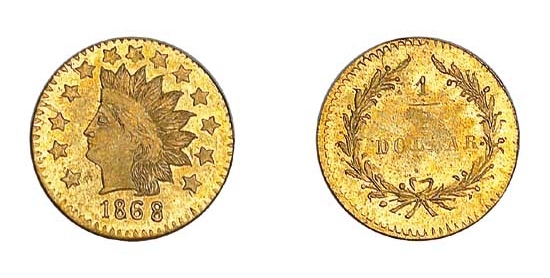
Obverse & Reverse
The 1868 BG-1073 50 Cents is a product of the second phase of California fractional gold production, a period numismatists define as 1858-1882. Unlike the 'Period One' issues (1852-1857), which arose from a genuine and severe shortage of small-denomination circulating coinage during the initial Gold Rush boom, these later pieces were created under a different set of circumstances. By 1868, the San Francisco Mint was in full operation, supplying ample federal coinage for commerce. Furthermore, the Coinage Act of April 22, 1864, had explicitly outlawed the private minting of currency. Consequently, pieces like the BG-1073 were technically illegal to produce as money. Instead, they were manufactured by jewelers primarily to satisfy a burgeoning market for souvenirs and keepsakes. San Francisco had become a major tourist destination, and these tiny gold coins were the perfect memento of a trip to the land of gold. The minter, Robert B. Gray & Co., was a prominent San Francisco jeweler who had entered the fractional gold business around 1859-60 after acquiring the business of another producer, Antoine Nouizillet. While Gray sometimes used Nouizillet's old dies, he also created new ones, often featuring an Indian Head motif, a popular and exotic design element of the era. These 'Suppressed Jewelers' Issues' were often underweight for their face value and varied in fineness, as their purpose was novelty rather than commerce. Their production continued semi-clandestinely until an aggressive crackdown by the U.S. Secret Service, led by James J. Brooks, effectively ended the practice by 1883. The BG-1073 is a tangible link to this fascinating later period, representing a transition from utilitarian private coinage to a celebrated and collectible souvenir tradition, produced in defiance of federal law.
Associated EventPost-Gold Rush California tourism and commerce
Reason For MintingPrimarily struck to be sold as jewelry, souvenirs, and curiosities rather than to alleviate a coinage shortage.
Minter HistoryRobert B. Gray & Co. was a San Francisco-based jewelry firm active in the mid-to-late 19th century. The company entered the fractional gold market around 1859 or 1860 by purchasing the operation of an earlier French jeweler, Antoine Louis Nouizillet. Gray continued to use some of Nouizillet's dies before creating his own, some of which bore a characteristic 'G' mintmark (though not all varieties are marked). His firm was a key producer of 'Period Two' fractional gold, catering to the souvenir market after the 1864 federal ban on private coinage. Gray's issues are noted for their variety and, in some cases, for being of slightly higher intrinsic value than those of his competitors. The firm was eventually sold to the California Jewelry Co. in 1871.
Historical SignificanceThe BG-1073 represents the evolution of California fractional gold from a necessary form of currency to an illegal but popular souvenir item. It highlights the continued romantic allure of the Gold Rush and the defiance of private minters in a rapidly federalizing monetary landscape. Its immense rarity today underscores the ephemeral nature of these jewelers' issues.
N/A
Denomination50 Cents
Minting Period1868
Assayer/MinterRobert B. Gray & Co.
Geographic OriginSan Francisco, California
Obverse DescriptionFeatures a stylized Indian Princess head facing left, a popular motif for the era. The portrait is typically surrounded by 13 six-pointed stars representing the original colonies. The date '1868' is positioned below the bust.
Obverse Inscription1868
Reverse DescriptionThe central device is the denomination '50 CENTS' enclosed within a wreath. The wreath is composed of two branches tied together at the bottom with a bow.
Reverse Inscription50 CENTS
CompositionGold
Stated Fineness Actual Fineness EdgePlain
Unknown; likely extremely small.
Survival EstimateFewer than 10; the combined NGC and PCGS population reports show only 5 examples graded.
Rarity ScaleR-7 (4-12 known)
This coin is highly sought after for its extreme rarity and connection to the later, semi-illicit period of fractional gold production. As a dated 'Period Two' Indian Head type, it appeals to specialists in the series who seek to acquire one of the toughest varieties. The allure of owning a piece from a near-vanished mintage is its primary driver of demand.
Key VarietiesNo major varieties of the BG-1073 are known. Given its date of manufacture, it is considered a business strike issue intended for souvenir purposes. No proof or special presentation strikings from the period have been documented. Collectors should be aware of the numerous modern replicas and fantasy pieces that imitate fractional gold designs; only pieces matching the Breen-Gillio diagnostic photographs are considered authentic.
Authentication TipsAuthenticity is paramount. Genuine examples exhibit sharp, albeit sometimes unevenly impressed, details from dies, not the soft, cast-like appearance of many replicas. The style of the Indian Head and the wreath must precisely match the Breen-Gillio plate coin photographs. Many fakes are brass or thinly gold-plated; weight and specific gravity tests can be conclusive. Any piece with a bear on the reverse is a modern souvenir. Given the coin's high rarity and value, certification by a top-tier grading service (PCGS or NGC) is virtually mandatory for a legitimate transaction.
Shopping ConsiderationsFor a coin of this rarity, any example is a major acquisition. A premium quality specimen would be one that is well-centered and sharply struck, as many fractional pieces suffer from weak or off-center strikes. Look for original, undisturbed surfaces with some remaining luster; even a hint of proof-like flash in the fields is highly desirable. Avoid examples that have been mounted in jewelry, tooled, harshly cleaned, or show evidence of soldering, as this was a common fate for these pieces. The visual appeal, or 'eye appeal,' is critical; a coin with a pleasing, uniform color will command a significant premium over a spotted or discolored example.
A coin's grade is its condition, rated on a 1-70 scale. For rare coins, this is the most critical factor in determining value, as a tiny difference in preservation can mean a huge difference in price.
Relevant Grade TypesAll original examples of BG-1073 were struck as business strikes, intended for sale as souvenirs. They are found in Circulated (1-58) and, more commonly for this later period, Mint State (MS, 60-70) grades. No Proofs (PR/PF) were struck during the original minting period, and there are no known later-date collector restrikes.
Mint State CharacteristicsUncirculated examples of this issue often exhibit semi-prooflike or prooflike surfaces, a result of being struck from polished dies on polished planchets to enhance their appeal as jewelry items. However, the strike can be weak in the centers, particularly on the highest points of the Indian princess's hair and the details within the wreath. Luster is typically bright and flashy rather than soft and satiny. Due to the primitive minting process and handling, even high-grade examples can show minor planchet flaws or small, scattered contact marks.
Circulated Wear PatternsOn circulated examples, wear will first appear on the high points of the design. For the obverse, this includes the cheek, the eyebrow, and the feathers of the headdress. On the reverse, the leaves and berries at the top of the wreath and the ribbon bow at the bottom will show the first signs of friction and flattening. In lower grades (VF and below), the finer details of the hair and feathers will merge, and the legend will begin to weaken.
Key Factors For ValueExtreme rarity is the primary value driver. Beyond that, the key factors are surface preservation and strike quality. An example with minimal contact marks and original, lustrous 'skin' is far more valuable than a cleaned or abraded piece. A sharp, well-centered strike that brings up the details of the portrait and wreath is highly desirable and commands a substantial premium. Eye appeal is crucial; coins with attractive, unimpaired surfaces will always be prioritized by serious collectors. A CAC sticker on a certified coin would add a significant premium, confirming its quality for the assigned grade.
PCGS Price Guide
| Grade | Price | Population |
|---|---|---|
| 55 | $1,000.00 | 1 |
| 55+ | $1,100.00 | N/A |
| 58 | $1,250.00 | N/A |
| 58+ | $1,350.00 | N/A |
| 60 | $1,600.00 | 1 |
| 61 | $1,950.00 | N/A |
| 62 | $2,500.00 | 2 |
| 62+ | $2,750.00 | N/A |
| 63 | $3,000.00 | N/A |
| 63+ | $3,350.00 | N/A |
| 64 | $3,750.00 | 2 |
| 64+ | $4,000.00 | N/A |
| 65 | $5,000.00 | 2 |