1852 G50C BG-1075 (Regular Strike)
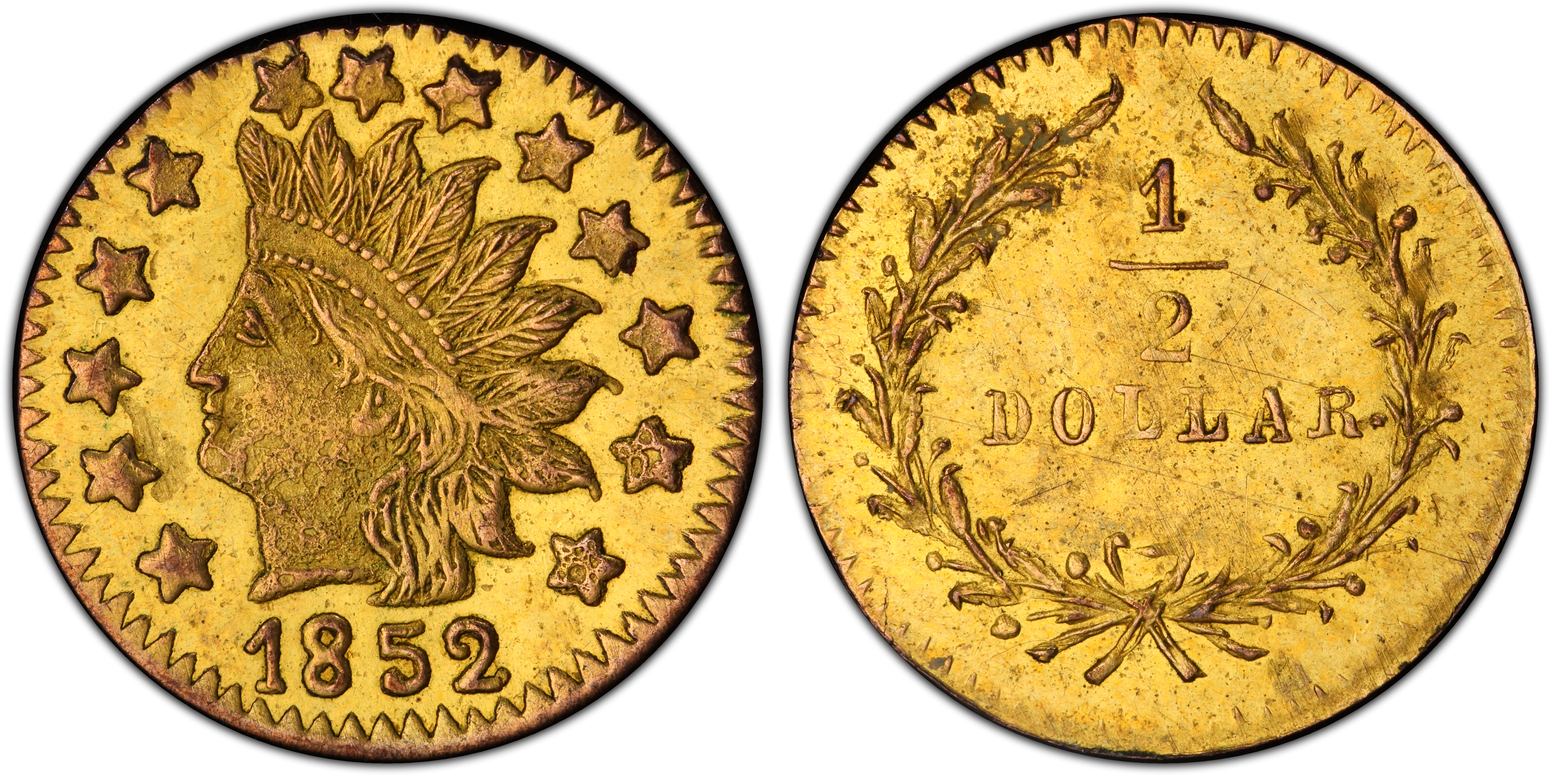
Obverse & Reverse
The 1852 BG-1075 50-cent piece is a quintessential artifact of the California Gold Rush, a tangible solution to one of the era's most pressing economic problems: a severe deficiency of small-denomination coinage. When gold was discovered at Sutter's Mill in 1848, the ensuing flood of prospectors and merchants created a booming economy almost overnight. However, this commerce was severely hampered by the lack of circulating money for everyday transactions. Gold dust, weighed in 'pinches,' was an imprecise and often contentious medium of exchange, while the smallest denomination federal coin readily available was often the silver dollar or gold quarter eagle, far too large for minor purchases. Into this monetary vacuum stepped enterprising jewelers and metalsmiths, many of whom were French immigrants who had brought their craft to the burgeoning metropolis of San Francisco. These artisans began striking their own small-denomination coins from native California gold. The earliest of these, known to numismatists as 'Period One' issues (1852-1857), were created not as souvenirs but as a genuine, albeit extralegal, circulating medium. The BG-1075 is a prime example of these necessary and widely accepted coins. Struck by Antoine Louis Nouizillet, these pieces were hammered out by hand or with rudimentary screw presses, resulting in variable strike quality. Despite often being slightly underweight compared to their stated face value, their utility far outweighed any intrinsic deficiency in the gold-rich, inflation-heavy economy of Gold Rush California. These tiny gold coins facilitated commerce, allowing a miner to buy a drink or a loaf of bread without resorting to the clumsy system of gold dust. Their acceptance is evidenced by the circulation wear seen on many surviving examples. The eventual establishment and full-scale operation of the San Francisco Mint in the mid-1850s gradually introduced a sufficient supply of federal coinage, rendering the private issues obsolete. Most were subsequently melted, lost, or damaged, contributing to their extreme rarity today. The BG-1075 is not merely a coin; it is a direct link to the daily life and struggles of the 'Forty-Niners' and a testament to the private ingenuity that sustained an economy on the nation's frontier.
Associated EventCalifornia Gold Rush
Reason For MintingTo alleviate a severe shortage of small-denomination coinage for daily commercial transactions in Gold Rush-era California.
Minter HistoryAntoine Louis Nouizillet was a French jeweler who operated in San Francisco during the early 1850s. Like several of his fellow French artisans, he recognized the critical need for small change and applied his metallurgical skills to produce fractional gold coins. He was a prolific issuer during the 'Period One' era, creating dies for various quarter dollar, half dollar, and dollar denominations in both round and octagonal shapes. His work is often characterized by a distinct style of Liberty and Indian head portraits. Nouizillet was also known to enter into partnerships, as evidenced by pieces bearing the initials 'D.N.' (Deriberpe and Nouizillet) and 'N.R.' (Nouizillet and Routhier). Around 1859-60, he sold his business, including his existing dies and punches, to another jeweler, Robert B. Gray & Co., which is why some later issues show evidence of Nouizillet's earlier work.
Historical SignificanceAs a 'Period One' issue, the BG-1075 is a historically significant piece that is believed to have genuinely circulated to meet the commercial needs of the Gold Rush. It represents the private enterprise and frontier spirit that addressed a failure in the supply of official government money, making it a key relic of American economic history.
N/A
Denomination50 Cents
Minting Period1852
Assayer/MinterAntoine Louis Nouizillet
Geographic OriginSan Francisco, California
Obverse DescriptionA crudely rendered bust of a Native American (Indian Head) facing left, wearing a feathered headdress. The portrait is surrounded by thirteen five-pointed stars. The date, 1852, appears below the bust truncation.
Obverse Inscription1852
Reverse DescriptionThe central device is a simple wreath composed of two branches tied with a bow at the bottom. The denomination, 50 CENTS, is located within the wreath.
Reverse Inscription50 CENTS
CompositionGold
Stated Fineness Actual FinenessVariable, typically made from native California gold which contained natural silver alloys, resulting in fineness between .800 and .900.
EdgePlain
Unknown
Survival EstimateFewer than 15 known
Rarity ScaleR-7 (4 to 12 known)
The BG-1075 is highly coveted for its extreme rarity (R-7), its status as a genuine 'Period One' circulating issue, and its direct connection to the height of the California Gold Rush. The primitive 'Indian Head' design adds a distinct aesthetic appeal for specialists.
Key VarietiesThe primary variety is the BG-1075 business strike. No proof strikings from the original minting period are known to exist. As these were utilitarian pieces, no special collector issues were produced at the time. Later souvenir pieces and replicas exist in abundance, but none are considered varieties of the original BG-1075.
Authentication TipsAuthentic Period One fractionals like BG-1075 must have a stated denomination (e.g., 'CENTS' or 'DOLLAR'). Replicas often say 'CALIFORNIA GOLD' without a denomination or feature a bear on the reverse, which is not found on genuine circulating issues. Genuine pieces often exhibit a somewhat crude, uneven strike, whereas many modern fakes are too sharp and uniform. The gold color should be consistent with the natural silver alloy of California gold, often a slightly lighter or 'greener' yellow than federal coinage. Third-party certification by a reputable service like PCGS or NGC is highly recommended for any prospective purchase.
Shopping ConsiderationsA premium quality example for its grade will show a bold strike for the issue, with clear details in the headdress and the denomination. Given the manufacturing process, perfectly centered and fully struck examples are virtually nonexistent and command significant premiums. Look for original, uncleaned surfaces with minimal distracting marks. The luster on high-grade examples is often prooflike or semi-prooflike. Avoid examples that are bent, holed, or show signs of being mounted in jewelry, as this was a common fate for these small coins. Planchet quality can be poor, so minor, as-made abrasions or laminations may be present and should be evaluated for their impact on eye appeal.
A coin's grade is its condition, rated on a 1-70 scale. For rare coins, this is the most critical factor in determining value, as a tiny difference in preservation can mean a huge difference in price.
Relevant Grade TypesOriginal period issues were business strikes intended for circulation and are found in Circulated (1-58) and Mint State (MS, 60-70) grades. No Proofs were struck during the original period. While many high-grade survivors exhibit reflective, prooflike (PL) or deep prooflike (DPL) surfaces due to the way they were struck, these are strike characteristics, not a separate issue type. They are highly desirable and command significant premiums.
Mint State CharacteristicsUncirculated examples of BG-1075 are characterized by their strike, which is often uneven. The highest points of the design, such as the center of the obverse and reverse, can show weakness even on a Gem specimen. Luster is typically vibrant and satiny to deeply prooflike. Due to the softness of the gold and the crude production methods, it is common to see small, as-made planchet flaws or minor handling marks, even on coins that never circulated. The quality of the strike and the originality of the surfaces are the paramount determinants of quality.
Circulated Wear PatternsWear first appears on the highest points of the design. On the obverse, this includes the cheek and the tips of the feathers in the headdress. On the reverse, the high points of the wreath's leaves and the numerals of the denomination will show friction first. On coins in lower grades (VF and below), the stars on the obverse will begin to lose their sharpness and the finer details of the wreath will merge.
Key Factors For ValueFor the BG-1075, value is driven primarily by rarity and grade. Surface quality is critical; an example with original, uncleaned 'skin' is vastly superior to a cleaned or polished piece of the same grade. Strike sharpness is a major factor, with well-centered and relatively bold strikes commanding huge premiums. Eye appeal, including attractive original gold toning and the presence of prooflike surfaces, significantly increases value. A CAC sticker on a certified coin provides a strong endorsement of quality for the grade and will result in a substantial price premium.
PCGS Price Guide
| Grade | Price | Population |
|---|---|---|
| 61 | N/A | 1 |
| 62 | $1,250.00 | 1 |
| 62+ | $1,400.00 | N/A |
| 63 | $1,750.00 | 3 |
| 63+ | $2,000.00 | N/A |
| 64 | $2,500.00 | 1 |
| 64+ | $3,000.00 | N/A |
| 65 | $3,750.00 | 3 |
| 65+ | $4,750.00 | N/A |
| 66 | $6,500.00 | N/A |