1870 G$1 BG-1202 (Regular Strike)
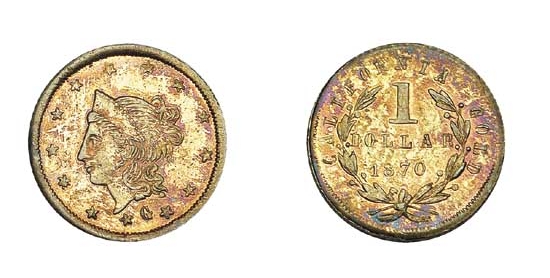
Obverse & Reverse
The 1870 G$1 BG-1202 is a quintessential example of a 'Period Two' California Fractional Gold piece. By 1870, the initial, desperate need for small denomination coinage that characterized the Gold Rush's peak (Period One, 1852-1857) had long subsided. The San Francisco Mint was in full operation, producing ample federal silver and gold coins for commerce. The motivation for private minters shifted from fulfilling a circulating currency void to capitalizing on a burgeoning market for souvenirs and keepsakes. San Francisco had become a major tourist destination, and these miniature gold dollars were popular mementos of the romanticized Gold Rush era. Robert B. Gray & Co., a prominent San Francisco manufacturing jeweler, was a key producer during this period. These 'jeweler's issues' were not intended to circulate as money, which allowed them to circumvent, for a time, the Private Coinage Act of 1864 that outlawed private currency. This law was not rigorously enforced by the Secret Service until 1883, creating a window for jewelers like Gray to continue production. The BG-1202 was likely produced using the 'hammer method,' where a gold blank was struck between two dies with a heavy sledgehammer, a process accounting for the frequent variability in strike quality. Unlike their Period One predecessors which often contained close to their face value in gold, Period Two issues were notoriously underweight and sometimes of debased fineness, as their value was in their novelty, not their metallic content. Today, the BG-1202 is prized not as a coin that fueled the Gold Rush economy, but as a tangible link to the post-Gold Rush period of California's development and the entrepreneurial spirit of its craftsmen.
Associated EventCalifornia Post-Gold Rush Souvenir Market
Reason For MintingTo be sold as a popular souvenir or jewelry item to tourists and locals in post-Gold Rush San Francisco.
Minter HistoryRobert B. Gray & Co. was a significant San Francisco manufacturing jeweler active in the production of California Fractional Gold during 'Period Two' (1859-1882). Around 1859, Gray purchased the business of another established jeweler and fractional gold producer, Antoine Louis Nouzillet. He utilized some of Nouzillet's old dies but also created new ones, characteristically marking his own issues with a 'G' hallmark, as seen on the BG-1202. Gray's operation was known for producing some of the heavier and more intrinsically valuable Period Two pieces, although they were still primarily intended as novelties. The firm continued its operations until 1871, when Gray sold his interests to the California Jewelry Company.
Historical SignificanceThe BG-1202 represents the transition of California fractional gold from a necessary circulating medium to a commercial souvenir. Its existence highlights the lax enforcement of the 1864 private coinage law and the demand for romanticized mementos of the Gold Rush, making it a significant artifact of California's cultural and economic history in the 1870s.
BG-1202
DenominationG$1
Minting Period1870
Assayer/MinterRobert B. Gray & Co.
Geographic OriginSan Francisco, California
Obverse DescriptionA left-facing Liberty Head, reminiscent of the design on contemporary federal gold coinage. She wears a coronet, and her hair is tied in the back. The portrait is encircled by thirteen five-pointed stars. The date '1870' is centered at the bottom, and the minter's hallmark, a small capital 'G', is located between the bust truncation and the date.
Obverse InscriptionG 1870
Reverse DescriptionA wreath composed of two branches tied together by a ribbon at the bottom encircles the central inscriptions. The denomination '1' is prominent in the center, with 'DOLLAR' inscribed directly below it. The legend 'CALIFORNIA GOLD' follows the upper curvature of the wreath.
Reverse InscriptionCALIFORNIA GOLD 1 DOLLAR
CompositionGold
Stated Fineness Actual FinenessFineness varied in Period Two issues, often between 14 and 22 karats.
Weight0.49 grams
Diameter11.50 mm
EdgePlain
Fewer than 500
Survival Estimate13 to 30 known
Rarity ScaleR-6
This is a highly sought-after, very rare die variety of the California Gold Dollar. Its appeal lies in its rarity (R-6), the identifiable maker's mark 'G' for the important jeweler Robert B. Gray & Co., and its status as a classic 'Period Two' souvenir issue.
Key VarietiesThere are no major varieties, patterns, or known restrikes of the BG-1202 die marriage. The coin itself is a specific variety within the larger series of 1870-dated California Gold Dollars.
Authentication TipsA genuine BG-1202 must possess the word 'DOLLAR' on the reverse; many contemporary replicas and modern fakes lack a legal denomination. The key diagnostic is the small 'G' initial for Robert B. Gray located on the obverse between the base of Liberty's bust and the date. The style of the lettering and stars should match known genuine examples; fakes often have a crude or modern look. Weakness in the strike, particularly on the highest points or in the center, can be a characteristic of the original hammer-striking process and is not necessarily a sign of a counterfeit. Look for sharp, well-defined die characteristics, even if the strike is not full.
Shopping ConsiderationsFor a premium quality BG-1202, look for a sharp strike, especially on Liberty's hair details, the stars, and the wreath leaves on the reverse. Given their use in jewelry, examine the rims and fields carefully under magnification for evidence of mounting, removal, or tooling. Original, uncleaned surfaces with some remaining mint luster are exceptionally rare and command significant premiums. Many survivors are found in circulated grades, so an attractive, problem-free AU example is a major prize. Because these pieces are small and were often handled carelessly, even high-grade uncirculated examples can have distracting contact marks. Eye appeal is paramount; seek out coins with a pleasing, original reddish-gold or coppery-gold toning.
A coin's grade is its condition, rated on a 1-70 scale. For rare coins, this is the most critical factor in determining value, as a tiny difference in preservation can mean a huge difference in price.
Relevant Grade TypesOriginal period issues were business strikes, although primarily intended for sale to collectors and tourists rather than for circulation. They are found in Circulated (1-58) and Mint State (MS, 60-70) grades. No original proofs were struck during this period, and there are no known later-date proof restrikes of the BG-1202 variety.
Mint State CharacteristicsUncirculated examples often exhibit a soft, satiny luster. The strike is a key variable; many were struck by hammer and can show central weakness or unevenness across the surface. A well-struck example with full detail on Liberty's coronet and hair strands is highly desirable. Due to the softness of the gold and their novelty nature, even Mint State examples may show minor handling marks or planchet striations original to the manufacturing process. Some specimens are described as 'prooflike,' with reflective fields, which adds to their appeal.
Circulated Wear PatternsWear first appears on the highest points of the design. On the obverse, check the hair above Liberty's eye and ear, her cheek, and the coronet. On the reverse, the high points of the wreath leaves and the bow ribbon will show the first signs of friction. In lower grades (VF and below), the finer details of the hair and wreath will become indistinct, and the legends will start to soften.
Key Factors For ValueRarity is the primary driver of value for this R-6 variety. Beyond that, the quality of the strike is crucial; a sharply struck coin will always be worth more than a weakly struck one of the same grade. Surface preservation is paramount: coins with original, lustrous, and uncleaned 'skin' are prized. Any damage, such as rim bumps, harsh cleaning, scratches, or evidence of having been mounted in jewelry, will drastically reduce the value. The presence of a CAC sticker for this issue indicates premium quality for the grade and typically results in a significant price premium.
PCGS Price Guide
| Grade | Price | Population |
|---|---|---|
| 35 | $1,800.00 | 1 |
| 40 | $1,900.00 | 1 |
| 45 | $2,000.00 | 5 |
| 45+ | $2,050.00 | N/A |
| 50 | $2,100.00 | 3 |
| 50+ | $2,150.00 | N/A |
| 53 | $2,200.00 | 2 |
| 53+ | $2,250.00 | N/A |
| 55 | $2,275.00 | N/A |
| 55+ | $2,300.00 | N/A |
| 58 | $2,500.00 | 1 |
| 58+ | $2,650.00 | N/A |
| 60 | $3,000.00 | 1 |
| 61 | $3,250.00 | 5 |
| 62 | $3,500.00 | 4 |
| 62+ | $3,750.00 | N/A |
| 63 | $5,000.00 | 1 |
| 64 | N/A | N/A |