1868 G50C BG-1303 (Regular Strike)
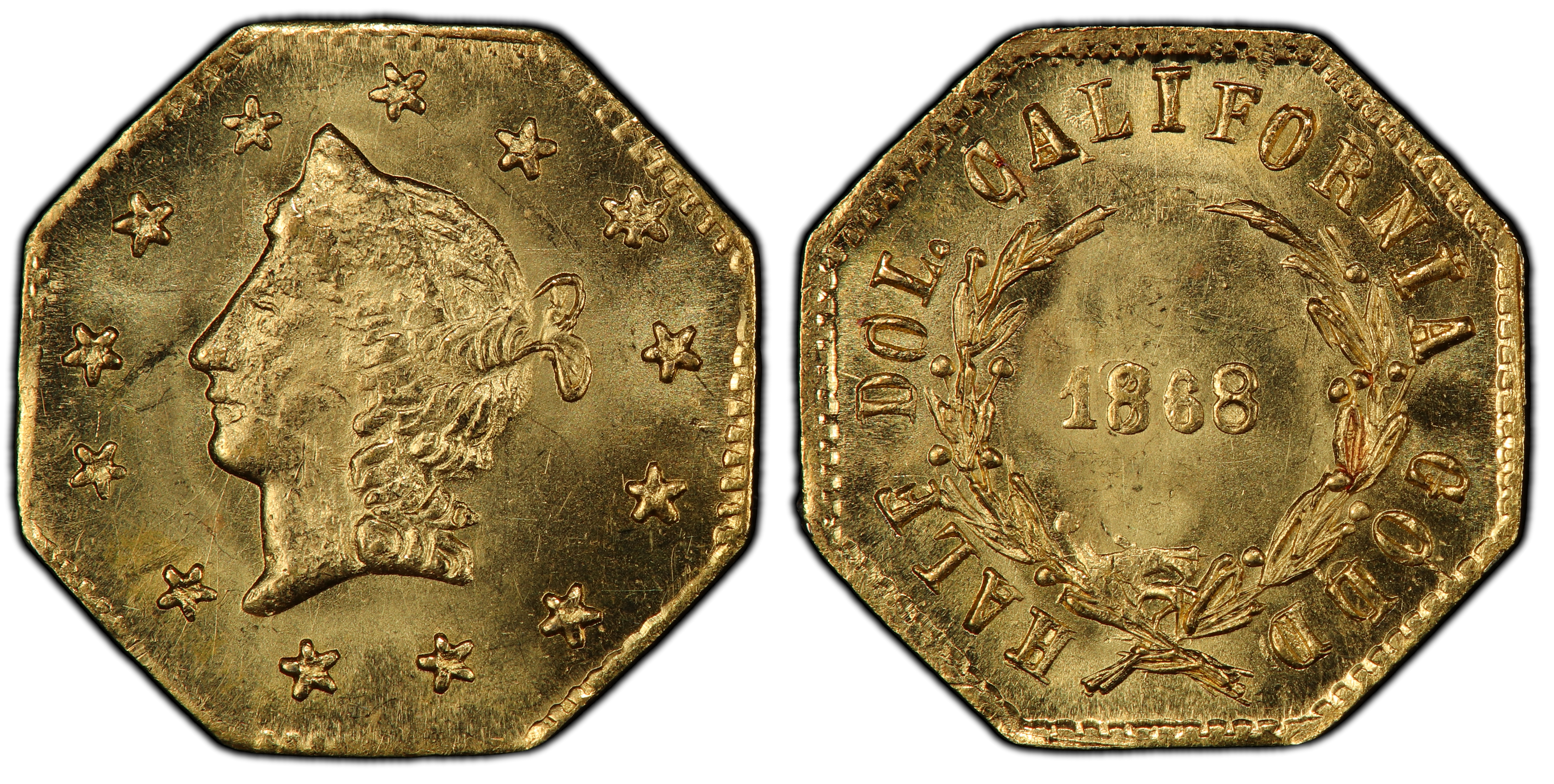
Obverse & Reverse
The 1868 G50C BG-1303 is a fascinating and numismatically significant piece whose story is one of intentional deception, a testament to the enduring collector appeal of California's Gold Rush romance. Unlike the earlier 'Period One' (1852-1857) issues struck out of commercial necessity in San Francisco to alleviate a shortage of small change, or the 'Period Two' (1858-1882) jeweler's issues made as souvenirs, the BG-1303 belongs to the enigmatic 'Period Three.' These pieces were manufactured clandestinely long after the era they purport to represent. The Coinage Act of April 22, 1864, strictly prohibited private coinage, a law the U.S. Secret Service began enforcing with vigor in the 1880s. This crackdown effectively ended the legitimate production of denominated fractional gold. However, demand from collectors and jewelers for these charming mementos of the Old West never fully waned. To satisfy this market while circumventing federal law, a New York City jeweler named Herman Kroll began producing a series of fractional gold pieces in the early 20th century, likely between 1906 and 1908. To avoid prosecution, Kroll cleverly backdated his creations to the years of legitimate production. The BG-1303, dated 1868, is a prime example of his work. Struck in New York, not California, it was never intended for circulation and was sold directly into the nascent numismatic and jewelry markets. These 'Kroll' issues, including the BG-1303 variety often called the 'Kroll Head,' are cruder in execution than their Period One and Two predecessors, often exhibiting a distinct style and fabric that allows specialists to identify them. They were typically struck in a debased gold alloy, further distinguishing them from the higher-purity gold used in the original California issues. The survival of Kroll's dies and his stock, which was later sold to collector A.C. Nygren and subsequently auctioned by Henry Chapman in 1924, provided a clear provenance and allowed numismatists like Walter Breen and Ronald Gillio to definitively attribute this group, cementing their unique place in the broader story of U.S. private coinage.
Associated EventPost-Gold Rush Numismatic & Collectible Market
Reason For MintingTo satisfy collector and jeweler demand for California Gold Rush mementos by clandestinely producing backdated issues to circumvent U.S. coinage laws.
Minter HistoryHerman Kroll was a New York City jeweler active in the late 19th and early 20th centuries. He is the only positively identified manufacturer of the 'Period Three' California Fractional Gold pieces. Recognizing a continued market for these historic items after federal laws prohibited their contemporary manufacture, Kroll produced a variety of backdated quarter, half, and one-dollar gold pieces. His operation was entirely commercial, aimed at the collector and jewelry trade. His distinctive die work and the subsequent provenance of his dies and remaining inventory have allowed numismatists to attribute a significant portion of the Period Three issues to him, making his work a distinct and important subset of the series.
Historical SignificanceThe BG-1303 is significant not as a product of the California Gold Rush, but as an artifact of its legacy. It represents a fascinating period of numismatic cat-and-mouse, where a private minter cleverly used backdating to resurrect a popular but outlawed coinage type for a new generation of collectors. It stands as a key, identifiable example of a 'Period Three' issue and is crucial to understanding the full, multi-generational story of California fractional gold.
BG-1303
Denomination50 Cents
Minting PeriodStruck circa 1906-1908 (backdated to 1868)
Assayer/MinterHerman Kroll
Geographic OriginNew York, New York
Obverse DescriptionOctagonal planchet. Features a crudely rendered Liberty Head facing left, wearing a coronet. The portrait is surrounded by thirteen unevenly spaced, misshapen stars. The date '1868' is below the bust.
Obverse Inscription1868
Reverse DescriptionOctagonal planchet. The denomination '1/2' appears within a wreath of two branches tied with a bow at the bottom. The legend 'CALIFORNIA GOLD' surrounds the wreath along the periphery.
Reverse InscriptionCALIFORNIA GOLD 1/2
CompositionGold
Stated Fineness Actual FinenessVariable, typically a lower-karat gold alloy compared to Period One issues.
EdgePlain
Unknown
Survival Estimate100-150 (per R-4 rating)
Rarity ScaleR-4
The BG-1303 appeals to specialists for its intriguing backstory as a clandestine, backdated 'Period Three' issue. Its direct attribution to the known minter Herman Kroll and its distinct 'Kroll Head' moniker add to its collectability. It is an essential piece for those assembling a complete set of Breen-Gillio varieties and for historians of the broader private coinage series.
Key VarietiesThe regular strike BG-1303 is the primary variety. As a Period Three issue, it is itself a special collector striking and distinct from all Period One and Two pieces. There are no known major variations, patterns, or official restrikes from the original Kroll minting period. However, some of Kroll's dies are known to have survived and were used to produce new restrikes in the mid-20th century; collectors must distinguish original Kroll strikings from these much later issues.
Authentication TipsAuthentic BG-1303 examples exhibit a characteristic crude style associated with Herman Kroll's work. The strike is often somewhat soft, and the stars on the obverse can be poorly formed and unevenly arranged. The surfaces may have a slightly different luster and color compared to the rich, often silver-rich alloy of genuine Gold Rush era pieces. The lettering and numerals have a distinct, slightly irregular punch style. Any piece appearing too well-made or matching the fabric of modern replicas should be viewed with suspicion. Authentication by a top-tier grading service (PCGS or NGC) that specializes in attributing Breen-Gillio varieties is highly recommended.
Shopping ConsiderationsA premium quality example of BG-1303 will be well-struck for the issue, with clear details on Liberty's hair and the wreath on the reverse. Given that these were made for collectors, most survivors are in high grades (AU or Mint State), and circulated examples are scarce. Look for pleasing original surfaces with minimal distracting marks. The strike is often uneven, so a piece with a centered and relatively bold impression commands a premium. Avoid examples that have been cleaned, polished, or used in jewelry, as this severely impacts their value. Eye appeal is paramount; a choice specimen will have a nice gold color and a sharp, visually pleasing appearance despite the inherent crudeness of its manufacture.
A coin's grade is its condition, rated on a 1-70 scale. For rare coins, this is the most critical factor in determining value, as a tiny difference in preservation can mean a huge difference in price.
Relevant Grade TypesAs the BG-1303 was a collector's issue made circa 1906-1908, virtually all original examples were sold as uncirculated pieces. Therefore, they are primarily found and graded as Mint State (MS, 60-70). While some may have entered circulation or been mishandled over the years, resulting in Circulated grades (1-58), this is atypical. There were no Proof (PR/PF) examples struck by Herman Kroll during the original minting period, and there are no known official, later-date Proof restrikes.
Mint State CharacteristicsUncirculated examples of the BG-1303 are defined by their luster and lack of wear. The quality of luster is often satiny rather than deeply prooflike. The strike is a key differentiator; many are softly struck in the centers, particularly on the highest points of Liberty's hair and the wreath leaves. A well-struck MS example with sharp details is highly desirable. Small, inherent planchet flaws or die polishing marks are common and should be distinguished from post-strike damage. Contact marks, even on high-grade pieces, are not unusual given their small size and handling over a century.
Circulated Wear PatternsOn circulated examples, wear will first appear on the highest points of the design. For the obverse, this includes Liberty's cheek, the hair above the ear, and the coronet. On the reverse, the high points of the wreath's leaves and the bow will show the first signs of friction, appearing smoothed and losing their fine detail. In lower grades, the stars and legends will begin to weaken and merge with the fields.
Key Factors For ValueFor the BG-1303, the primary value drivers are grade and surface quality. An uncirculated piece with minimal contact marks and original, unimpaired luster will command a significant premium. The sharpness of the strike is a major factor; a weakly struck MS-64 may be less valuable than a sharply struck MS-63. Eye appeal, encompassing attractive original toning and a clean appearance, is critical. Given the coin's esoteric nature, certification by PCGS or NGC, which confirms both authenticity and the BG-1303 attribution, is essential for marketability. A CAC sticker for this issue would denote premium quality for the grade and add a further price premium.
PCGS Price Guide
| Grade | Price | Population |
|---|---|---|
| 58 | $240.00 | 1 |
| 58+ | $250.00 | N/A |
| 60 | $265.00 | N/A |
| 61 | $285.00 | 1 |
| 62 | $315.00 | 4 |
| 62+ | $350.00 | N/A |
| 63 | $400.00 | 4 |
| 63+ | $425.00 | N/A |
| 64 | $500.00 | 1 |
| 64+ | $525.00 | N/A |
| 65 | $550.00 | 1 |
| 65+ | $575.00 | N/A |
| 66 | $625.00 | 1 |