1876 G50C BG-1061 (Regular Strike)
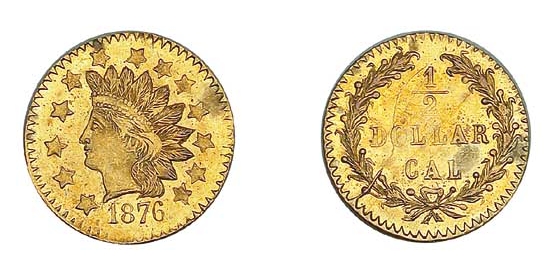
Obverse & Reverse
The 1876 G50C BG-1061 is a fascinating and extremely rare artifact from the twilight of America's private coinage era. It belongs to what numismatists classify as 'Period Three' (circa 1883-1903) of California Fractional Gold production. This period is defined by clandestine operations undertaken after the U.S. Secret Service began aggressively enforcing the Private Coinage Act of 1864. To circumvent prosecution, the unknown minters of these pieces deliberately backdated their creations to years within the legal 'Period Two' (1859-1882), with 1876 being a plausible date that would not arouse immediate suspicion. These pieces were not intended to alleviate a shortage of small change, as the Period One issues had been. By the 1880s, the San Francisco Mint produced ample coinage for commerce. Instead, Period Three fractionals were created purely as numismatic curiosities, souvenirs, and collectibles for a public still fascinated by the allure of the Gold Rush. The makers were typically jewelers who possessed the requisite skills for die cutting and striking. Their operations were small, and their identities were jealously guarded secrets. The only Period Three maker who has been positively identified is Herman Kroll of New York City, though most issues from this era, including BG-1061, are attributed to anonymous California-based craftsmen. The extreme rarity of BG-1061 suggests a minuscule original mintage, perhaps only a handful of specimens struck to test the dies or to satisfy a very small circle of collectors. The 'discovery specimen' for this variety, ex-Kenneth W. Lee, has a well-documented provenance, tracing back through major auctions and underscoring its numismatic importance. Today, it is regarded as one of the great rarities in the entire California Fractional Gold series.
Associated EventPost-Gold Rush Era Souvenir Production
Reason For MintingTo create a numismatic souvenir or collectible, backdated to avoid federal anti-private-coinage laws.
Minter HistoryThe assayer or minter for BG-1061 is unknown. Production of 'Period Three' fractionals was a clandestine affair carried out by jewelers to avoid prosecution by the U.S. Secret Service. These artisans operated anonymously, leaving behind no mintmarks or identifying records. While Herman Kroll of New York is one known maker from this period, most are believed to have been located in San Francisco, continuing the tradition of creating these popular gold novelties.
Historical SignificanceBG-1061 is significant as a representative of the final, defiant phase of private gold minting in the United States. It showcases the transition of fractional gold from a circulating medium of necessity (Period One) to a purely collectible souvenir (Period Two and Three), and highlights the legal pressures that drove its production underground, forcing makers to employ deceptive dating.
BG-1061
DenominationG50C
Minting Period1876 (Dated)
Assayer/MinterUnknown
Geographic OriginSan Francisco, California
Obverse DescriptionAn Indian Head portrait facing left, reminiscent of the design used on contemporary U.S. coinage. The portrait is surrounded by 13 stars, representing the original colonies. The date '1876' is positioned below the bust truncation.
Obverse Inscription1876
Reverse DescriptionA simple wreath composed of two branches tied together with a bow at the bottom. The wreath encircles the denomination '50 CENTS'. The legend 'CALIFORNIA GOLD' is inscribed around the wreath at the upper periphery.
Reverse InscriptionCALIFORNIA GOLD 50 CENTS
CompositionGold
Stated Fineness Actual Fineness EdgePlain
Extremely low; likely fewer than 10.
Survival Estimate4 or fewer known. The second edition of 'California Pioneer Fractional Gold' by Breen-Gillio enumerated exactly four examples.
Rarity ScaleR-7 (High)
This is a landmark rarity for the advanced specialist. Its appeal lies in its extreme scarcity, its status as a clandestine 'Period Three' issue, and its well-documented provenance, including the famous Kenneth W. Lee collection. Acquiring a BG-1061 is a major event for any serious collector of California small denomination gold.
Key VarietiesNo major varieties of BG-1061 are known from the original striking period, which is unsurprising given its minuscule production. There are no known special collector issues, patterns, or restrikes associated with this specific Breen-Gillio number.
Authentication TipsAuthentication requires comparison to known genuine examples, as illustrated in the Breen-Gillio/Leonard reference book and major auction catalogs. Key diagnostics include the precise shape and positioning of the date numerals, the style of the Indian portrait, and the specific details of the wreath's leaves and bow. The fabric of the planchet is also critical; genuine pieces often show a slightly irregular strike and a unique luster. Counterfeits are numerous in the fractional gold series, but rarely target ultra-rarities like BG-1061; more common are generic fakes that do not match any known BG number.
Shopping ConsiderationsFor a coin of this rarity, any opportunity to acquire one is significant, and condition is secondary to availability. However, a premium quality example would be defined by a sharp, well-centered strike, particularly on the high points of the Indian's hair and the leaves in the wreath. Original, lustrous surfaces are highly desirable; the discovery coin was noted for its prooflike fields and frosty devices. Look for deep green-gold or reddish-gold toning, which is considered attractive. Avoid examples with evidence of jewelry mounting, harsh cleaning, or tooling. Given the rarity, even a repaired or details-graded specimen would be highly sought after.
A coin's grade is its condition, rated on a 1-70 scale. For rare coins, this is the most critical factor in determining value, as a tiny difference in preservation can mean a huge difference in price.
Relevant Grade TypesOriginal period issues of BG-1061 were business strikes, although they were made for collectors and not circulation. They are found in both Circulated (1-58) and, more commonly for this variety, Mint State (MS, 60-70) grades. No Proof (PR/PF) examples were struck during the original period of manufacture, and there are no known later-date Proof restrikes.
Mint State CharacteristicsUncirculated examples of BG-1061 are characterized by a unique, often slightly irregular strike on what can be a minutely warped planchet, a byproduct of clandestine production. The luster can be exceptional, with some pieces exhibiting deep prooflike or semi-prooflike fields contrasted with frosty design elements. As with most fractional gold, strikes can be inconsistent, with softness possible on the highest points. The presence of original, undisturbed skin and minimal contact marks defines the grade and eye appeal.
Circulated Wear PatternsAs virtually all known examples are in Mint State, descriptions of wear are theoretical. Wear would first appear on the highest points of the design: the cheek and the details of the feathered headdress on the obverse. On the reverse, the highest points of the wreath's leaves and the bow would show the first signs of friction. In lower grades, the finer details of the hair and feathers would merge, and the legends would soften.
Key Factors For ValueFor BG-1061, rarity is the paramount factor. Given the minuscule population, any example is a treasure. Beyond its mere existence, value is determined by surface preservation and eye appeal. An example with original, lustrous surfaces free of impairments (cleaning, scratches, rim bumps) will command a significant premium. A sharp strike that brings up the full detail of the portrait and wreath is highly desirable. Coins with attractive natural toning and a prestigious provenance (like the Lee specimen) will always be valued highest. A CAC sticker would provide further confirmation of quality for the assigned grade and would be a major value driver.
PCGS Price Guide
| Grade | Price | Population |
|---|---|---|
| 50 | $1,500.00 | 2 |
| 50+ | $1,600.00 | N/A |
| 53 | $1,750.00 | N/A |
| 53+ | $1,850.00 | N/A |
| 55 | $2,200.00 | N/A |
| 55+ | $2,300.00 | N/A |
| 58 | $2,500.00 | N/A |
| 58+ | $2,750.00 | N/A |
| 60 | $3,500.00 | N/A |
| 61 | $4,000.00 | N/A |
| 62 | $4,500.00 | N/A |
| 62+ | $5,000.00 | N/A |
| 63 | $5,500.00 | 2 |
| 63+ | $6,250.00 | N/A |
| 64 | $7,500.00 | 1 |