1876 G$1 BG-1117 (Regular Strike)
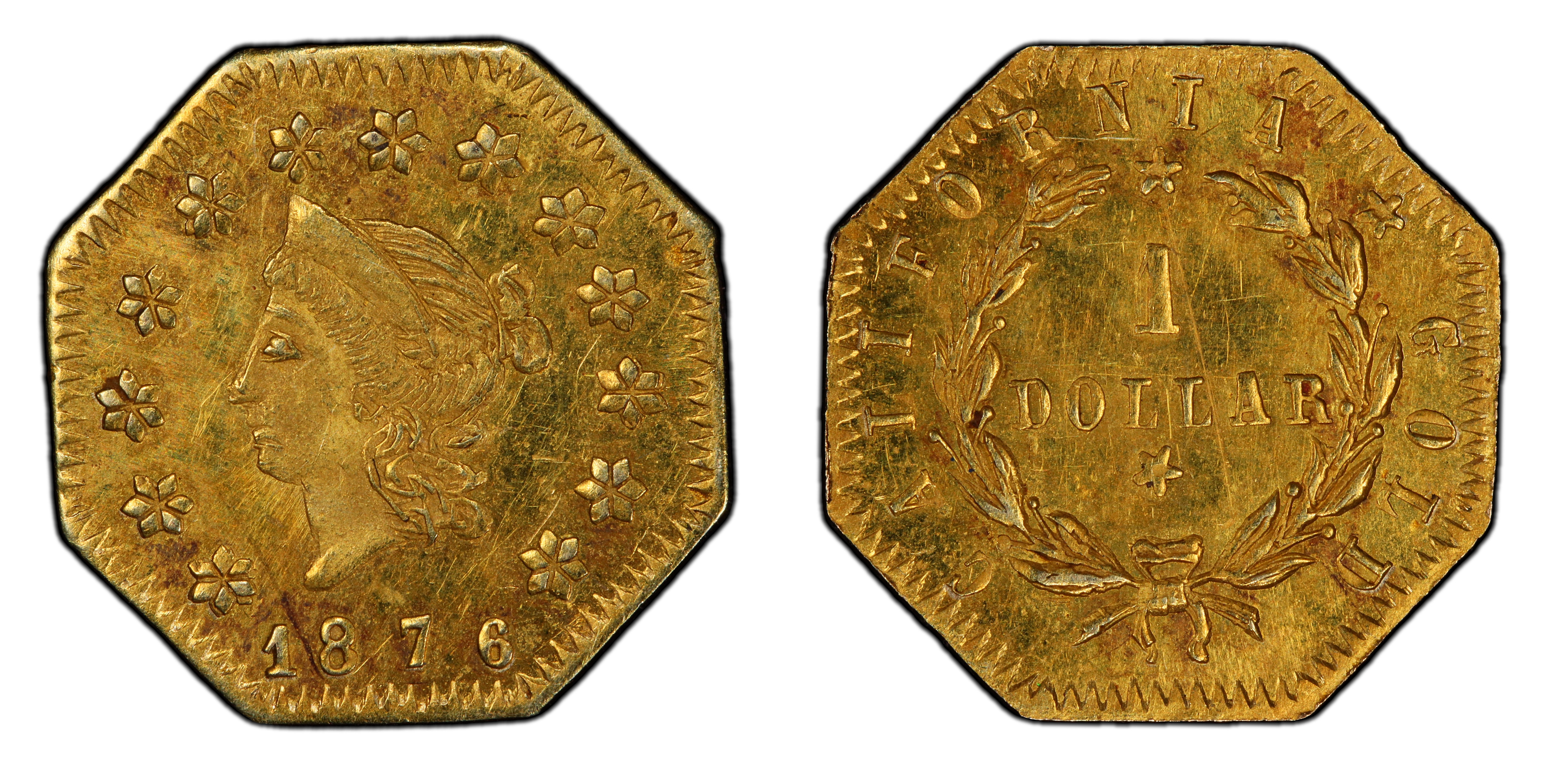
Obverse & Reverse
The 1876 G$1 BG-1117 is a product of the second period of California Fractional Gold production (1859-1882), often termed the 'Jeweler's Period.' Unlike the earlier 'Period One' issues struck out of commercial necessity to alleviate a chronic shortage of small change during the Gold Rush, these later pieces were created under different circumstances. By the mid-1870s, the United States Mint in San Francisco was in full operation, and the acute need for private coinage had subsided. The Coinage Act of 1864 had officially made private minting illegal, but it was not strictly enforced by the Secret Service in California until 1883. This legal gray area allowed numerous jewelers and assayers, primarily in San Francisco, to continue producing these small-denomination gold pieces. However, their purpose had shifted. They were no longer primarily instruments of commerce but were instead manufactured as souvenirs, keepsakes for tourists, and novelty items. The 1876 date coincides with the Centennial Exposition in Philadelphia, a nationwide celebration that spurred the creation of memorabilia of all kinds, and it's plausible this piece was part of that trend. These 'jeweler's issues' were typically underweight for their face value and often of a lower fineness than official U.S. coinage, facts well-understood by the contemporary public who accepted them as tokens rather than true money. Their production was crude, often using a hammer-striking method, resulting in inconsistent strike quality. The anonymity of the minter is characteristic of the period, as many jewelers produced them without specific identifying marks. Today, the BG-1117 is a numismatic artifact not of the Gold Rush's frantic necessity, but of its long and romanticized legacy in American culture.
Associated EventPost-Gold Rush 'Jeweler's Period'
Reason For MintingPrimarily created as a souvenir or novelty item for the tourist trade, not for general circulation, during a period of lax enforcement of private coinage laws.
Minter HistoryThe identity of the specific private minter or jeweler who produced the dies for BG-1117 is unknown. During this era, many San Francisco jewelers, such as Robert B. Gray & Co. and the California Jewelry Co. (Levison Brothers), were known to produce fractional gold. However, a great number of varieties from this period remain unattributed to a specific maker, a testament to the decentralized and often clandestine nature of their manufacture.
Historical SignificanceThis coin is significant as an example of the evolution of California Fractional Gold from essential circulating currency to a commercial souvenir. It represents the final phase of private minting in California, a lingering echo of the Gold Rush that persisted until federal laws were finally enforced. Its extreme rarity today underscores the very limited production numbers of these late-date tokens.
BG-1117
DenominationG$1
Minting Period1876
Assayer/MinterUnknown Private Minter
Geographic OriginSan Francisco, California
Obverse DescriptionA stylized Liberty Head, facing left, with hair tied in a bun. She is surrounded by thirteen stars, typically weakly defined, arranged around the octagonal border. The date '1876' is below the bust.
Obverse Inscription1876
Reverse DescriptionThe denomination '1' and the word 'DOLLAR' are enclosed within a wreath of two olive branches tied with a ribbon at the bottom. The legend 'CALIFORNIA GOLD' is sometimes found on similar issues, but the primary reverse inscription is the denomination within the wreath.
Reverse Inscription1 DOLLAR
CompositionGold
Stated Fineness Actual FinenessVariable, generally lower than the .900 standard of federal gold.
Weight0.50 grams
Diameter11.50 mm
EdgePlain
Extremely low; likely fewer than 100.
Survival Estimate2-3 known specimens.
Rarity ScaleR-8
The 1876 G$1 BG-1117 is a trophy coin for advanced specialists in California Fractional Gold. Its appeal lies in its absolute rarity as a major Breen-Gillio variety, its attractive octagonal shape, and its status as a late-date issue from the fascinating 'Jeweler's Period.'
Key VarietiesThe primary variety is BG-1117. A closely related and also extremely rare variety is BG-1117A, struck from a different die pair. The key diagnostic for BG-1117A is that the large obverse stars are positioned distant from the border, and on the reverse, the 'D' in DOLLAR is noticeably high. No proof or special collector strikes are known to exist from the period of issue.
Authentication TipsGenuine pieces from this period are denominated 'DOLLAR' or an abbreviation; fakes and later tokens often lack a denomination or say 'CAL GOLD CHARM.' The strike is often somewhat crude but the details, though soft, should have a certain sharpness unlike the mushy appearance of modern cast copies. The planchets can be thin and slightly irregular. Weight and size should be reasonably close to the norms for the series. Any piece with a bear on the reverse is a 20th-century fantasy piece. Authentication by a major third-party grading service is highly recommended due to the prevalence of counterfeits.
Shopping ConsiderationsFor a coin of this rarity, any example that is certifiably genuine is a major acquisition. A 'premium quality' example would be one that avoids the significant problems often plaguing this series, such as evidence of having been mounted in jewelry, harsh cleaning, or significant planchet flaws. Look for a relatively well-centered strike, as many are off-center. Any remaining original luster, often with a slightly reddish or orange-peel texture, is highly desirable. Sharpness on the highest points of Liberty's hair and the wreath on the reverse would be characteristic of a top-tier specimen. Given the rarity, even a problem-free circulated example in a grade like AU-50 would be considered a prize.
A coin's grade is its condition, rated on a 1-70 scale. For rare coins, this is the most critical factor in determining value, as a tiny difference in preservation can mean a huge difference in price.
Relevant Grade TypesAll original issues of BG-1117 were business strikes intended for sale as souvenirs, not general circulation. They are found in Circulated grades (1-58) and, very rarely, in Mint State (MS, 60-70). No proofs were struck during the original period of issue, and no known later-date restrikes exist.
Mint State CharacteristicsAn uncirculated BG-1117 is defined by the presence of original mint luster. The quality of this luster can vary from satiny to semi-prooflike. The strike is almost never full; weakness is expected in the center of the design, particularly on the strands of Liberty's hair and the leaves of the wreath. Due to the rudimentary manufacturing process, it is common to see minor planchet flaws or adjustment marks, which should not be confused with post-strike damage. Bag marks are less of a concern than with federal issues, as these were not typically stored in bulk.
Circulated Wear PatternsWear first appears on the highest points of the design: the hair above Liberty's eye and ear, her cheek, and the high points of the wreath leaves on the reverse. On moderately worn examples, the individual hair strands will merge, and the smaller details of the wreath will become flat. In lower grades (Fine and below), the stars on the obverse and the letters in 'DOLLAR' will begin to lose their definition and merge with the fields.
Key Factors For ValueFor the BG-1117, rarity is paramount, but among the few known examples, value is driven by surface preservation and eye appeal. An example with clean, original surfaces that have not been cleaned or polished will command a significant premium. The sharpness of the strike is a major factor; a coin with a clearer-than-average strike on the central devices is highly desirable. Finally, attractive, original reddish-gold or deep yellow-gold toning adds to its eye appeal. A CAC sticker on an already graded coin would provide a further boost in value, confirming its quality for the assigned grade.
PCGS Price Guide
| Grade | Price | Population |
|---|---|---|
| 53 | $2,650.00 | 1 |
| 53+ | $3,000.00 | N/A |
| 55 | $3,250.00 | N/A |
| 55+ | $3,500.00 | N/A |
| 58 | $3,750.00 | N/A |
| 58+ | $4,000.00 | N/A |
| 60 | $4,250.00 | N/A |
| 61 | $5,000.00 | N/A |
| 62 | $6,000.00 | 1 |
| 62+ | $7,500.00 | N/A |
| 63 | $11,500.00 | 2 |