1876 G50C BG-1062 (Regular Strike)
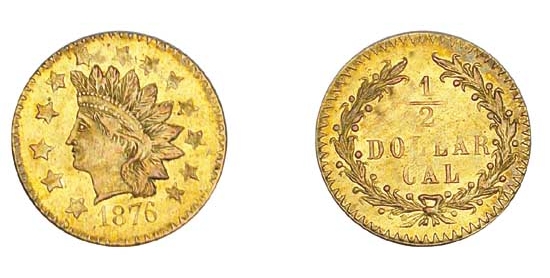
Obverse & Reverse
The 1876 BG-1062 50-cent piece emerges from the second major phase of California Fractional Gold production, known as Period Two (1859-1882). Unlike their Period One predecessors which were struck to alleviate a critical shortage of small change during the initial Gold Rush, these later issues served a different purpose. By the mid-1870s, the San Francisco Mint was in full operation, supplying the region with ample federal coinage. The raison d'être for fractional gold had shifted from commerce to curiosity. These small gold pieces were now primarily manufactured by jewelers and private minters as souvenirs and keepsakes, catering to a burgeoning tourist trade and a national fascination with the 'Wild West.' The year 1876 was particularly significant as the nation celebrated its Centennial, an event that spurred the production of all manner of tokens and memorabilia. Although the Private Coinage Act of 1864 had made such private issues illegal, enforcement by the Secret Service was inconsistent and largely ignored in California until the early 1880s. This legal gray area allowed dozens of anonymous craftsmen, likely concentrated in San Francisco, to continue producing a wide variety of designs. These 'jeweler's issues' were intentionally underweight and often of a lower fineness than their face value suggested, a clear indicator of their non-monetary function. They were sold as novelties, often incorporated into jewelry. The BG-1062 is a product of this era, a tiny, tangible memento of the Gold Rush legacy, created not for the saloon counter but for the tourist's pocket or the collector's cabinet. Its extreme rarity today, with perhaps only a couple of examples known, suggests a very limited, ephemeral production, possibly from a single jeweler's workshop that produced only a handful before the dies failed or were discarded.
Associated EventPost-Gold Rush Souvenir Trade
Reason For MintingPrimarily produced as souvenirs and for the jewelry trade rather than for monetary circulation.
Minter HistoryThe specific minter for BG-1062 is unknown, as is typical for most Period Two California Fractional Gold. These pieces were generally produced anonymously by various San Francisco jewelers to avoid potential legal repercussions and scrutiny from federal authorities. Their work is characterized by artistic license, varied quality, and a focus on novelty appeal over monetary precision.
Historical SignificanceThis coin is significant as a representative of the later, commercialized phase of private gold minting in California. It illustrates the transition of fractional gold from a necessary form of currency to a collectible souvenir, reflecting a mature California economy and a romanticized view of the Gold Rush era. Its rarity makes it an important artifact for specialists studying the die varieties and private minters of the period.
BG-1062
DenominationG50C
Minting Period1876
Assayer/MinterUnknown Private Minter
Geographic OriginSan Francisco, California
Obverse DescriptionFeatures a crudely rendered Indian Head facing left, a common motif for Period Two issues. The portrait is typically surrounded by 13 stars of varying quality, often appearing weak or malformed. The date '1876' is below the bust.
Obverse Inscription1876
Reverse DescriptionA simple wreath, open at the top, encircles the denomination. The design is often unevenly struck.
Reverse Inscription1/2 DOLLAR CAL.
CompositionGold
Stated Fineness Actual FinenessVariable, but typically less than .900 fine, often in the 14-22 karat range for Period Two issues.
Weight0.25 grams
Diameter10.00 mm
EdgePlain
Unknown, but exceedingly small.
Survival Estimate2-3 known examples.
Rarity ScaleR-8 (Very Rare)
The BG-1062 is a classic condition rarity, sought by advanced specialists in the California Fractional Gold series. Its appeal lies in its extreme rarity as a specific die marriage and its status as a representative of the popular Indian Head type from the Centennial year. Any opportunity to acquire an example is a significant event in the numismatic market.
Key VarietiesThe BG-1062 is itself a specific and rare die variety. No major sub-varieties or special collector issues like Proofs or restrikes are known to exist from the period of issue. All known examples are considered business strikes, though they were not intended for circulation.
Authentication TipsAuthenticity is paramount. Genuine Period Two pieces often exhibit a characteristic crude or soft strike. Lettering may be uneven, and stars can be misshapen or 'blob-like.' Look for known die markers if published in Breen-Gillio. Be wary of modern replicas which are extremely common; these often have a soapy, cast-like appearance, incorrect weight, or design details that do not match known genuine examples. Authentication by a major third-party grading service is essential.
Shopping ConsiderationsFor a coin of this rarity, any example that appears on the market is noteworthy. A 'premium quality' example would be one that is well-centered and shows as much of the design detail as possible for the variety, as strikes are characteristically weak. Look for pleasing, original surfaces without evidence of having been mounted in jewelry, which is a common problem for these souvenir pieces. Avoid examples with harsh cleaning, significant scratches, or edge damage. Luster, if present, is a significant bonus, and coins with a prooflike or semi-prooflike appearance command a substantial premium.
A coin's grade is its condition, rated on a 1-70 scale. For rare coins, this is the most critical factor in determining value, as a tiny difference in preservation can mean a huge difference in price.
Relevant Grade TypesOriginal period issues were business strikes, although not intended for circulation, and are found in both Circulated (1-58) and Mint State (MS, 60-70) grades. Given their purpose as souvenirs, high-grade examples are more common than for Period One issues. No true Proofs were struck during the original period of issue, and no later-date restrikes are known for this specific variety.
Mint State CharacteristicsAn uncirculated BG-1062 will be defined by its technical features. The strike is paramount; these are often weakly struck, particularly on the stars, the date, and the details of the wreath. A superior example would show unusual sharpness in these areas. Luster is typically flashy and reflective, sometimes earning a 'Prooflike' (PL) designation from grading services. Due to the small size and minting process, even Mint State examples may show minor planchet flaws or handling marks, but these should be minimal.
Circulated Wear PatternsWhile most known examples are uncirculated, any wear would first appear on the high points of the design. On the obverse, this includes the Indian's cheek, eyebrow, and the feathers in the headdress. On the reverse, the highest points of the leaves and bow of the wreath would show initial friction and smoothing.
Key Factors For ValueFor the BG-1062, rarity is the dominant value factor. Beyond that, the quality of the strike is the most important differentiator; a sharply struck coin is a major exception. Surface preservation is next; an example with bright, prooflike fields and minimal distracting marks will be prized. Original, uncleaned surfaces are critical. Eye appeal, encompassing toning and overall visual harmony, also plays a role. A CAC sticker would provide a significant premium, confirming the quality for the assigned grade.
PCGS Price Guide
| Grade | Price | Population |
|---|---|---|
| 61 | $1,250.00 | N/A |
| 62 | $1,600.00 | 2 |
| 62+ | $1,850.00 | N/A |
| 63 | $2,150.00 | 4 |