1874 G$1 BG-1110 (Regular Strike)
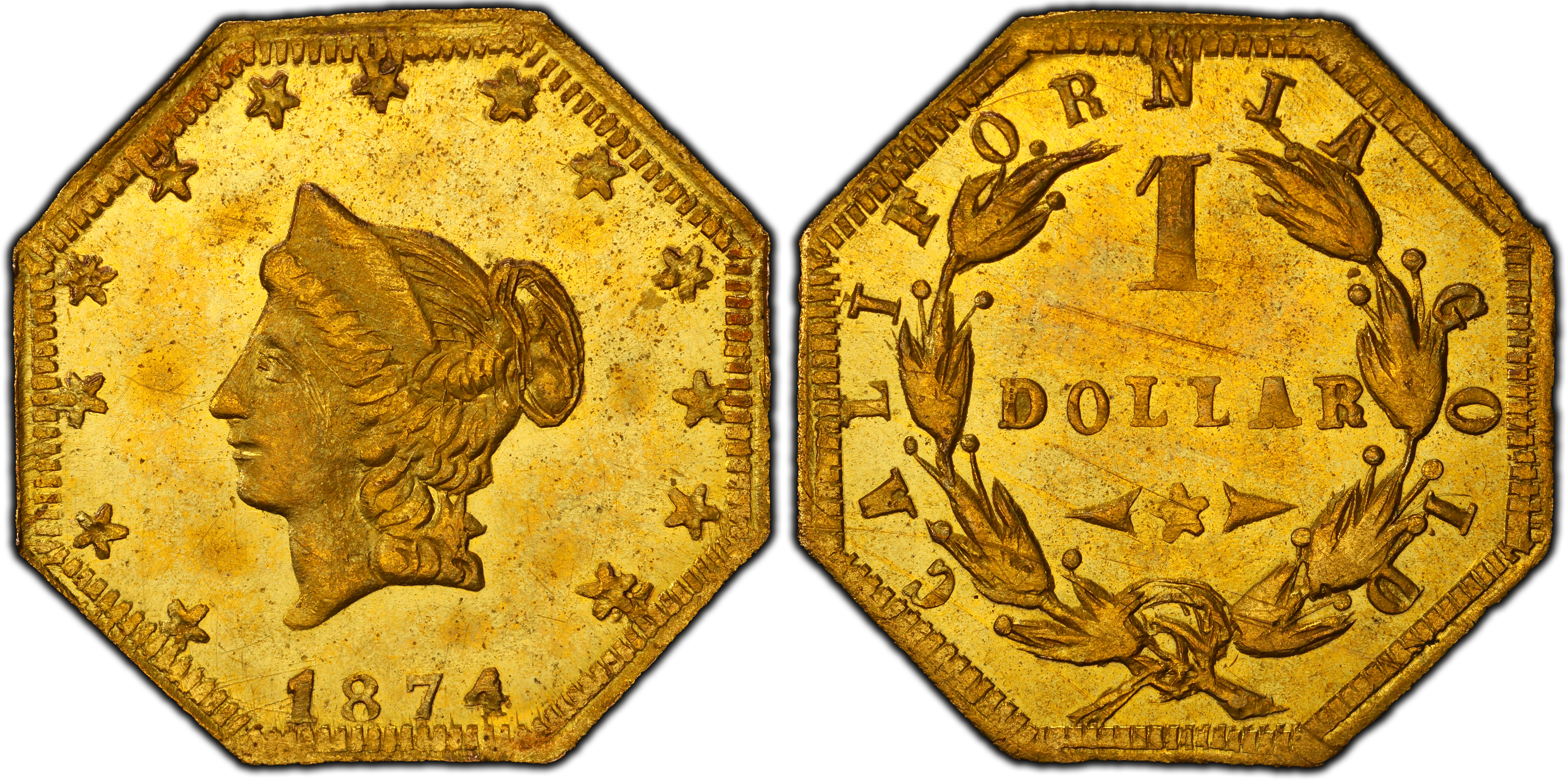
Obverse & Reverse
The 1874 Octagonal Gold Dollar, cataloged as Breen-Gillio 1110 (BG-1110), is a numismatic artifact from the second phase of California's private gold coining era, often dubbed 'Period Two' (1858-1882). Unlike the 'Period One' issues which were struck out of genuine commercial necessity to alleviate a shortage of small change during the initial Gold Rush, the Period Two pieces emerged in a different economic landscape. By the 1870s, the San Francisco Mint was in full operation, supplying the region with ample federal coinage. The raison d'être for fractional gold had thus shifted from utility to novelty. These later issues, frequently called 'Jeweler's Issues,' were primarily manufactured by San Francisco jewelers as souvenirs, keepsakes, and decorative items for tourists and locals nostalgic for the heady days of the Gold Rush. The BG-1110 is a product of this environment. Struck in 1874, it was created long after the Private Coinage Act of 1864 had made such private minting illegal. However, enforcement by the Secret Service was lax until the early 1880s, allowing for a flourishing clandestine market. The minters of these pieces remain anonymous, a deliberate choice to avoid prosecution. They employed cruder manufacturing techniques than the earlier period, often using hand-engraved dies and manual presses, resulting in coins with a distinct 'folk art' feel. Despite their technical illegality, these tokens were openly sold and treasured. The extreme rarity of the BG-1110 variety, rated R-7+, suggests a minuscule original mintage, perhaps only a handful of pieces struck from a single pair of dies that may have failed or been retired quickly. Its survival in high grades is characteristic of a souvenir issue that never saw the wear and tear of circulation, but was instead kept in a jewelry box or coin cabinet. Today, it stands as a testament to a fascinating and legally ambiguous chapter in American numismatics, representing the sunset of private coining in California.
Associated EventCalifornia Gold Rush (Later Souvenir Period)
Reason For MintingPrimarily created as a souvenir or charm for the tourist trade, not for general circulation.
Minter HistoryThe specific minter of BG-1110 is unknown, a common characteristic of Period Two California Fractional Gold. These pieces were typically produced by jewelers in San Francisco who, after the Coinage Act of 1864, operated clandestinely to avoid federal prosecution. Unlike the more organized private minters of the early 1850s, these craftsmen were numerous and their operations small-scale. They hand-cut their own dies, leading to a wide variety of artistic styles, lettering punches, and overall quality. Their business model focused on selling these gold tokens directly to the public as mementos of the Golden State, capitalizing on the romanticism of the Gold Rush.
Historical SignificanceBG-1110 is significant as an exemplar of a 'Jeweler's Issue' from the latter, less-understood period of fractional gold production. Its high rarity underscores the ephemeral nature of many of these private minting operations. It represents a transition from functional private currency to numismatic souvenir, produced in defiance of federal law but tolerated for nearly two decades.
K-N/A
DenominationG$1
Minting Period1874
Assayer/MinterUnknown Private Minter
Geographic OriginSan Francisco, California
Obverse DescriptionA central, left-facing Liberty Head, styled after the contemporary federal gold coinage but often of a more primitive artistic execution. The hair is tied in a bun at the back. Thirteen five-pointed stars encircle the portrait within the octagonal border.
Obverse InscriptionLIBERTY (on coronet)
Reverse DescriptionA simple wreath composed of two branches tied with a bow at the bottom. The interior of the wreath contains the denomination '1' and 'DOLLAR'. The date '1874' is positioned below the wreath, inside the octagonal border.
Reverse Inscription1 DOLLAR 1874
CompositionGold
Stated Fineness Actual FinenessVariable, but typically ranges from .500 to .850 fine for Period Two issues. Generally lower and less consistent than federal issues.
Weight0.50 grams
Diameter11.50 mm
EdgePlain
Extremely low; likely fewer than a dozen pieces.
Survival Estimate4-6 known examples
Rarity ScaleR-7+ (High)
The BG-1110 is a classic rarity in the popular California Fractional Gold series. Its appeal is driven by its extreme scarcity, attractive octagonal shape, and its status as a high-grade survivor from the romantic 'Jeweler's Issue' period. It is a significant prize for advanced specialists.
Key VarietiesNo major varieties of BG-1110 are known. As is common with Period Two issues, there are no known patterns, trial pieces, or official restrikes. The entire BG-1110 issue consists of a single die pairing struck as business strikes, though intended for collectors.
Authentication TipsAuthentication requires comparison to known genuine examples. Key diagnostics include the specific shape and placement of the stars, the style of the lettering punches (especially the numerals in the date), and the details of the wreath. Period Two originals have a distinct feel; the devices are often somewhat flatly struck but sharply outlined against the fields. Replicas are extremely common; genuine pieces must have a denomination (e.g., 'DOLLAR'). Fakes often have incorrect luster, weight, or a soapy, cast-like appearance. Any piece with a bear on the reverse is a modern fantasy piece.
Shopping ConsiderationsFor a 'premium quality' BG-1110, a buyer should seek an example with a sharp strike, particularly on the highest points of Liberty's hair and the leaves of the wreath. The fields are sometimes semi-prooflike on high-grade examples, and this quality commands a significant premium. Original, lustrous surfaces are paramount; any signs of harsh cleaning, polishing, or removal from jewelry will drastically reduce the value. Given the minuscule population, any example that appears on the market is a major event. Prospective buyers should prioritize problem-free surfaces and strong eye appeal over the absolute grade number.
A coin's grade is its condition, rated on a 1-70 scale. For rare coins, this is the most critical factor in determining value, as a tiny difference in preservation can mean a huge difference in price.
Relevant Grade TypesOriginal period issues were business strikes (Mint State, MS) intended as souvenirs, so they are primarily found in high grades from AU-50 to low Mint State. Circulated examples are virtually unheard of, as they did not serve as currency. No Proof (PR/PF) examples were struck during the original minting period, and no later-date restrikes are known to exist for this specific variety.
Mint State CharacteristicsUncirculated examples of BG-1110 typically exhibit a soft, satiny luster. The strike can be inconsistent; a key determinant of quality is the sharpness of the stars and the word 'LIBERTY' on the coronet. The fields may be semi-prooflike. Small planchet flaws or die polishing marks are common and not necessarily detrimental if they do not detract from the overall eye appeal. Due to the hand-operated nature of their striking, perfect centering is rare.
Circulated Wear PatternsWhile circulation is almost never seen, hypothetical wear would first appear on the highest points of Liberty's hair above the ear and on the coronet. On the reverse, the highest leaves of the wreath and the bow would show the first traces of friction. In lower grades, the delicate denticles around the border would begin to merge with the rim.
Key Factors For ValueValue is overwhelmingly driven by rarity and grade. For the BG-1110, a problem-free surface is the most important factor. An example graded MS-62 with original surfaces is far more desirable than an MS-63 that has been cleaned or dipped. Eye appeal is critical; coins with reflective fields and a sharp strike command the highest prices. Given its rarity, any certified example is a major numismatic prize, and a CAC sticker would add a significant premium, confirming its quality for the assigned grade.
PCGS Price Guide
| Grade | Price | Population |
|---|---|---|
| 55 | $2,500.00 | 1 |
| 55+ | $2,750.00 | N/A |
| 58 | $2,900.00 | 1 |
| 58+ | $2,950.00 | N/A |
| 60 | $3,000.00 | N/A |
| 61 | $3,150.00 | N/A |
| 62 | $3,400.00 | N/A |
| 62+ | $3,700.00 | N/A |
| 63 | $4,250.00 | 1 |
| 63+ | $5,000.00 | N/A |