1872 G$1 BG-1119 (Regular Strike)
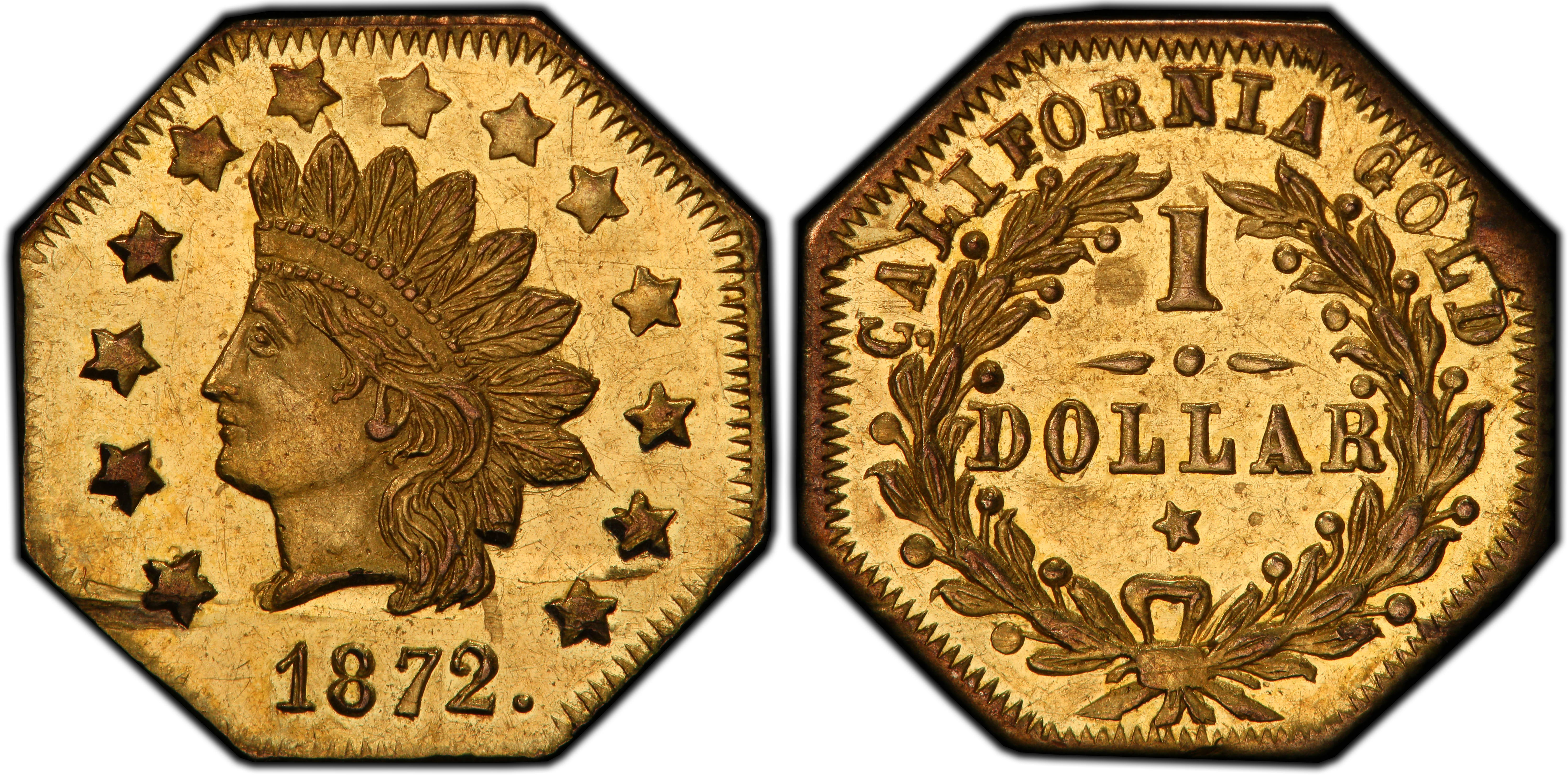
Obverse & Reverse
The 1872 G$1 BG-1119 is a product of the second period (1859-1882) of California Fractional Gold production, a fascinating and complex chapter in American numismatics. Following the initial California Gold Rush boom, the acute shortage of small-denomination coinage was partially met by Period One (1852-1856) fractional gold pieces, which were generally intended to circulate and contained a reasonably high gold content. By the 1870s, the economic landscape of California had matured. The U.S. Branch Mint in San Francisco was in full operation, producing ample federal coinage for daily trade. Consequently, the primary reason for producing fractional gold shifted from necessity to novelty. These Period Two issues, often called 'jeweler's pieces,' were struck primarily as souvenirs, keepsakes, and curios for tourists and locals nostalgic for the Gold Rush's heady days. They were not intended to, and largely did not, fulfill a vital role in commerce. This particular variety, BG-1119, with its iconic Indian Head motif, was part of a wave of privately struck small-denomination gold pieces that mimicked federal designs to enhance their appeal. The minters of these pieces were often anonymous jewelers in San Francisco who operated in a legally grey area. While private coinage was not explicitly outlawed until later, the Act of June 8, 1864, prohibited private issues intended to circulate as money. By creating pieces with slightly less than their face value in gold and marketing them as souvenirs, makers could often circumvent these regulations. The BG-1119, like its contemporaries, was typically struck using the 'hammer method,' a crude process where dies were struck by hand, leading to significant variations in strike quality and centering. Most of these fractional pieces were eventually melted down over the decades, ensuring the rarity of surviving examples.
Associated EventPost-California Gold Rush Era
Reason For MintingPrimarily struck as a souvenir or keepsake for the tourist trade in a prospering, post-Gold Rush San Francisco.
Minter HistoryThe specific minter or jeweler who produced the BG-1119 variety is unknown. During this second period of production, many San Francisco jewelers struck fractional gold pieces, often anonymously, to avoid potential legal issues with the U.S. government. Notable makers from the broader period include Deriberpe & Nouizillet and Frontier & Deviercy, but a direct link to this specific variety has not been established. These craftsmen were skilled metalworkers who capitalized on the public's fascination with gold and the romanticism of the Gold Rush.
Historical SignificanceThe BG-1119 is historically significant not as a coin of commerce, but as a tangible artifact of California's evolving identity in the late 19th century. It represents the transition from a frontier economy of necessity to a more established society that could support a market for souvenirs and luxury goods. These pieces reflect the romantic mythology that was already building around the Gold Rush, even as it was still within living memory, and are a key part of the broader story of private and territorial coinage in the United States.
N/A
Denomination$1
Minting Period1872
Assayer/MinterUnknown Private Minter
Geographic OriginSan Francisco, California
Obverse DescriptionAn Indian Head motif, facing left, styled after the contemporary U.S. Indian Head cent. The portrait is surrounded by thirteen stars, representing the original colonies.
Obverse InscriptionNone
Reverse DescriptionThe reverse features the denomination '1' and the word 'DOLLAR' within a wreath of leaves and berries. The date '1872' is located below the wreath.
Reverse Inscription1 DOLLAR 1872
CompositionGold
Stated Fineness Actual FinenessVaries, but typically lower than U.S. Mint standards for the era.
EdgePlain
Unknown
Survival EstimateFewer than 75
Rarity ScaleR-6
This octagonal one-dollar piece is highly sought after for its classic Indian Head design, octagonal shape, and high rarity. As a representative of the 'souvenir' era of fractional gold, it tells a unique story about California's history and the public's fascination with the Gold Rush. High-grade and prooflike examples are particularly prized by specialists.
Key VarietiesThe primary variety is the Regular Strike BG-1119. A notable and very rare sub-variety is the BG-1119 Prooflike (PL) striking, which exhibits mirrored fields and frosted devices, indicating preparation of the dies for a special presentation-quality strike. No later-date restrikes are known to exist.
Authentication TipsGenuine examples often exhibit a somewhat soft or uneven strike, a characteristic of the hammer-striking process. The details of the Indian's headdress and the wreath on the reverse should be examined for the correct die characteristics. Weight and specific gravity tests are crucial, as many contemporary counterfeits and modern replicas exist. Common counterfeits are often brassy in color, have poorly defined details, or may show casting bubbles under magnification. Authentication by a major grading service (PCGS or NGC) is highly recommended.
Shopping ConsiderationsA premium quality example for its grade will possess a sharp, well-centered strike, which is uncommon for the issue. Look for specimens with minimal distracting marks on the central devices and in the fields. Original, uncleaned surfaces with some remaining luster are highly desirable. Some pieces exhibit attractive reddish-gold or deep orange toning that can enhance eye appeal. Be wary of coins that have been harshly cleaned, polished, or show signs of being mounted in jewelry, such as rim damage or solder marks. The prooflike (PL) designated examples carry a significant premium.
A coin's grade is its condition, rated on a 1-70 scale. For rare coins, this is the most critical factor in determining value, as a tiny difference in preservation can mean a huge difference in price.
Relevant Grade TypesOriginal period issues were business strikes, although they were primarily intended for sale to collectors and tourists rather than for circulation. They are found in Circulated (1-58) and Mint State (MS, 60-70) grades. No true Proofs are known from the original minting period. However, a small number of Prooflike (PL) business strikes were produced from specially polished dies and are recognized as a distinct and desirable variety by grading services.
Mint State CharacteristicsAn uncirculated BG-1119 is defined by the absence of wear. Quality is determined by the strength of the strike, the quality of the luster, and the presence of contact marks. Strikes are frequently weak in the center, particularly on the high points of the Indian's hair and the bow on the reverse wreath. Luster is typically satiny but can be deeply prooflike on PL examples. Due to their small size and handling as souvenirs, even Mint State examples often have small, scattered contact marks.
Circulated Wear PatternsWear first appears on the high points of the design. On the obverse, check the cheek, the details of the feathers in the headdress, and the stars. On the reverse, the highest points of the wreath's leaves and the number '1' will show the first signs of friction and flattening. In lower grades (VF and below), the finer details of the feathers and the wreath become indistinct.
Key Factors For ValueThe primary value drivers for an 1872 G$1 BG-1119 are grade and surface quality. A sharply struck coin with minimal marks and original, lustrous surfaces will command a significant premium over a weakly struck or cleaned example in the same grade. Eye appeal is crucial; coins with pleasing color and a bold strike are highly prized. The Prooflike (PL) designation adds a substantial premium due to its rarity and visual appeal. Certification by PCGS or NGC is standard, and a CAC sticker for this issue indicates superior quality for the grade and adds further value.
PCGS Price Guide
| Grade | Price | Population |
|---|---|---|
| 55 | $1,600.00 | 1 |
| 55+ | $1,700.00 | N/A |
| 58 | $1,800.00 | 2 |
| 58+ | $1,875.00 | N/A |
| 60 | $2,000.00 | 1 |
| 61 | $2,100.00 | 1 |
| 62 | $2,200.00 | 9 |
| 62+ | $2,250.00 | N/A |
| 63 | $2,600.00 | 7 |
| 63+ | $3,000.00 | N/A |
| 64 | $3,500.00 | 8 |
| 66 | N/A | N/A |