1875 G$1 BG-1126 (Regular Strike)
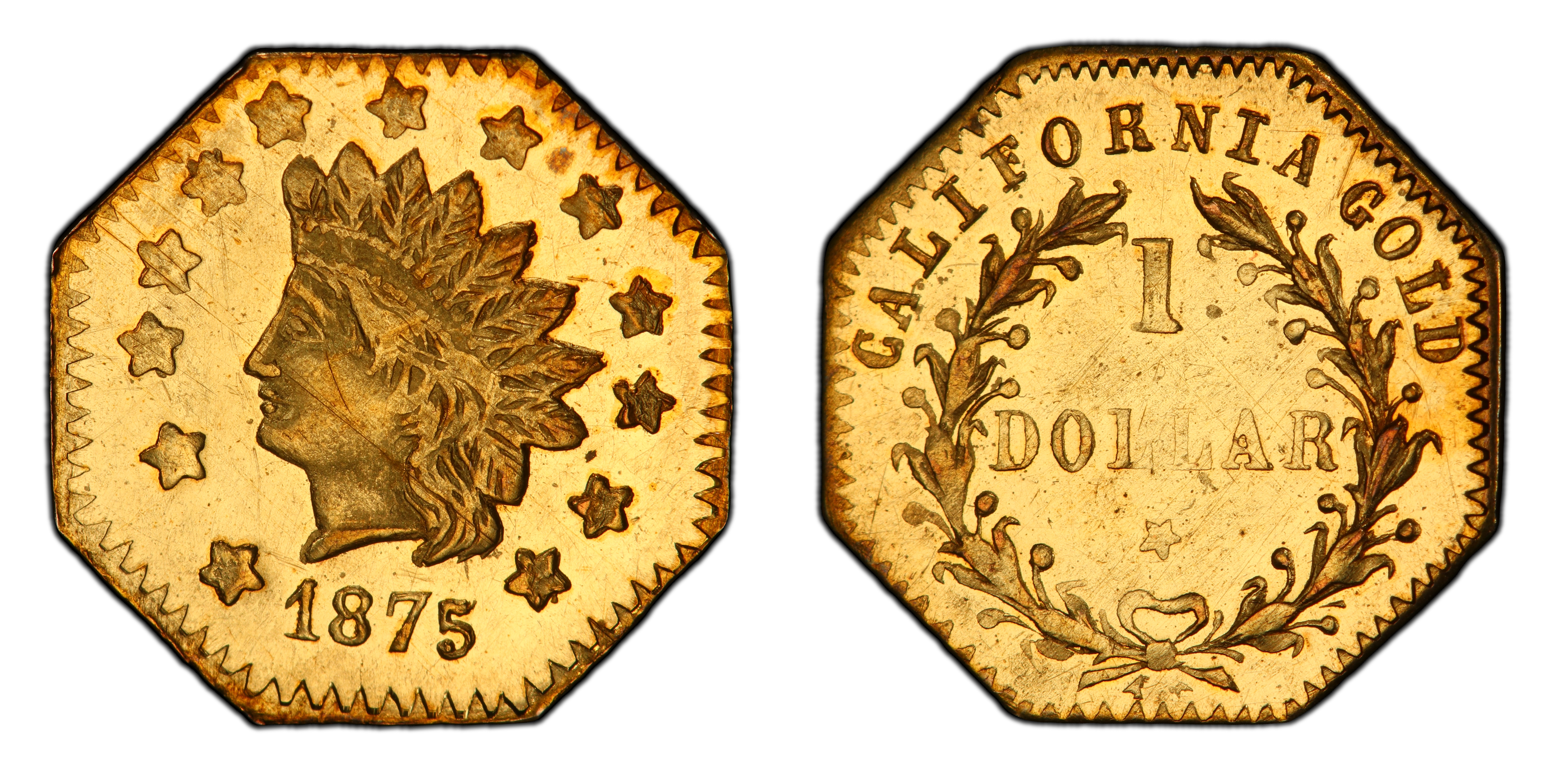
Obverse & Reverse
The 1875 G$1 BG-1126 is a quintessential example from 'Period Two' of California's fascinating fractional gold series, a period numismatists often refer to as the 'Jewelers' Issues.' Unlike the earlier 'Period One' (1852-1857) pieces, which were struck with some earnest intent to alleviate the chronic shortage of small change during the initial Gold Rush, Period Two issues were created in a dramatically different legal and economic landscape. The Coinage Act of 1864 explicitly outlawed private coinage, driving the practice underground. San Francisco's official Branch Mint was by then in full operation, satisfying the region's commercial needs for currency. Consequently, the impetus for fractional gold shifted from utility to novelty. Enterprising jewelers and craftsmen, whose identities are now mostly lost to history, recognized a burgeoning market for these miniature gold pieces as souvenirs, keepsakes, and jewelry items. They were popular with locals and tourists alike, serving as tangible, affordable mementos of the romanticized Gold Rush era. These minters operated clandestinely to avoid seizure by Treasury Department agents, who viewed their products as a violation of federal law. To further obscure their origins, minters often used backdates and omitted any identifying marks. The BG-1126, dated 1875, was struck squarely in this era of suppression. Its production was not that of a formal mint but of a small-scale workshop, likely employing hand-operated screw presses or even cruder hammer-striking methods. These coins were intentionally struck with a gold content significantly below their face value, rendering them tokens rather than true coins, a fact well understood by their contemporary purchasers who valued them for their charm, not their intrinsic worth. The survival of pieces like the BG-1126 is a testament to their success as souvenirs; had they been intended for commerce, their lightweight nature would have ensured their swift rejection and consignment to the melting pot.
Associated EventPost-Gold Rush California Economy
Reason For MintingPrimarily created to be sold as souvenirs and used in jewelry, capitalizing on the romantic appeal of the California Gold Rush.
Minter HistoryThe minters of 'Period Two' fractional gold are largely anonymous, a necessity born from the Coinage Act of 1864 which made their activities illegal. They were typically skilled jewelers and metalworkers operating small, clandestine shops in San Francisco. Unlike the more identifiable assayers of the main Gold Rush period, these craftsmen avoided placing their initials or company names on their products to evade prosecution by the U.S. Secret Service, which was tasked with suppressing private coinage. Their workmanship varied, but they produced a wide array of imaginative designs, including the popular Indian Head motif, to appeal to the souvenir trade.
Historical SignificanceThe BG-1126 represents the evolution of private Californian coinage from a commercial necessity to a clandestine but popular souvenir industry. It is a tangible artifact of the post-Gold Rush era's romantic view of its recent past and demonstrates how private enterprise adapted to federal restrictions, continuing to produce these popular miniature gold tokens for a market driven by tourism and nostalgia.
BG-1126
DenominationG$1
Minting Period1875
Assayer/MinterUnknown private minter
Geographic OriginSan Francisco, California
Obverse DescriptionAn Indian Head motif facing left, adorned with a feathered headdress. The portrait is encircled by thirteen stars, representing the original colonies. The date '1875' is positioned below the bust truncation.
Obverse Inscription1875
Reverse DescriptionA wreath composed of two branches tied together by a bow at the bottom. The wreath encircles the denomination '1' and the word 'DOLLAR'.
Reverse Inscription1 DOLLAR
CompositionGold
Stated Fineness Actual FinenessVariable, but typically of a lower fineness than official U.S. Mint issues, consistent with Period Two jeweler's issues.
EdgePlain
Unknown
Survival Estimate31-75 coins
Rarity ScaleR-5
This octagonal Indian Head dollar is highly sought after for its classic design, tangible connection to the post-Gold Rush era, and its defined rarity. As an R-5 variety, it represents a significant challenge for specialists in the popular California Fractional Gold series, offering a blend of historical intrigue and scarcity.
Key VarietiesThe BG-1126 itself is a specific die marriage and is considered a 'regular strike' business issue for the period, although its true purpose was for souvenir sales. No known official restrikes, proofs, or patterns exist for this variety. The primary variations within the broader series are the numerous different die pairings (BG numbers), each with its own unique design nuances, representing the decentralized and competitive nature of the jewelers who produced them.
Authentication TipsGenuine Period Two fractionals are characteristically thin. Replicas are often thicker and have a more modern, uniform, and 'soapy' appearance. Look for diagnostic die characteristics; some known examples of BG-1126 exhibit faint, slender die cracks on the reverse. The strike on genuine pieces can be uneven, with areas of weakness, a byproduct of the less-standardized minting process. Counterfeits may have a granular or porous surface texture, unlike the fields of an authentic piece. Weight and composition analysis by an expert or a third-party grading service is the most reliable authentication method.
Shopping ConsiderationsA premium quality BG-1126 for its grade will exhibit a sharp strike, particularly on the details of the headdress and the lettering on the reverse. Seek out examples with smooth, lustrous surfaces and minimal distracting marks. Original, unconserved 'skin' with a pleasing reddish-gold or orange-gold hue is highly desirable and commands a significant premium. Avoid pieces that have been harshly cleaned, which imparts a sterile, lifeless appearance, or those that show evidence of being mounted in jewelry (solder marks, edge damage, or excessive scratching). Given the high number of contemporary counterfeits and modern replicas, purchasing a specimen certified by a leading third-party grading service like PCGS or NGC is strongly recommended.
A coin's grade is its condition, rated on a 1-70 scale. For rare coins, this is the most critical factor in determining value, as a tiny difference in preservation can mean a huge difference in price.
Relevant Grade TypesOriginal issues of BG-1126 were produced as business strikes, not for circulation in the traditional sense, but for direct sale to the public. They are found in both Circulated (1-58) and Mint State (MS, 60-70) grades. No Proofs were struck during the original minting period, and there are no known later-date Proof restrikes or special collector strikings associated with this variety.
Mint State CharacteristicsUncirculated examples of BG-1126 are defined by their luster, which is typically satiny rather than deeply frosty. The strike can be inconsistent; a well-struck example with full feather details and a bold date is the exception and highly valued. Due to the small size and handling over the years, even Mint State coins often show minor ticks and hairlines. High-grade examples frequently display attractive deep orange-gold or reddish toning.
Circulated Wear PatternsWear first appears on the highest points of the design. On the obverse, look for flattening on the cheek, the eyebrow, and the feathers of the headdress. On the reverse, the high points of the wreath's leaves and the numerals of the denomination will show initial friction and loss of detail. In lower grades (VF and below), the stars on the obverse will begin to merge with the fields, and the finer details of the wreath will become indistinct.
Key Factors For ValueFor the BG-1126, value is driven by three main factors: grade, surface quality, and eye appeal. A high-grade Mint State coin will always be worth multiples of a circulated example. However, a problem-free AU coin with original surfaces is often preferred over a low-end MS coin that has been cleaned or has distracting marks. Exceptional eye appeal, characterized by a sharp strike and attractive original toning, can add a significant premium. Certification by PCGS or NGC is standard for the series, and a CAC sticker, indicating premium quality for the grade, will further enhance its market value.
PCGS Price Guide
| Grade | Price | Population |
|---|---|---|
| 50 | $700.00 | 1 |
| 55 | $775.00 | 3 |
| 55+ | $800.00 | N/A |
| 58 | $850.00 | 4 |
| 58+ | $925.00 | N/A |
| 60 | $975.00 | 2 |
| 61 | $1,150.00 | 1 |
| 62 | $1,300.00 | 11 |
| 62+ | $1,750.00 | N/A |
| 63 | $2,250.00 | 9 |
| 63+ | $2,750.00 | N/A |
| 64 | $3,750.00 | 2 |
| 66 | N/A | N/A |