1873 G50C BG-1051 (Regular Strike)
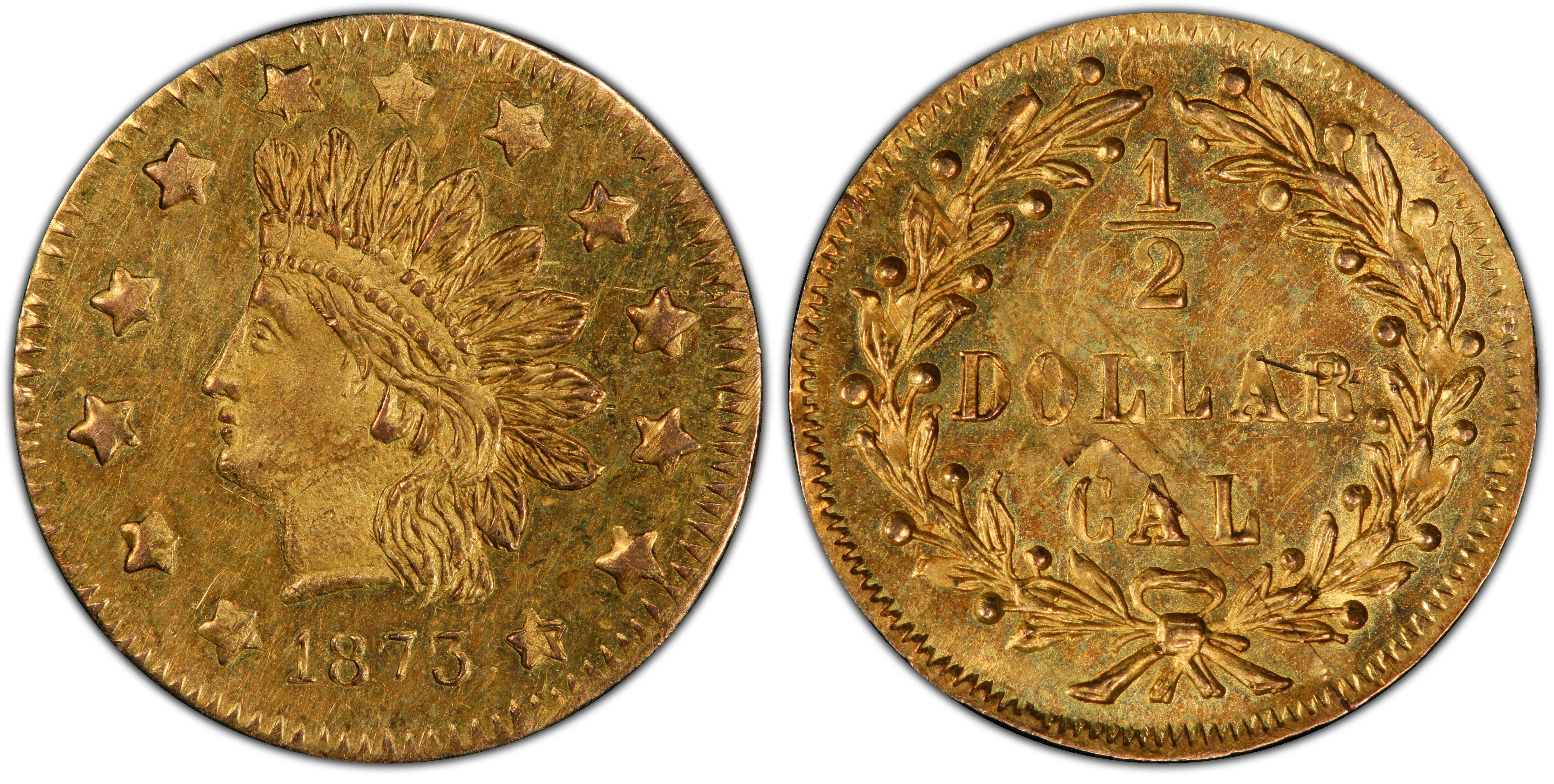
Obverse & Reverse
The 1873 G50C BG-1051 is a product of the second great phase of California's private gold coinage, known to numismatists as 'Period Two' (1859-1882). Unlike the 'Period One' issues, which were struck out of genuine commercial necessity during the height of the Gold Rush to alleviate a dire shortage of small change, the Period Two pieces were created in a different economic climate. By the 1870s, the San Francisco Mint was in full operation, producing ample federal coinage for circulation. The initial rationale for fractional gold had vanished. However, a robust market for these miniature gold coins persisted, driven by jewelers and souvenir makers. California remained a land of mystique and romance in the American imagination, and these tiny gold pieces served as popular keepsakes, mementos of the Golden State, and items to be incorporated into jewelry. The minters of these 'jeweler's issues' were often anonymous, operating in a legal gray area following the Private Coinage Act of 1864, which was not strictly enforced until 1883. These minters were skilled artisans, but their products were not intended to meet any specific weight or fineness standard, often containing gold valued at significantly less than their face value. The BG-1051, with its stylized Indian Head, represents a popular, quintessentially American motif of the era, designed to appeal to this broad souvenir market. Their production was a testament to the enduring legacy of the Gold Rush and the continued demand for tangible, golden reminders of its promise. These pieces are not merely tokens, but numismatic artifacts that bridge the gap between the raw necessity of the Gold Rush and the burgeoning tourism and nostalgia-driven commerce that followed in its wake.
Associated EventPost-Gold Rush California Commerce and Tourism
Reason For MintingPrimarily produced for use in jewelry and as souvenirs for the tourist and export trade, not for general circulation.
Minter HistoryThe specific manufacturer of the BG-1051 variety is unknown, a common characteristic of the 'Period Two' issues. Most were produced by San Francisco-based jewelers who created a wide variety of designs to cater to the significant demand for gold souvenirs. These artisans were not formal minters or assayers in the manner of their Period One predecessors like Moffat & Co., but were instead entrepreneurs capitalizing on the romantic appeal of California gold.
Historical SignificanceThe BG-1051 is significant as a representative of the later period of fractional gold production, illustrating the transition of these pieces from essential circulating currency to commercial keepsakes. It highlights a mature California economy where the image and allure of the Gold Rush had become a marketable commodity in itself. The coin's existence speaks to a continued defiance of the 1864 Private Coinage Act, a law that federal authorities in the West did not begin to rigorously enforce until the early 1880s.
N/A
Denomination50 Cents
Minting Period1873
Assayer/MinterUnknown Private Minter
Geographic OriginSan Francisco, California
Obverse DescriptionA stylized head of a Native American chieftain facing left, wearing a feathered war bonnet. The portrait is somewhat crude in its rendering, typical of jeweler's issues. The date '1873' is positioned below the bust. Thirteen stars, often unevenly spaced, encircle the central device along the denticled rim.
Obverse Inscription1873
Reverse DescriptionA wreath composed of two branches of varying foliage, tied at the bottom with a bow. Inside the wreath, the denomination '50 CENTS' is inscribed. The reverse design is utilitarian and less ornate than many federal issues of the period.
Reverse Inscription50 CENTS
CompositionGold
Stated Fineness Actual FinenessVariable; Period Two issues were notoriously underweight and often of a lower fineness than official U.S. coinage, though still of a high-karat gold.
EdgePlain
Unknown
Survival Estimate31-75 (Low R-5)
Rarity ScaleLow R-5
This variety is sought after as a classic example of a 'Period Two' Indian Head fractional. Its appeal lies in its historical connection to the post-Gold Rush era, its charmingly naive artistry, and its relative scarcity. The BG-1051 is a tangible piece of California's souvenir trade history and a necessary type for specialists assembling comprehensive collections of fractional gold by design and period.
Key VarietiesThe BG-1051 itself is a specific die marriage. There are no major varieties from the original minting period, nor are there any known later-date restrikes or special collector issues. Collectors should note that an example from the famed Jay Roe collection is the plate coin for this variety in the second edition of Breen-Gillio's 'California Pioneer Fractional Gold,' adding to its pedigree and desirability.
Authentication TipsAuthentication requires direct comparison to known genuine examples, ideally the plate coin in the Breen-Gillio reference. Key diagnostics include the specific shape and position of the numerals in the date, the style of the Indian's portrait, and the leaf and bow details on the reverse wreath. Counterfeits and modern replicas often feature incorrect design elements, have a soapy or cast-like appearance, or may be made of brass or low-karat gold. A common red flag for replicas is the presence of a bear on the reverse, which no genuine denominated fractional gold pieces have. Genuine pieces have a sharp, if sometimes crude, strike from dies.
Shopping ConsiderationsA premium quality example for its grade will exhibit a sharp strike, particularly on the Indian's feathers and the denomination on the reverse. Many examples are weakly struck in the centers. Look for original, undisturbed surfaces with some degree of mint luster; many Period Two pieces survive in high grades because they were not circulated. However, they are frequently found with damage from being mounted in jewelry, so check carefully for solder marks, rim filing, or evidence of holes that have been plugged. A slightly proof-like or deep mirror proof-like (DMPL) surface is sometimes encountered on this issue and commands a significant premium.
A coin's grade is its condition, rated on a 1-70 scale. For rare coins, this is the most critical factor in determining value, as a tiny difference in preservation can mean a huge difference in price.
Relevant Grade TypesOriginal issues were business strikes, though not intended for circulation in the traditional sense. They are found in Circulated grades (1-58) but are far more common in Mint State (MS, 60-70) as they were primarily sold as souvenirs. No official Proofs were struck. However, due to the use of polished dies by some jewelers, examples can be found with proof-like (PL) or deep-mirror proof-like (DMPL) surfaces. These are not a separate striking but rather a manufacturing characteristic, and they are highly prized.
Mint State CharacteristicsIn uncirculated condition, the BG-1051 typically displays a soft, satiny to sometimes proof-like luster with a distinctive rich yellow-gold or lemon-gold color. The strike is a key determinant of quality; many are softly struck, particularly on the high points of the feathers and the word 'CENTS'. A well-struck example with full detail is rare and desirable. As these pieces were handled as novelties rather than money, they are prone to light friction and hairline scratches but may be free of significant contact marks.
Circulated Wear PatternsFor circulated examples, wear first appears on the highest points of the design. On the obverse, this includes the cheek and the feathers of the headdress. On the reverse, the highest leaves of the wreath and the bow will show the first signs of friction and metal loss. In lower grades (VF and below), the date and stars will begin to weaken, and the fine details of the wreath will merge.
Key Factors For ValueThe primary value drivers for a BG-1051 are grade and surface quality. An uncirculated piece with minimal marks and strong luster will be worth many times more than a circulated or damaged example. Strike quality is paramount; a coin with a full, sharp strike can command a premium over a higher-graded but weakly struck piece. Eye appeal is crucial, with collectors favoring coins that have attractive, original color and luster. Any history of being used as jewelry severely diminishes the value. A CAC sticker for this issue indicates superior quality for the grade and will add a significant premium.
PCGS Price Guide
| Grade | Price | Population |
|---|---|---|
| 45 | $225.00 | 1 |
| 45+ | $230.00 | N/A |
| 50 | $235.00 | N/A |
| 50+ | $240.00 | N/A |
| 53 | $245.00 | N/A |
| 53+ | $250.00 | N/A |
| 55 | $260.00 | N/A |
| 55+ | $265.00 | N/A |
| 58 | $275.00 | 6 |
| 58+ | $285.00 | N/A |
| 60 | $300.00 | 3 |
| 61 | $315.00 | 2 |
| 62 | $400.00 | 9 |
| 62+ | $525.00 | N/A |
| 63 | $675.00 | 12 |
| 63+ | $850.00 | N/A |
| 64 | $1,350.00 | 3 |
| 64+ | $1,450.00 | N/A |
| 65 | $1,500.00 | 2 |
| 65+ | $1,850.00 | N/A |
| 66 | $2,750.00 | 2 |