1854 G$1 BG-504 Eagle (Regular Strike)
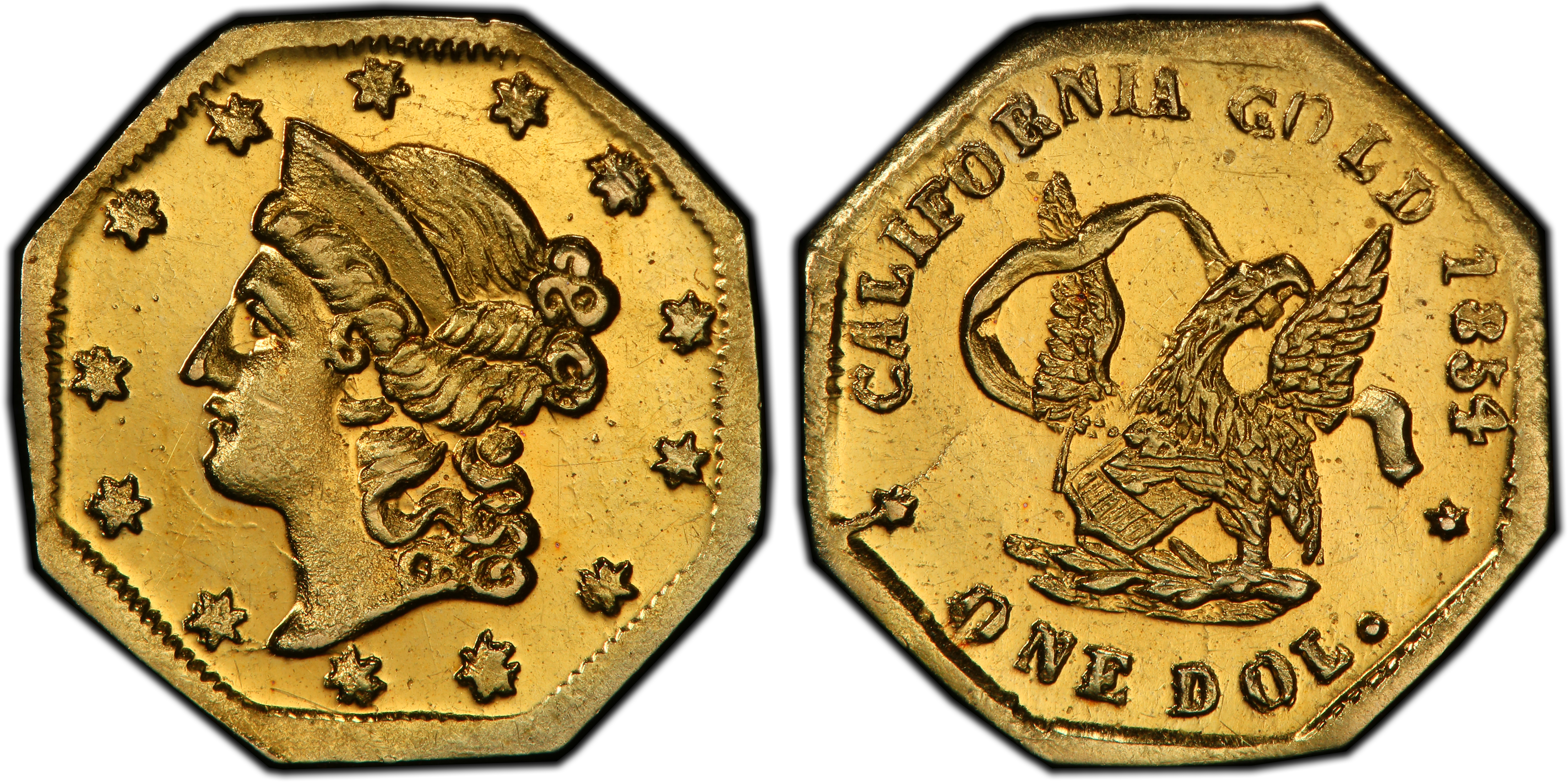
Obverse & Reverse
The 1854 BG-504 octagonal one-dollar piece is a quintessential artifact of the California Gold Rush, a direct response to the chronic shortage of small-denomination coinage that plagued the booming economy of the West. Following the discovery of gold at Sutter's Mill in 1848, a massive influx of prospectors and merchants descended upon California, creating instant cities and rampant commerce. However, the nearest United States Mint was in Philadelphia, an arduously long and dangerous journey away. While gold dust and nuggets served for larger transactions, the need for divisible, reliable currency for everyday purchases was acute. Into this void stepped private minters, often jewelers or assayers, who began striking their own coins from the plentiful local gold. These 'California Fractional Gold' pieces, issued in denominations of 25 cents, 50 cents, and one dollar, became the lifeblood of local trade. The BG-504 belongs to 'Period One' (1852-1856) of this coinage, a time when the pieces were genuinely intended for circulation and were generally of good weight and fineness, closely mimicking federal issues. Their distinctive octagonal shape, along with round counterparts, made them instantly recognizable. The reverse of the BG-504 is particularly noteworthy for its 'Humbert Eagle' design, a direct imitation of the heraldic eagle used by the prestigious U.S. Assay Office under Augustus Humbert on its iconic $50 'slugs.' This was a clear attempt to leverage the public's trust in the quasi-official Humbert issues. These tiny coins, however, proved difficult to handle and easy to lose, and their intrinsic value was often slightly less than their face value. As the San Francisco Mint began full-scale operations in 1854, the necessity for these private issues waned, and many were eventually melted down. The Coinage Act of 1864 officially outlawed private coinage, though production of souvenir pieces continued until the early 1880s. Today, the BG-504 is prized not just for its rarity, but as a tangible link to the vibrant, chaotic, and entrepreneurial spirit of the Gold Rush.
Associated EventCalifornia Gold Rush
Reason For MintingTo alleviate a severe shortage of small-denomination circulating coinage for daily commerce in Gold Rush-era California.
Minter HistoryWhile not definitively signed, the style and workmanship of the BG-504 are widely attributed to Antoine Louis Nouizillet, a French jeweler who was a prolific manufacturer of California Fractional Gold. Nouizillet, often in partnership with other French expatriate jewelers like M. Deriberpe, operated in San Francisco during the 1850s. Their creations are noted for their artistic merit and technical quality relative to other private issues of the time. These minters were entrepreneurs filling a crucial economic niche, converting raw gold dust into a usable medium of exchange before the establishment and full operation of the San Francisco Mint.
Historical SignificanceThe BG-504 and its brethren represent a critical, albeit temporary, solution to a currency crisis and are a prime example of private enterprise stepping in where government infrastructure was lacking. They are among the few privately issued coins to have circulated widely in American history, embodying the economic autonomy and unique conditions of the California frontier. The 'Humbert Eagle' reverse specifically highlights the makers' attempts to create legitimacy and public trust by association with a respected federal entity.
N/A
Denomination$1
Minting Period1854
Assayer/MinterProbably Antoine Louis Nouizillet
Geographic OriginSan Francisco, California
Obverse DescriptionA bust of Liberty faces left, her hair tied in a bun. She wears a coronet inscribed LIBERTY. The bust is surrounded by 13 six-pointed stars, typically with 7 to the left and 6 to the right.
Obverse InscriptionLIBERTY
Reverse DescriptionA heraldic eagle with a shield on its breast, clutching an olive branch and arrows in its talons. A ribbon, usually without a motto, streams from its beak. This design is famously modeled after the reverse of the Humbert & Co. $50 gold pieces, earning it the nickname 'Humbert Eagle' among collectors.
Reverse InscriptionCALIFORNIA GOLD / 1 DOLLAR 1854
CompositionGold
Stated FinenessNot explicitly stated on the coin.
Actual FinenessVaries, but Period One issues like this were generally of relatively high purity, ranging from 14 to 22 carats.
EdgePlain
Unknown
Survival EstimateFewer than 75
Rarity ScaleR-5 to R-6
This variety is highly sought after due to its connection to the famous Humbert $50 slugs, its status as a true circulating 'Period One' issue, its octagonal shape, and its high rarity. It represents a fascinating chapter in U.S. monetary history.
Key VarietiesThe Breen-Gillio (BG) reference is the standard for the series. For BG-504, no major varieties from the original minting period are known. Unlike some federal series, there are no known proof restrikes or special collector issues from later dates for this specific variety. The field of California Fractional Gold is, however, rife with contemporary counterfeits, souvenir pieces from 'Period Two' and 'Period Three' which were often backdated, and modern replicas. Collectors must strictly adhere to authenticated, graded examples of Period One issues.
Authentication TipsGenuine BG-504s exhibit a characteristic strike that is often uneven due to the manual hammer-striking process. Look for slightly soft details, but not the mushy, cast-like appearance of many fakes. The lettering and stars should be sharp in places, even if weak in others. Replicas are often thicker and have a more uniform, modern look. The eagle's details are a key diagnostic point; compare any potential purchase to high-resolution images of certified examples. Authentication by a major third-party grading service (PCGS or NGC) is virtually essential for this series.
Shopping ConsiderationsA premium quality example for this issue is one that retains strong details, particularly on Liberty's coronet and hair, and on the eagle's head, shield, and wing feathers. Original, uncleaned surfaces with some remaining luster command a significant premium. Look for warm, olive-gold or reddish-gold toning that is consistent with aged, unadulterated California gold. Avoid examples that are heavily abraded, bent, holed, or show signs of being mounted in jewelry, as was common. Also, be wary of coins with extensive unstruck areas, though some weakness from the hammer-striking process is expected and acceptable. A CAC sticker is a strong indicator of superior quality for the grade.
A coin's grade is its condition, rated on a 1-70 scale. For rare coins, this is the most critical factor in determining value, as a tiny difference in preservation can mean a huge difference in price.
Relevant Grade TypesOriginal period BG-504 coins were business strikes intended for circulation. They are found in Circulated grades (AG-3 to AU-58) and, very rarely, in Mint State (MS-60 to 70). No true Proofs were struck during the original period of issue. Any piece described as a 'Proof' would likely be a later souvenir striking or a modern replica and should not be confused with these original, circulating coins.
Mint State CharacteristicsAn uncirculated BG-504 will show full, unbroken luster, though it may be more satiny than brilliant. Due to the primitive minting method, the strike is rarely perfect. Expect to see some softness in the central devices, such as the eagle's breast feathers or Liberty's highest hair strands, even on a high-grade MS example. Small planchet flaws or adjustment marks are not uncommon and may not detract from the grade if they are original to the minting process. Contact marks, while present on most examples, should be minimal and not distracting for a choice Mint State grade.
Circulated Wear PatternsWear first appears on the highest points: Liberty's cheek, the hair above her ear, and the inscription on the coronet. On the reverse, the eagle's head, the upper part of the shield, and the edges of the wings will show the first signs of friction. In lower grades (Fine and below), the stars will begin to merge with the fields, and the legends will become soft and difficult to read.
Key Factors For ValueFor the BG-504, value is driven by four primary factors: 1) Absolute Rarity: Very few are known to exist. 2) Grade: Higher condition examples are exponentially more valuable. 3) Surface Quality: An example with original, undisturbed surfaces and attractive toning is far more desirable than a cleaned, polished, or damaged coin of the same grade. 4) Strike: Coins with an unusually sharp strike on both the obverse and reverse are highly prized and command significant premiums. A CAC sticker confirming the quality for the assigned grade adds a substantial premium.
PCGS Price Guide
| Grade | Price | Population |
|---|---|---|
| 40 | $2,000.00 | 1 |
| 45 | $2,200.00 | 1 |
| 45+ | $2,250.00 | N/A |
| 50 | $2,450.00 | 2 |
| 50+ | $2,550.00 | N/A |
| 53 | $3,000.00 | 2 |
| 53+ | $3,100.00 | N/A |
| 55 | $3,300.00 | 6 |
| 55+ | $3,400.00 | N/A |
| 58 | $3,600.00 | 9 |
| 58+ | $3,800.00 | N/A |
| 60 | $4,350.00 | 1 |
| 61 | $4,750.00 | 5 |
| 62 | $6,000.00 | 8 |
| 62+ | $6,500.00 | N/A |
| 63 | $9,000.00 | 9 |
| 63+ | $9,750.00 | N/A |
| 64 | $12,500.00 | 2 |
| 64+ | $15,500.00 | N/A |
| 65 | N/A | N/A |