1871 G$1 BG-1201 (Regular Strike)
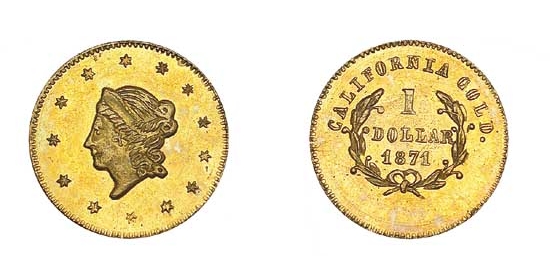
Obverse & Reverse
The 1871 G$1 BG-1201 is a quintessential example of a 'Period Two' California Fractional Gold piece, a fascinating and complex series born from the aftermath of the initial Gold Rush. The first period (1852-1857) saw privately minted gold coins fill a genuine and desperate need for small-denomination currency in the gold fields. However, by the late 1850s, the new San Francisco Mint was in full operation, producing ample federal silver and gold coinage, effectively ending the commercial necessity for these tiny, private issues. Despite this, demand for the miniature gold coins persisted, transforming from a monetary need into a commercial enterprise for souvenirs and keepsakes. San Francisco jewelers, many of French origin, recognized this market and began producing a wide variety of fractional gold pieces from 1858 to 1882. These 'Period Two' issues, including the BG-1201, were not intended to circulate as money. Instead, they were sold as mementos of the Gold Rush, jewelry inserts, and curiosities for tourists and locals alike. Unlike their Period One predecessors, which were generally of honest weight for their size, Period Two pieces were often significantly underweight and sometimes of lower fineness, maximizing profit for the makers. Their production existed in a legal gray area; the Private Coinage Act of 1864 made such minting illegal, but the law was not seriously enforced by the Secret Service in California until 1883. This particular piece, dated 1871, was struck during the zenith of this souvenir trade. The specific maker of the BG-1201 dies is unconfirmed, but prominent jeweler-minters of the era, such as Robert B. Gray and his successors, the Levison Brothers, are the most likely candidates. Gray sold his business in 1871, making this coin a product of that transitional period. These pieces are a tangible link to the romantic mythology of the Gold Rush, created for a public eager to own a piece of the California dream, long after the harsh realities of the initial rush had faded.
Associated EventCalifornia Gold Rush Aftermath & Souvenir Trade
Reason For MintingTo serve the robust market for Gold Rush souvenirs and jewelry items, not for monetary circulation.
Minter HistoryThe specific minter for BG-1201 is not definitively known. However, the dominant producer of similar pieces during this period was Robert B. Gray & Co. Gray had purchased the business of another jeweler, Antoine Louis Nouizillet, in the late 1850s and continued to strike fractional gold. In 1871, the very year this coin is dated, Gray sold his business to the Levison brothers, Jacob and Herman, who operated as the California Jewelry Company. It is highly probable that the BG-1201 was produced by one of these entities during the transition. These jewelers were skilled craftsmen who leveraged the allure of gold to create popular and profitable keepsakes.
Historical SignificanceThe BG-1201 represents the institutionalization of the California Gold Rush mythos. While not a circulating coin, its existence signifies a shift from the utilitarian need for coinage to the commercial capitalization of a historical event, making it an important artifact of 19th-century American commerce, tourism, and nostalgia.
BG-1201
Denomination$1
Minting Period1871
Assayer/MinterUnknown Jeweler, possibly Robert B. Gray or his successors, the Levison Brothers (California Jewelry Company)
Geographic OriginSan Francisco, California
Obverse DescriptionA small, delicate Liberty Head facing left, similar in style to the contemporary federal gold dollar but often of cruder execution. The portrait is surrounded by 13 six-pointed stars. The date '1871' is positioned below the bust.
Obverse Inscription1871
Reverse DescriptionThe reverse features the denomination '1 DOLLAR' within a wreath. The wreath is composed of two branches tied together at the bottom with a bow.
Reverse Inscription1 DOLLAR
CompositionGold
Stated Fineness Actual FinenessVariable, often between .500 and .800 fine gold, sometimes with a high silver content resulting in a 'green-gold' appearance.
Weight0.50 grams
Diameter11.20 mm
EdgePlain
Unknown, but very small.
Survival Estimate13-30 coins are believed to exist in all grades.
Rarity ScaleR-6 (Very Rare) to R-7 (Extremely Rare)
This is a highly sought-after variety due to its extreme rarity and classic Period Two design. Collectors value its connection to the San Francisco souvenir trade and the challenge of acquiring one of the few known examples. Its status as a round dollar, as opposed to the more common quarter and half dollar denominations, adds to its appeal.
Key VarietiesThe BG-1201 is a specific die marriage and has no major varieties from its original minting period. No known restrikes or patterns are associated with this specific BG number.
Authentication TipsAuthentic examples are struck, not cast. Look for sharp, albeit sometimes uneven, details on the stars and wreath. The surfaces often exhibit prooflike or semi-prooflike fields, a common characteristic of jeweler's issues. The planchet may show striations or file marks from preparation. The 'green-gold' color, resulting from a high silver content in the alloy, is a known characteristic. Counterfeits are often soapy in appearance, have incorrect weights and diameters, and may be gold-plated rather than solid gold. Comparison with certified examples is the most reliable method of authentication.
Shopping ConsiderationsFor a premium quality BG-1201, a buyer should prioritize a sharp strike, especially on the Liberty Head and the word 'DOLLAR' on the reverse. Given their purpose as souvenirs, many survivors are found in high grades (AU or MS). Look for examples with clean, prooflike surfaces and minimal contact marks. The originality of the 'skin' is paramount; many examples have been cleaned or polished over the years, which drastically reduces their value. An attractive, original patina, often with hints of lilac or rose toning over the greenish-gold base, is highly desirable. Avoid examples with evidence of being mounted in jewelry, such as solder marks or rim damage. Third-party certification by PCGS or NGC is virtually mandatory for a purchase of this magnitude.
A coin's grade is its condition, rated on a 1-70 scale. For rare coins, this is the most critical factor in determining value, as a tiny difference in preservation can mean a huge difference in price.
Relevant Grade TypesOriginal period issues were business strikes, although not intended for circulation. They are found in Circulated grades (About Uncirculated 50-58) and, more commonly, Mint State grades (MS 60-70) due to their status as souvenirs. No true Proofs were struck during the original period. The frequent 'prooflike' (PL) designation refers to the mirror-like surfaces resulting from polished dies and is a characteristic of the strike, not a separate issue type.
Mint State CharacteristicsAn uncirculated BG-1201 is defined by its luster and absence of wear. The quality of the strike is a key differentiator; well-struck examples will show clear details in Liberty's hair and the leaves of the wreath. Luster is typically flashy and reflective (prooflike) rather than satiny. Contact marks, even small ones, can be distracting on the mirrored fields and will affect the grade. The inherent planchet quality can vary, with some pieces showing minor natural flaws or striations from the manufacturing process which should not be confused with post-strike damage.
Circulated Wear PatternsAlthough not intended to circulate, some examples show light wear. Wear first appears on the highest points: the hair above Liberty's eye and ear, her cheekbone, and the high points of the wreath leaves and bow on the reverse. On lower-grade AU pieces, the prooflike fields will be interrupted by friction, and the finest details will be slightly smoothed.
Key Factors For ValueRarity is the primary driver of value. Beyond that, the key factors are grade, strike, and surface quality. A high-grade (MS-62 or better) example with a sharp strike and deeply prooflike, mark-free surfaces will command a significant premium. The originality of the surfaces is critical; any signs of harsh cleaning, polishing, or removal from jewelry will severely impact the coin's value. Specimens with attractive original color and a CAC sticker, indicating premium quality for the grade, are the most sought-after by advanced collectors.
PCGS Price Guide
| Grade | Price | Population |
|---|---|---|
| 55 | $2,500.00 | 1 |
| 55+ | $2,750.00 | N/A |
| 58 | $3,000.00 | 2 |
| 58+ | $3,100.00 | N/A |
| 60 | $3,200.00 | N/A |
| 61 | $3,300.00 | 1 |
| 62 | $3,400.00 | 4 |
| 62+ | $4,750.00 | N/A |
| 63 | $8,000.00 | 3 |