1880/70 G50C BG-1067 (Regular Strike)
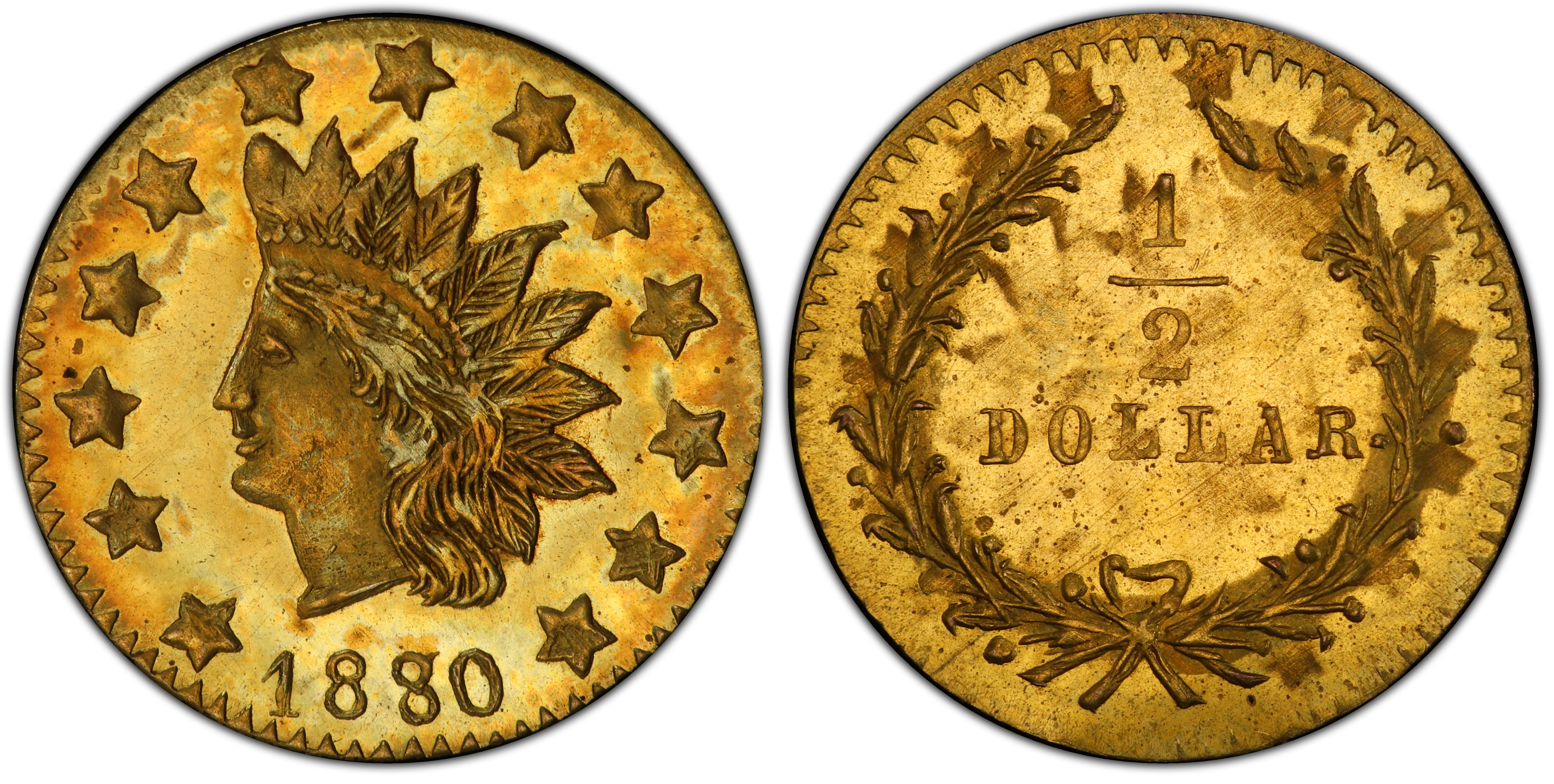
Obverse & Reverse
The 1880/70 G50C BG-1067 is a fascinating product of the twilight years of America's private gold coining tradition. It belongs to what numismatists classify as 'Period Two' (1859-1882) of California Fractional Gold production. Unlike the 'Period One' issues (1852-1856), which were struck out of genuine necessity to alleviate a critical shortage of small change during the initial Gold Rush boom, the Period Two pieces were created in a vastly different economic environment. By the 1870s and 1880s, the San Francisco Mint was in full operation, supplying ample federal coinage for commerce. The original justification for private minting had vanished. Consequently, the purpose of fractional gold shifted from utility to novelty. San Francisco had become a major tourist destination, and a cottage industry of jewelers and private minters arose to meet the demand for gold rush souvenirs. These later issues, often called 'jeweler's pieces,' were typically underweight and sometimes made of debased gold or even gold-plated base metal, intended to be sold as keepsakes, charms, and mementos rather than to function as currency. The BG-1067, with its clear 1880/70 overdate, is a prime example of this era's production methods. The use of older, re-engraved dies was common practice to save on costs and to evoke a sense of history for the buyer. These pieces were often struck with polished dies to create an attractive, prooflike surface that would appeal to tourists. While they carried a denomination, their primary value was in their novelty and their tangible connection to the romantic idea of the California Gold Rush, which was already passing into legend. The United States Secret Service began cracking down on private coinage in the early 1880s, viewing it as a violation of federal law, which brought the era of denominated fractional gold to a definitive close by 1883.
Associated EventCalifornia Gold Rush Tourist & Souvenir Trade
Reason For MintingPrimarily struck as a souvenir or charm for the tourist trade, not for general circulation.
Minter HistoryThe specific minter for the BG-1067 variety is unknown, a common trait for many Period Two issues. The production of these pieces was carried out by a number of San Francisco jewelers who often remained anonymous to avoid scrutiny from federal authorities. They operated small, private minting facilities, using hand-operated presses to strike these miniature gold tokens. Their business model was based on creating attractive, gold-based novelties that could be sold at a significant markup over their minimal intrinsic value.
Historical SignificanceThe BG-1067 is historically significant not as a coin used in commerce, but as an artifact of how the California Gold Rush was memorialized and commercialized in the late 19th century. It represents the transition of fractional gold from a necessary form of currency to a collectible souvenir, marking the final chapter of denominated private gold coinage in the United States before federal laws were more strictly enforced.
N/A
Denomination50 Cents
Minting Period1880
Assayer/MinterUnknown private minter
Geographic OriginSan Francisco, California
Obverse DescriptionThe obverse features a left-facing Indian Head, likely modeled after the contemporary U.S. Indian Head cent. The portrait wears a feathered headdress. The design is encircled by 13 six-pointed stars, representing the original colonies. The date, 1880, is positioned below the bust truncation and clearly shows an 8 punched over a 7 from an earlier 1870 die.
Obverse Inscription1880
Reverse DescriptionThe reverse is dominated by a wreath composed of two branches tied with a ribbon at the bottom. Within the wreath, the denomination is expressed on two lines as '1/2' and 'DOLLAR'. The legend 'CALIFORNIA GOLD' follows the curvature of the coin outside the top of thewreath.
Reverse InscriptionCALIFORNIA GOLD 1/2 DOLLAR
CompositionGold, though often of a lower fineness than stated or sometimes gold-plated over a base metal core.
Stated Fineness Actual Fineness EdgePlain
Unknown
Survival Estimate76-200 Known
Rarity ScaleR-4-
This variety is highly appealing due to its clear and dramatic 1880/70 overdate, which is a significant and easily identifiable die variety. As a Period Two issue, it is more affordable than its Period One predecessors, making it an accessible entry point for collectors interested in the broader California Fractional Gold series. The Indian Head design is also classic and widely collected.
Key VarietiesThe primary variety is the 1880/70 overdate, which defines the BG-1067 attribution. There are no other major varieties known for this specific Breen-Gillio number from the original minting period. No later-date restrikes or special collector issues are known to exist for this specific die marriage.
Authentication TipsGenuine BG-1067 examples should exhibit a sharp, distinct overdate; mushy or poorly defined numerals are a red flag. Look for characteristic weakness in the strike, as many jeweler's pieces were not struck with the same force as federal coinage. Counterfeits are common in the fractional gold series; many are brass replicas or modern fantasies. Authentic pieces, even if underweight, are made of gold. Replicas often have incorrect design details, wrong luster (brassy instead of golden), and may feature a bear on the reverse, a design element not used on genuine denominated issues of this period. Comparing the piece to high-resolution images of certified examples is the best authentication method.
Shopping ConsiderationsA premium quality example for its grade will possess sharp details, particularly on the feathers of the headdress and the numerals of the overdate. Many Period Two pieces were struck with polished dies to enhance their appeal as souvenirs, so look for examples with prooflike or semi-prooflike surfaces. Original, undisturbed luster is highly desirable. Common problems include cleaning, which imparts hairline scratches and dulls the surface, and previous use as jewelry, which can result in scratches, rim damage, or evidence of being mounted. Eye appeal is paramount; seek out coins with a pleasing, original reddish-gold hue and minimal distracting contact marks.
A coin's grade is its condition, rated on a 1-70 scale. For rare coins, this is the most critical factor in determining value, as a tiny difference in preservation can mean a huge difference in price.
Relevant Grade TypesOriginal issues of BG-1067 were business strikes, although many were struck with polished dies to create a prooflike finish for the souvenir market. They are found in both Circulated (1-58) and Mint State (MS, 60-70) grades. No true Proofs (PR/PF) were struck during the original period of issue. The 'PL' (Prooflike) or 'DMPL' (Deep Mirror Prooflike) designators are often applied to high-grade Mint State examples and command a premium.
Mint State CharacteristicsUncirculated examples of BG-1067 are characterized by their luster, which can range from satiny to deeply prooflike. The strike can be inconsistent; some examples are sharply detailed, while others may show weakness on the high points of the Indian Head's cheek or the center of the wreath on the reverse. Due to their marketing as souvenirs, many were well-preserved, but their small size made them susceptible to handling marks. Even high-grade examples may show tiny planchet flaws or ticks from contact with other pieces.
Circulated Wear PatternsWear first appears on the highest points of the design. On the obverse, look for flattening on the cheek, the eyebrow, and the feathers of the headdress. On the reverse, the highest points of the wreath's leaves and the bow will show the first signs of friction. In lower grades (VF and below), the fine details of the feathers will merge and the legends will begin to weaken.
Key Factors For ValueThe primary value drivers for this coin are grade and surface quality. A high-grade Mint State coin (e.g., MS-63 or higher) with prooflike surfaces will command a significant premium over a circulated example. Originality is crucial; coins that have been cleaned, polished, or removed from jewelry will be worth substantially less. The sharpness and clarity of the 1880/70 overdate also contribute to value and eye appeal. Certification by a top-tier grading service (PCGS or NGC) is essential for marketability, and a CAC sticker indicating premium quality for the grade adds a further premium.
PCGS Price Guide
| Grade | Price | Population |
|---|---|---|
| 40 | $200.00 | 1 |
| 45 | $205.00 | 1 |
| 45+ | $207.00 | N/A |
| 50 | $210.00 | N/A |
| 50+ | $215.00 | N/A |
| 53 | $220.00 | N/A |
| 53+ | $225.00 | N/A |
| 55 | $230.00 | 8 |
| 55+ | $240.00 | N/A |
| 58 | $275.00 | 14 |
| 58+ | $300.00 | N/A |
| 60 | $325.00 | N/A |
| 61 | $350.00 | 10 |
| 62 | $375.00 | 29 |
| 62+ | $425.00 | N/A |
| 63 | $500.00 | 24 |
| 63+ | $575.00 | N/A |
| 64 | $775.00 | 24 |
| 64+ | $950.00 | N/A |
| 65 | $1,250.00 | 7 |
| 65+ | $1,650.00 | N/A |
| 66 | $3,000.00 | N/A |