1871 G$1 BG-1109 (Regular Strike)
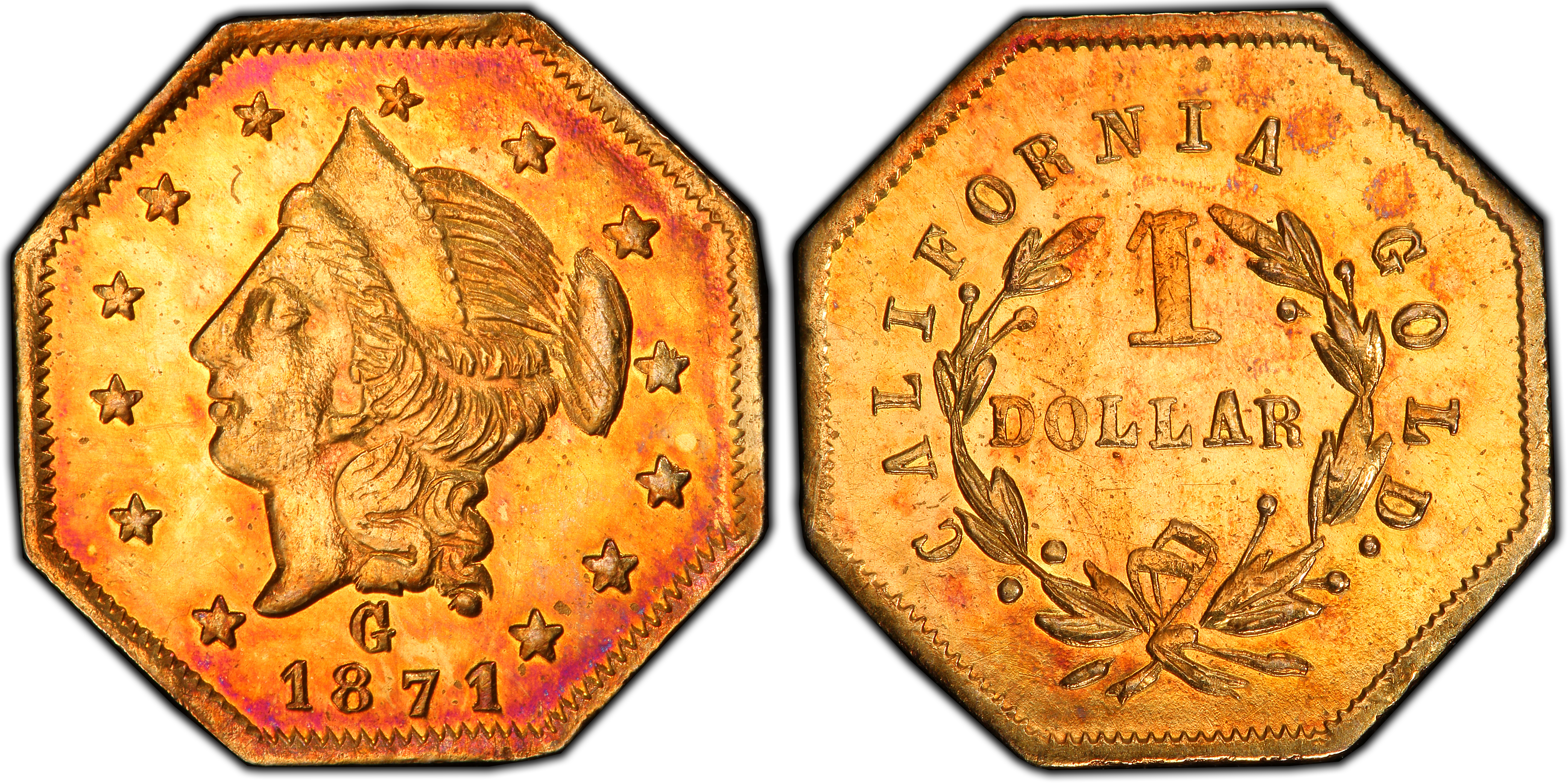
Obverse & Reverse
The 1871 G$1 BG-1109 is a quintessential example of a 'Period Two' California Fractional Gold piece. By the 1870s, the acute shortage of small circulating coinage that had plagued California during the initial Gold Rush years had been largely resolved by the output of the San Francisco Mint. The impetus for producing these minuscule gold dollars had shifted from commerce to souvenir sales. These pieces were no longer intended to serve as pocket change but were created as mementos of the romanticized Gold Rush era, eagerly purchased by tourists, merchants, and those sending gifts back to family in the East. This particular variety, designated BG-1109 in the authoritative work by Walter Breen and Ronald J. Gillio, is part of a series struck by jewelers who recognized this lucrative market. Unlike the earlier 'Period One' issues (1852-1857), which were generally of honest weight and intended for circulation, Period Two pieces were notoriously underweight and often of a lower fineness, maximizing the profit for their makers. The 'G' mark is attributed to Robert B. Gray & Co., a prominent San Francisco jeweler who had been active in producing fractional gold. However, historical records indicate that Gray sold his interests to the California Jewelry Co. (who used an 'L' mintmark) in 1871. It is highly probable that the California Jewelry Co. continued to use Gray's existing dies in the immediate aftermath of the sale, accounting for the 'G' on an 1871-dated issue. The production of these pieces was a legally gray area; the Private Coinage Act of 1864 had made such minting illegal, but the law was not aggressively enforced against these popular souvenir tokens until the early 1880s. This lax enforcement allowed a cottage industry of jewelers, both in San Francisco and in eastern cities like Philadelphia, to continue production throughout the 1870s. The BG-1109, with its delicate octagonal shape and Liberty Head motif, represents the final chapter of private gold 'coinage,' a fascinating numismatic echo of the great California Gold Rush.
Associated EventPost-Gold Rush California Economic Expansion
Reason For MintingPrimarily produced as a souvenir or keepsake of the California Gold Rush era for the tourist and jewelry trade, not for general circulation.
Minter HistoryThe 'G' mintmark is attributed to Robert B. Gray & Co. of San Francisco. Gray had purchased the business of Antoine Nouizillet, another fractional gold minter, around 1859-60. He produced a variety of fractional pieces until 1871, when he sold his interests to the California Jewelry Co. The California Jewelry Co. was run by the Levison Brothers and typically used an 'L' mintmark, suggesting that for the BG-1109, they were likely using up old stock of their predecessor's dies.
Historical SignificanceThis piece is historically significant as a 'Period Two' or 'Jeweler's Issue,' representing the transition of fractional gold from a circulating medium of necessity to a commercial souvenir product. It highlights the sustained national fascination with the Gold Rush long after its peak and exists as an artifact from a legally ambiguous period of private minting in the United States.
BG-1109
Denomination$1
Minting Period1871
Assayer/MinterRobert B. Gray & Co. / California Jewelry Co.
Geographic OriginSan Francisco, California or Philadelphia, Pennsylvania
Obverse DescriptionA representation of a Liberty Head, facing left, modeled after the contemporary U.S. Mint gold dollar design by James B. Longacre. She wears a coronet inscribed LIBERTY. Thirteen stars encircle the portrait, representing the original colonies. The date, 1871, appears below the bust truncation.
Obverse InscriptionLIBERTY
Reverse DescriptionA simple wreath composed of two branches tied with a bow at the bottom. Within the wreath, the denomination '1' sits above the word 'DOLLAR'. A small letter 'G' (for the minter) is located below the bow of the wreath.
Reverse Inscription1 DOLLAR G
CompositionGold
Stated Fineness Actual FinenessVariable, but generally lower than the .900 standard of federal coinage.
EdgePlain
Unknown
Survival EstimateFewer than 75
Rarity ScaleR-5 (Very Rare)
The BG-1109 is sought after for its specific date, octagonal shape, and connection to the final years of the fractional gold era. Its status as a 'Period Two' issue makes it more accessible than many Period One pieces, yet its R-5 rarity ensures it remains a challenge to acquire, especially in high grades. The often-seen prooflike surfaces add to its aesthetic appeal.
Key VarietiesThe primary issue is the business strike intended for souvenir sales, often found with prooflike surfaces from being struck on polished planchets. No official proof versions or restrikes are known to have been created. The key variation within the broader 1871 dollar series would be the minter, with this 'G' (Gray/California Jewelry Co.) and others with an 'L' (California Jewelry Co.) mark.
Authentication TipsGenuine pieces must have a denomination (e.g., 'DOLLAR'). Replicas and fantasy pieces often lack a denomination or feature a bear on the reverse; no genuine 19th-century issues have bears. The strike on genuine pieces can be characteristically weak in areas, particularly on the stars or parts of the wreath, due to the thin planchets. Many modern fakes are sharply and evenly struck. Look for die polish lines and a fabric consistent with mid-19th century minting techniques. Referencing the Breen-Gillio guide for die characteristics is the ultimate verification method.
Shopping ConsiderationsA premium quality example for its grade will possess deeply mirrored, prooflike fields and satiny, frosted devices. Look for sharp details on Liberty's coronet and hair strands. Avoid examples that have been harshly cleaned, which destroys the original surfaces and imparts a dull or hairlined appearance. Also, avoid pieces that are bent, holed, or show signs of having been mounted in jewelry, as was common for these souvenir items. Attractive, original reddish-gold toning can add a significant premium. Given the often-weak strikes, a coin that is well-struck for the variety commands a higher price.
A coin's grade is its condition, rated on a 1-70 scale. For rare coins, this is the most critical factor in determining value, as a tiny difference in preservation can mean a huge difference in price.
Relevant Grade TypesOriginal period issues were business strikes, although primarily for souvenir purposes. They are found in Circulated (1-58) and Mint State (MS, 60-70) grades. Many were struck on polished planchets to enhance their appeal as jewelry items, resulting in a significant number of surviving examples having 'Prooflike' (PL) or 'Deeply Mirrored Prooflike' (DMPL) surfaces. No true Proofs (PR/PF) were struck during the original minting period, and no later restrikes are known.
Mint State CharacteristicsUncirculated examples are defined by their luster, which is typically semi-prooflike to deeply prooflike. Strike quality is a key differentiator; many are softly struck on the peripheral stars or the details within the wreath. A well-struck example with sharp details throughout is rare and desirable. As these pieces were handled as souvenirs, even Mint State examples can show small, scattered contact marks or hairlines from minor mishandling.
Circulated Wear PatternsWear first appears on the highest points of the design. On the obverse, check for flatness on the hair just above Liberty's eye, the highest point of her cheek, and the lettering on the coronet. On the reverse, the high points of the wreath's leaves and the bow will show the first signs of friction and metal loss. In lower circulated grades (VF and below), the stars will begin to lose their definition and merge with the fields.
Key Factors For ValueThe primary value driver is the quality of the surfaces. An example with original, deeply mirrored fields commands a significant premium over a cleaned or circulated piece. Strike sharpness is the second key factor; a bold strike can elevate a coin's value above others of the same numerical grade. Eye appeal, encompassing attractive original toning and a lack of distracting marks, is paramount. For this series, a CAC sticker carries significant weight, confirming both the grade and the superior quality for that grade.
PCGS Price Guide
| Grade | Price | Population |
|---|---|---|
| 30 | $400.00 | 3 |
| 35 | $450.00 | 4 |
| 40 | $475.00 | 2 |
| 45 | $500.00 | 2 |
| 45+ | $550.00 | N/A |
| 50 | $575.00 | 2 |
| 50+ | $600.00 | N/A |
| 53 | $625.00 | 2 |
| 53+ | $635.00 | N/A |
| 55 | $675.00 | 17 |
| 55+ | $700.00 | N/A |
| 58 | $750.00 | 15 |
| 58+ | $800.00 | N/A |
| 60 | $950.00 | 1 |
| 61 | $1,075.00 | 9 |
| 62 | $1,250.00 | 27 |
| 62+ | $1,500.00 | N/A |
| 63 | $2,000.00 | 13 |
| 63+ | $2,500.00 | N/A |
| 64 | $3,000.00 | 8 |