1876 G$1 BG-1116 (Regular Strike)
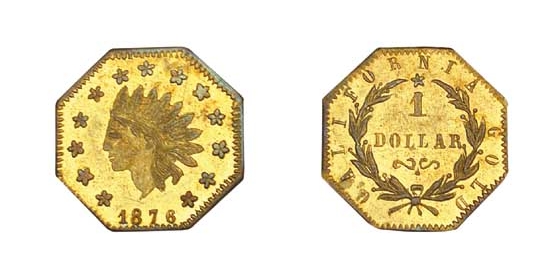
Obverse & Reverse
The 1876 BG-1116 One Dollar piece is a fascinating artifact from the second period of California Fractional Gold production (1859-1882). Unlike the earlier issues of 1852-1858, which were struck with the genuine intent of alleviating a severe shortage of small change during the initial chaos of the Gold Rush, these later pieces were created primarily as souvenirs and keepsakes. By the mid-1870s, the United States Mint in San Francisco was in full operation, supplying the region with ample federal coinage and rendering private issues for commerce obsolete. However, the romance of the '49ers and the allure of gold had created a robust market for mementos of the Golden State. Jewelers and private minters, many of whom remain anonymous, stepped in to fill this demand. The legal environment for these pieces was precarious. The Private Coinage Act of 1864 had explicitly outlawed the striking of private coins intended for circulation. While enforcement was initially lax, by the 1870s, federal authorities, particularly the Secret Service, began to take a greater interest. This led to a clandestine industry where minters often backdated their creations to pre-1864 dates to avoid prosecution. The fact that the BG-1116 bears a contemporary date of 1876 suggests a certain boldness on the part of its maker, perhaps relying on the piece's status as a 'token' or 'charm' rather than a coin intended to defraud. These 'Period Two' issues were characteristically underweight and their gold content was often less than their face value would imply, further cementing their status as tokens. Struck crudely, often by hand with a hammer, they possess a unique character that is distinct from the more utilitarian, though still primitive, issues of Period One. The BG-1116, with its iconic Indian Head design, appealed to the popular romanticism of the American West and remains a tangible link to the enduring legacy of the Gold Rush, long after the economic necessity for such pieces had vanished.
Associated EventCalifornia Gold Rush Aftermath
Reason For MintingPrimarily struck as a souvenir or charm for the tourist and jewelry trade, not for general circulation.
Minter HistoryThe specific minter of the BG-1116 variety is unknown. During this period, numerous San Francisco-based jewelers and artisans produced fractional gold pieces, often without identifying marks to avoid legal repercussions from the enforcement of the Private Coinage Act of 1864. Their operations were small, and records of their activities are virtually nonexistent.
Historical SignificanceThis coin is significant as a representative of the 'Period Two' issues of California Fractional Gold, which transitioned from necessary circulating currency to popular souvenirs. It highlights the sustained national fascination with the Gold Rush and the legal gray area in which private minters operated following the Act of 1864. Its high rarity underscores the small-scale, ephemeral nature of its production.
BG-1116
Denomination$1
Minting Period1876
Assayer/MinterUnknown Jeweler/Minter
Geographic OriginSan Francisco, California
Obverse DescriptionAn octagonal planchet featuring a stylized portrait of a Native American chief facing left, wearing a feathered headdress. The portrait is surrounded by thirteen stars, representing the original colonies.
Obverse InscriptionNo inscriptions are present on the obverse.
Reverse DescriptionA simple wreath composed of two branches tied with a bow at the bottom. Inside the wreath, the denomination '1' and 'DOLLAR' are displayed on two lines, with the date '1876' positioned below the wreath.
Reverse Inscription1 DOLLAR 1876
CompositionGold
Stated Fineness Actual FinenessVariable, but typically less than federal standards for the era, ranging from .500 to .800 fine.
Diameter11.50 mm
EdgePlain
Extremely low, likely less than 500.
Survival Estimate13-30 known specimens
Rarity ScaleHigh R-6
The BG-1116 is highly sought after due to its extreme rarity, octagonal shape, and classic Indian Head design. It represents the later, more clandestine period of fractional gold production, making it a compelling piece of numismatic history.
Key VarietiesThe primary reference is Breen-Gillio 1116 (BG-1116). No major varieties struck during the period of issue are known. All known examples are considered business strikes, though some may exhibit prooflike surfaces from polished dies. No patterns or restrikes have been identified.
Authentication TipsGenuine examples must have the word 'DOLLAR' on the reverse; many contemporary counterfeits and modern replicas say 'CALIFORNIA GOLD' or feature a bear, which is a definitive sign of a fake. The strike is often crude and somewhat uneven, a hallmark of the hand-hammering process. The gold color should be consistent with native California gold, which often has a slightly brassy or greenish hue due to natural silver content. Modern fakes are often brassy in color, gold-plated, and may have a soapy or artificial luster.
Shopping ConsiderationsA premium quality example for this issue is one that retains a significant amount of original luster, often with prooflike or semi-prooflike fields. Look for a sharp strike on the high points of the Indian's cheek and headdress feathers, as well as the numerals of the date. Surfaces should be free of distracting marks, cleaning, or evidence of having been mounted in jewelry, which is a common problem for this series. Coins with attractive, original deep gold or coppery-orange toning command a significant premium. Given the high rarity, any certified example is desirable, but buyers should prioritize eye appeal and surface integrity over the numeric grade alone.
A coin's grade is its condition, rated on a 1-70 scale. For rare coins, this is the most critical factor in determining value, as a tiny difference in preservation can mean a huge difference in price.
Relevant Grade TypesOriginal period issues were business strikes, although intended as souvenirs rather than for circulation. They are found in Circulated grades (AU-50 to AU-58 are most common for pieces that were handled) and Mint State (MS, 60-70) grades. No true Proofs were struck during the original period of manufacture. The term 'Prooflike' (PL) is often used to describe examples struck from freshly polished dies, which is a desirable characteristic and not a separate issue type.
Mint State CharacteristicsUncirculated examples of BG-1116 are characterized by a soft, satiny luster, though some are known with highly reflective, prooflike fields. The strike is typically somewhat weak in the centers, particularly on the highest points of the feathers and the wreath. It is common to see planchet adjustment marks or minor die breaks, which are characteristic of the crude manufacturing process and not necessarily considered defects. Contact marks, even on high-grade specimens, are to be expected due to the softness of the gold and the method of production and storage.
Circulated Wear PatternsWear first appears on the high points of the design: the Indian's cheekbone, the feathers in the headdress, and the leaves of the wreath on the reverse. On moderately circulated examples, the finer details of the feathers will merge and the stars will begin to show flatness. In lower grades (VF and below, though rarely seen), the legends and date will become soft and lose definition.
Key Factors For ValueFor the BG-1116, the key value drivers are rarity and grade. Surface quality is paramount; an example with clean, original, and lustrous surfaces will command a massive premium over a cleaned or damaged piece of the same grade. Strike sharpness is also critical; a coin with a bold strike on the central devices is far more desirable. Eye appeal, driven by attractive toning and mark-free fields, plays a major role. A CAC sticker for this issue is highly significant, indicating a premium quality coin for its assigned grade, and will add a substantial percentage to its value.
PCGS Price Guide
| Grade | Price | Population |
|---|---|---|
| 58 | $2,250.00 | 1 |
| 58+ | $2,350.00 | N/A |
| 60 | $2,500.00 | N/A |
| 61 | $2,650.00 | 2 |
| 62 | $3,000.00 | 1 |
| 62+ | $3,250.00 | N/A |
| 63 | $3,750.00 | 4 |
| 63+ | $4,250.00 | N/A |
| 64 | $5,500.00 | 2 |