1872 G$1 BG-1208 (Regular Strike)
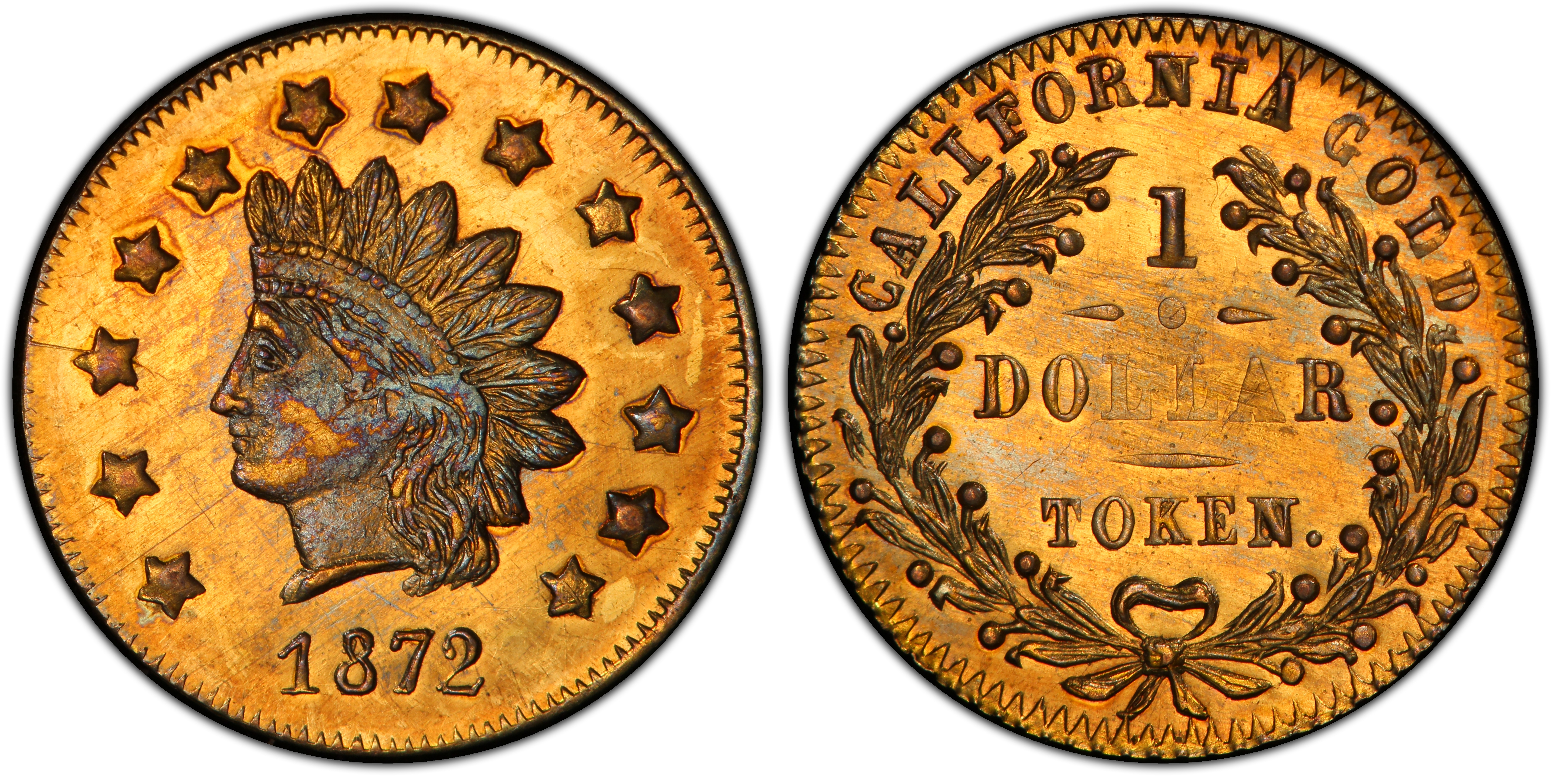
Obverse & Reverse
The 1872 G$1 BG-1208 is a quintessential example of a 'Period Two' California Fractional Gold piece, a series born from the unique economic conditions of post-Gold Rush California. By the 1870s, the initial, desperate need for small denomination circulating coinage that characterized the 1850s ('Period One') had largely subsided. The San Francisco Mint was in full operation, producing ample federal coinage. However, the romance of the Gold Rush had created a robust market for souvenirs and keepsakes. Jewelers and private minters, who had previously struck coins out of commercial necessity, now pivoted to serving this tourist and novelty trade. The Private Coinage Act of 1864 had explicitly outlawed the private issuance of money, casting a long legal shadow over these operations. To circumvent prosecution, minters began producing pieces that were technically tokens, often underweight and sometimes of lower fineness than their Period One predecessors. The BG-1208 variety is a direct product of this legal tightrope act, distinguished by the explicit inclusion of the word 'TOKEN' within the reverse wreath. This was a clear, if not entirely successful, attempt to signal to federal authorities, namely the increasingly vigilant Secret Service, that the piece was not intended to circulate as legal tender. These 'jeweler's issues' were struck using the traditional hammer method, resulting in inconsistent strike quality. Their small size made them popular for setting into jewelry, such as stickpins, cufflinks, and watch fobs, which accounts for the frequent appearance of impaired or ex-jewelry examples in the market today. Despite their non-monetary intent, they represent a direct continuation of the private minting tradition of the Gold Rush and are a tangible link to the evolving economy and culture of 19th-century California.
Associated EventPost-California Gold Rush Souvenir Trade
Reason For MintingTo serve the growing market for Gold Rush souvenirs and jewelry inserts while attempting to avoid federal anti-counterfeiting laws.
Minter HistoryThe BG-1208 is attributed to the California Jewelry Company of San Francisco, owned and operated by the Levison Brothers. This firm was a successor to one of the most prolific Period Two minters, Robert B. Gray & Co. Gray sold his interests to the California Jewelry Co. in 1871, and production of fractional gold pieces continued under the new ownership. Some issues from 1871 bear a small 'L' mintmark, explicitly for Levison. While the BG-1208 does not bear this initial, its date, design characteristics, and provenance place it firmly within the output of this prominent San Francisco jeweler during a period of their active production.
Historical SignificanceThe BG-1208 is historically significant for its 'TOKEN' designation, which explicitly demonstrates the legal pressures faced by private minters in the 1870s. It marks the full transition of these pieces from quasi-mercantile necessity to commercial novelty, capturing a specific moment in the sunset era of American private gold coinage.
N/A
DenominationG$1
Minting Period1872
Assayer/MinterCalifornia Jewelry Company (Levison Brothers)
Geographic OriginSan Francisco, California
Obverse DescriptionA stylized head of a Native American chief facing left, wearing a feathered headdress. The portrait is surrounded by 13 five-pointed stars. The date '1872' is below the bust.
Obverse Inscription1872
Reverse DescriptionThe inscription 'CALIFORNIA GOLD' encircles the upper two-thirds of the periphery. Inside this, a wreath of 21 berries is open at the top and tied with a bow at the bottom. Within the wreath, the denomination '1' is centered above 'DOLLAR', which is above a small five-pointed star. Crucially for this variety, the word 'TOKEN' appears horizontally between 'DOLLAR' and the star.
Reverse InscriptionCALIFORNIA GOLD / 1 / DOLLAR / TOKEN / ★
CompositionGold
Stated Fineness Actual FinenessVariable, typically between .583 to .900 (14 to 22 karats)
Weight1.10 grams
Diameter12.20 mm
EdgePlain
Unknown, as with all private issues of this era.
Survival Estimate13 to 30 coins known.
Rarity ScaleR-6
The BG-1208 is highly sought after by specialists for its extreme rarity and its unique 'TOKEN' reverse, which tells a compelling story of the legal challenges facing private minters. It is a key variety for understanding the evolution of the California Fractional Gold series.
Key VarietiesThe BG-1208 is itself a key variety, distinguished from the BG-1206 and BG-1207 of the same year by the presence of 'TOKEN' on the reverse. No major sub-varieties or contemporary restrikes are noted in numismatic literature. Modern replicas exist and are common, but are not considered part of the original series.
Authentication TipsAuthentication hinges on several key points. First, the presence of the word 'TOKEN' on the reverse is the primary diagnostic. Second, the fabric of the coin should be consistent with 19th-century hammer striking; look for a slightly irregular shape and strike, not the uniform perfection of a modern machine-struck piece. The luster on high-grade examples is often prooflike and slightly glassy. Replicas are often brassy in color, have a soapy or greasy luster, and may feature a bear on the reverse, a design element never used on genuine denominated fractional gold pieces.
Shopping ConsiderationsA premium quality example for its grade will exhibit sharp details on the high points of the Indian's headdress and cheek. The reverse is often softly struck in the center, so a well-defined '1 DOLLAR TOKEN' is highly desirable. Look for original, uncleaned surfaces, which often display a rich, reddish-gold or greenish-gold patina. Many surviving examples have been cleaned, repaired, or removed from jewelry; avoid pieces with deep scratches, rim damage, or evidence of solder. The prooflike (PL) designation from grading services carries a significant premium, as it reflects the original flashy surfaces intended to appeal to souvenir buyers.
A coin's grade is its condition, rated on a 1-70 scale. For rare coins, this is the most critical factor in determining value, as a tiny difference in preservation can mean a huge difference in price.
Relevant Grade TypesOriginal period issues were business strikes, although many were struck with polished dies to create a flashy, prooflike appearance for the jewelry and souvenir trade. They are found in Circulated (1-58) and Mint State (MS, 60-70) grades. No true Proofs were struck during the original period of issue. Any coin designated as a Proof is likely a later restrike or modern replica and should be treated as a separate numismatic item.
Mint State CharacteristicsUncirculated examples of BG-1208 are characterized by their prooflike, reflective surfaces. Luster is typically flashy rather than frosty or satiny. The strike is often weak on the reverse, particularly on the wreath and central inscriptions, due to the challenges of hammer striking such small pieces. The obverse is generally better struck. Small planchet flaws or adjustment marks are not uncommon and should not be confused with post-strike damage. Bag marks are less common than on larger coins, but small, scattered contact marks from handling are typical.
Circulated Wear PatternsWear first appears on the highest points of the design. On the obverse, check for flatness on the Indian's cheekbone, the eyebrow, and the tips of the feathers in the headdress. On the reverse, the highest points of the wreath leaves and the bow will show wear first. In grades below Very Fine (VF), the finer details of the feathers and the word 'TOKEN' will begin to soften and merge.
Key Factors For ValueFor the BG-1208, rarity is paramount, so any example is valuable. The primary value drivers are grade and surface quality. An example with original, lustrous, and uncleaned surfaces will command a massive premium over a cleaned or damaged coin of the same technical grade. Eye appeal is critical; coins with attractive original toning and flashy prooflike surfaces are most prized. Sharpness of the strike, especially on the often-weak reverse, adds significant value. A CAC sticker indicating premium quality for the grade is highly sought after for this rare and historically significant token.
PCGS Price Guide
| Grade | Price | Population |
|---|---|---|
| 53 | $1,200.00 | 1 |
| 53+ | $1,250.00 | N/A |
| 55 | $1,300.00 | 1 |
| 55+ | $1,400.00 | N/A |
| 58 | $1,500.00 | 4 |
| 58+ | $1,750.00 | N/A |
| 60 | $2,500.00 | N/A |
| 61 | $3,000.00 | 3 |
| 62 | $3,850.00 | 5 |
| 62+ | $4,000.00 | N/A |
| 63 | $4,250.00 | 7 |
| 63+ | $6,000.00 | N/A |
| 64 | $8,750.00 | 2 |