1870 G$1 BG-1107 (Regular Strike)
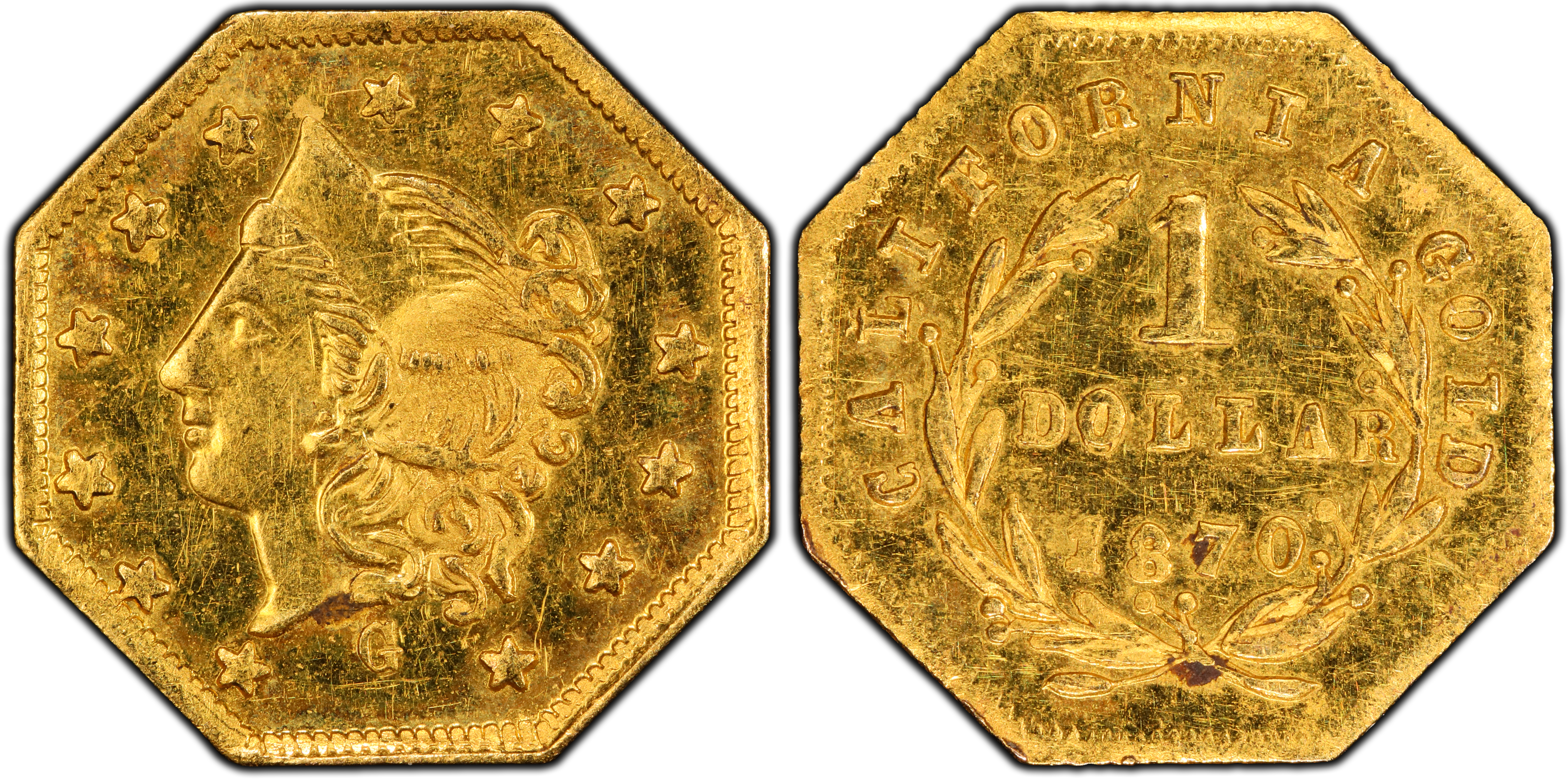
Obverse & Reverse
The 1870 G$1 BG-1107 is a quintessential example of a 'Period Two' California Fractional Gold piece. By 1870, the acute shortage of small change that had plagued California in the early 1850s and necessitated the original 'Period One' fractionals had largely been resolved by the output of the United States Mint in San Francisco. The impetus for creating these tiny gold coins had shifted dramatically from commerce to curiosity. San Francisco was becoming a major tourist destination, a celebrated monument to the wealth and romanticism of the Gold Rush. Jewelers, many of them of French origin, astutely recognized a market for high-quality, memorable souvenirs. These 'jeweler's issues,' as they are often called, were not intended to circulate as money but were sold as keepsakes, charms, and mementos for visitors and locals alike. The Coinage Act of 1864 had officially prohibited private coinage, but enforcement was lax in the West until the early 1880s. This legal gray area allowed for the continued production of denominated pieces like the BG-1107. Unlike their Period One predecessors, which often contained close to their face value in gold, Period Two issues are notorious for their variable and often debased fineness, ranging from .585 to .900 fine (14 to 22 karats). Their weight was not standardized, as their value was in their novelty, not their intrinsic content. The BG-1107, with its classic Liberty Head motif mimicking federal gold dollars, would have been an instantly recognizable and attractive souvenir. Because they were primarily purchased as collectibles from the outset, a higher proportion of the original mintage has survived in Mint State condition compared to the earlier, heavily circulated issues. Today, the BG-1107 is a tangible link to post-Gold Rush California, representing the era's transition from a frontier economy to a center of tourism and established wealth.
Associated EventPost-California Gold Rush Souvenir Trade
Reason For MintingPrimarily produced as a souvenir or keepsake for the growing tourist trade in San Francisco, not for monetary circulation.
Minter HistoryThe specific minter of the BG-1107 die pair is not definitively known, which is common for many Period Two varieties. Production of these pieces was dominated by a community of jewelers and engravers operating in San Francisco. Firms like the Levison Brothers (successors to Gray & Co.) were prominent manufacturers of similar pieces during this era, though a direct attribution for this variety has not been established. These craftsmen used techniques like die striking with screw presses to create their miniature gold tokens for commercial sale.
Historical SignificanceThis coin is historically significant not as a medium of exchange, but as a cultural artifact representing the commercialization of the Gold Rush legend. It marks a shift from the utilitarian private coinage of the 1850s to a souvenir-driven market, reflecting San Francisco's evolving identity and the public's romantic fascination with gold and the West.
N/A
DenominationG$1
Minting Period1870
Assayer/MinterUnknown Private Minter
Geographic OriginSan Francisco, California
Obverse DescriptionA classic Liberty Head portrait facing left, modeled after the federal gold dollars designed by James B. Longacre. The hair is tied in a bun at the back. The portrait is encircled by thirteen six-pointed stars.
Obverse Inscription[None]
Reverse DescriptionAn octagonal planchet. The denomination '1' and 'DOLLAR' are centered within a wreath of two branches tied by a bow at the bottom. The legend 'CALIFORNIA GOLD' appears above the wreath along the upper facets, and the date '1870' is below the wreath.
Reverse InscriptionCALIFORNIA GOLD / 1 / DOLLAR / 1870
CompositionGold
Stated Fineness Actual FinenessVariable, typical for Period Two issues, ranging from approximately 14 to 22 karats.
EdgePlain
Unknown
Survival Estimate13-75. There is conflicting data; Heritage Auctions has previously assigned it R-6 (13-30 known), while other sources such as Greysheet list it as R-5 (31-75 known).
Rarity ScaleR-5 / R-6
The BG-1107 is highly appealing due to its classic octagonal shape, Liberty Head design, and its status as a scarce, attributable 'Period Two' variety. Its history as a Gold Rush-era souvenir adds a layer of romanticism. Higher-grade examples are often found with attractive prooflike or deep mirror prooflike surfaces, making them visually stunning despite their small size.
Key VarietiesThe primary variety distinction is the Business Strike. Some specimens are designated as PL (Prooflike) or DPL/DMPL (Deep Mirror Prooflike) by grading services, which command significant premiums. No major die varieties from the original minting period are widely recognized for BG-1107, nor are there any known authorized restrikes.
Authentication TipsA genuine BG-1107 must be denominated; fakes and modern replicas often omit the word 'DOLLAR' or feature a bear on the reverse. The strike on genuine pieces can be uneven, a result of the hammer or early screw press methods used. Look for crisp details where well-struck, not the soft, 'mushy' appearance of cast counterfeits. The style of the engraving, particularly the shape of the numerals and letters, should match known genuine examples. Weight and fineness are highly variable and not reliable sole indicators of authenticity for Period Two issues.
Shopping ConsiderationsA premium quality BG-1107 is defined by a sharp, well-centered strike, particularly on the highest points like the hair details of Liberty and the leaves in the wreath. Seek out examples with clean, original surfaces free of distracting marks, cleaning, or evidence of having been mounted in jewelry. Luster is a key value driver; specimens with vibrant, frosty mint luster or deeply reflective prooflike fields are most desirable. A slight reddish or coppery toning can be attractive and is often seen on original pieces. A CAC sticker for this issue confirms premium quality for the assigned grade and is highly sought after.
A coin's grade is its condition, rated on a 1-70 scale. For rare coins, this is the most critical factor in determining value, as a tiny difference in preservation can mean a huge difference in price.
Relevant Grade TypesOriginal period issues of BG-1107 were business strikes, though not intended for circulation. They are found in Circulated (AU-50 to AU-58) and, more commonly, Mint State (MS-60 to MS-70) grades. Due to their nature as souvenirs, many were preserved in high grade. No true Proofs were struck during the original period. However, many examples were struck on polished planchets with polished dies, resulting in Prooflike (PL) and Deep Mirror Prooflike (DMPL) surfaces, which are special designations applied to business strikes and are not a separate issue type.
Mint State CharacteristicsUncirculated examples are judged on the quality of their strike, luster, and surface preservation. Strikes can be inconsistent; some pieces are sharply detailed while others show softness on the central devices or peripheral lettering. Luster can range from a soft, satiny texture to intensely reflective, prooflike fields. Due to the softness of the gold and primitive production methods, it is common to see minor planchet flaws or small, scattered contact marks, even on high-grade specimens. The key is to find a coin with strong 'eye appeal,' where marks are minimal and do not detract from the overall beauty.
Circulated Wear PatternsOn circulated examples, wear first appears on the highest points of the design. For the obverse, this includes Liberty's cheek, the hair curls above her ear and eye, and the coronet. On the reverse, the high points of the wreath's leaves and the bow will show the first signs of friction and flattening of details. In lower grades (VF and below, though rare for this issue), the finer details of the hair and wreath merge, and the legends will begin to soften.
Key Factors For ValueThe most significant value drivers for a BG-1107 are grade and surface characteristics. A coin with brilliant, original luster and minimal contact marks will always command a premium. The Prooflike (PL) or Deep Mirror Prooflike (DMPL) designation dramatically increases value. Eye appeal is paramount; an example with a sharp strike and attractive, original coloration will be worth more than a poorly struck or cleaned coin of the same grade. Finally, a CAC sticker, indicating the coin is solid or premium for its grade, adds a significant premium and enhances liquidity.
PCGS Price Guide
| Grade | Price | Population |
|---|---|---|
| 45 | $600.00 | 2 |
| 45+ | $625.00 | N/A |
| 50 | $700.00 | 1 |
| 50+ | $725.00 | N/A |
| 53 | $775.00 | N/A |
| 53+ | $800.00 | N/A |
| 55 | $825.00 | 1 |
| 55+ | $840.00 | N/A |
| 58 | $950.00 | 3 |
| 58+ | $1,000.00 | N/A |
| 60 | $1,150.00 | N/A |
| 61 | $1,250.00 | 3 |
| 62 | $1,750.00 | 11 |
| 62+ | $2,150.00 | N/A |
| 63 | $3,250.00 | 8 |
| 63+ | $3,750.00 | N/A |
| 64 | $4,250.00 | 2 |
| 65 | N/A | N/A |
| 66 | N/A | N/A |