1874/3 G50C BG-1052 (Regular Strike)
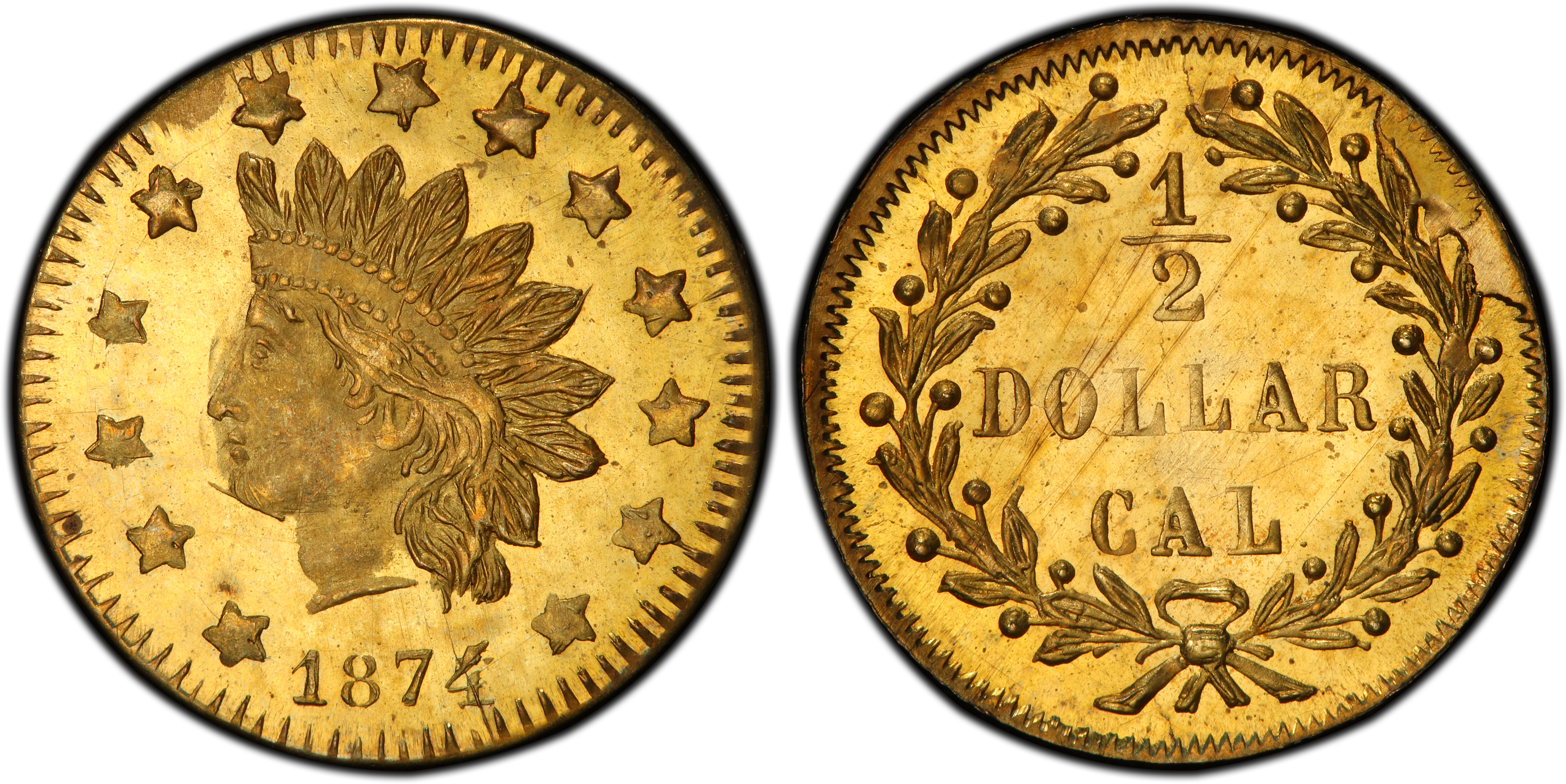
Obverse & Reverse
The 1874/3 G50C, cataloged as Breen-Gillio 1052, represents a fascinating chapter in the later period of California Fractional Gold. By the mid-1870s, the initial chaos of the Gold Rush had long subsided, and San Francisco had matured into a major financial and commercial center. The United States government had established a branch mint in the city in 1854, producing an abundance of federal gold and silver coinage. Yet, a peculiar demand persisted for small-denomination gold coins. These tiny pieces, often called 'charms' or 'tokens' by modern collectors, served practical purposes in a region where small change was often scarce and where gold remained the preferred medium of exchange for transactions large and small. They were particularly popular as gifts, souvenirs of California's golden heritage, and in jewelry. The production of these pieces was a continuation of a tradition that began in 1852 to alleviate a shortage of small coins. While the legal status of these private issues was always ambiguous, enforcement of federal laws prohibiting private coinage was lax, especially for pieces that did not directly imitate U.S. coinage designs. The 1874/3 variety is notable for its prominent overdate, a clear repunching of the numeral '4' over a '3' in the date on the obverse die. This was a common money-saving technique used by private die sinkers, who would repurpose an older die for a new year's production. This specific variety is attributed to the jewelers Robert B. Gray & Co. of San Francisco, who were major producers of these small-denomination gold pieces during this era. The coins were struck with precision, intended for a public that appreciated their novelty and intrinsic value, and they circulated to a limited extent alongside federal cents and dimes before eventually being saved as keepsakes.
Associated EventPost-Gold Rush Economic Expansion in California
Reason For MintingTo satisfy commercial and novelty demand for small-denomination gold coins in California, a region accustomed to using gold for all transactions.
Minter HistoryRobert B. Gray & Co. was a prominent San Francisco firm located at 616 Merchant Street. Active from the 1850s into the 1880s, they were not a private mint in the traditional sense but rather manufacturing jewelers. They specialized in creating a wide array of items, including society regalia, medals, and these popular small-denomination gold pieces. They employed skilled die sinkers and utilized coining presses to produce high-quality, intricate items that appealed to the public. Their production of fractional gold filled a niche market left vacant by the U.S. Mint, which did not produce gold coins smaller than one dollar. The firm was one of the most prolific issuers of Period Three (1872-1882) California Fractional Gold.
Historical SignificanceThe BG-1052 is significant as a prime example of the later-period 'souvenir' or 'token' phase of California Fractional Gold. It demonstrates the persistence of a local 'gold culture' long after the federal government had standardized coinage in the West. The clear 1874/3 overdate provides a valuable window into the production methods of private manufacturers of the era, highlighting their practical, cost-saving measures. As a product of a well-known San Francisco jeweler rather than a quasi-legal assayer, it underscores the transition of these pieces from emergency money to cherished keepsakes and novelties.
N/A
Denomination50 Cents (G50C)
Minting Period1874
Assayer/MinterProbably Robert B. Gray & Co. (manufacturers of jewelry and regalia)
Geographic OriginSan Francisco, California
Obverse DescriptionA beaded border encircles a Liberty head facing left, often described as an 'Indian Head' design. Liberty wears a feathered headdress, with 'LIBERTY' inscribed on the headband. Thirteen stars surround the portrait, with seven to the left, six to the right. The date '1874' is below the bust, with the '4' clearly punched over a '3'.
Obverse Inscription[LIBERTY on headband], 1874
Reverse DescriptionA wreath of two olive branches, tied with a ribbon at the bottom, encircles the denomination. The denomination is expressed on three lines: '1/2', 'DOLLAR', and 'CAL'.
Reverse Inscription1/2 DOLLAR CAL
CompositionGold
Stated Fineness Actual FinenessApproximately .800 to .900, though it could vary.
Weight0.25 grams
Diameter10.10 mm
EdgePlain
500 - 1,500
Survival Estimate100 - 150
Rarity ScaleR-5
This variety is highly sought after by specialists for its dramatic and easily visible 1874/3 overdate. It combines the popularity of the Indian Head motif with a significant die variety, making it a key target for collectors of California Fractional Gold and die variety enthusiasts alike. Its status as a Period Three issue makes it more accessible than the earlier, rarer pieces, offering a tangible link to San Francisco's post-Gold Rush history.
Key VarietiesThe primary variety is the 1874/3 overdate itself (BG-1052). No major sub-varieties from the original minting period are widely recognized. No known patterns, trial pieces, or later-date Proof restrikes exist for this specific variety; all known examples are business strikes from the original 1874 production.
Authentication TipsGenuine examples exhibit a sharp, well-defined overdate with clear remnants of the underlying '3' visible, especially around the curves of the '4'. The strike should be consistent with known originals, which are often slightly weak in the centers. The surfaces should have the correct luster and color for 19th-century California gold. Counterfeits may have a mushy or tool-engraved appearance to the overdate, incorrect weight, or a brassy, unnatural color. Authentication by a third-party grading service is highly recommended.
Shopping ConsiderationsA premium quality example for its grade will display a bold overdate and a strong strike on the word 'LIBERTY' and the feathers. Look for smooth, clean surfaces with minimal distracting marks; these tiny coins are easily damaged. Original, uncleaned 'skin' with a touch of reddish-gold toning is highly desirable and commands a significant premium. Avoid examples that have been harshly cleaned, polished, or show evidence of being removed from jewelry (solder marks, rim damage). Even in lower grades, focus on finding a piece with good eye appeal and a clear overdate.
A coin's grade is its condition, rated on a 1-70 scale. For rare coins, this is the most critical factor in determining value, as a tiny difference in preservation can mean a huge difference in price.
Relevant Grade TypesAll original examples of BG-1052 are business strikes, intended for circulation or use as keepsakes, and are found in Circulated (1-58) and Mint State (MS, 60-70) grades. No Proof (PR/PF) examples were struck during the original period of issue, and no later-date Proof restrikes are known to exist for this variety. Any coin claiming to be a 'Proof' would be highly suspect.
Mint State CharacteristicsUncirculated examples of BG-1052 typically exhibit a soft, satiny luster rather than a hard, frosty one. The strike can be uneven; the highest points of the feathers and the word 'DOLLAR' on the reverse may show some weakness even on a Gem specimen. Due to the softness of the gold and the minting process, small planchet flaws or adjustment marks are not uncommon and should be evaluated for their impact on eye appeal. Contact marks are common, with pristine examples being very rare.
Circulated Wear PatternsWear first appears on the highest points of the design. On the obverse, check the cheekbone of Liberty and the feathers in the headdress. On the reverse, the high points of the wreath's leaves and the numerals '1/2' will show the first signs of friction. In lower grades (VF and below), the word 'LIBERTY' on the headband will become indistinct, and the finer details of the feathers will merge.
Key Factors For ValueFor the 1874/3 G50C, the primary value drivers are grade and surface quality. A sharply struck coin with minimal marks and original, lustrous surfaces will always command a premium. The boldness of the overdate itself is a key factor; a dramatic and clear 4/3 will be more desirable than a weaker one. Eye appeal is paramount: coins with attractive, original toning and problem-free surfaces are prized. A CAC sticker, indicating superior quality for the grade, adds a significant premium, as it confirms the coin's originality and strong visual appeal.
PCGS Price Guide
| Grade | Price | Population |
|---|---|---|
| 45 | $210.00 | 1 |
| 45+ | $220.00 | N/A |
| 50 | $230.00 | N/A |
| 50+ | $235.00 | N/A |
| 53 | $240.00 | N/A |
| 53+ | $245.00 | N/A |
| 55 | $250.00 | 4 |
| 55+ | $260.00 | N/A |
| 58 | $275.00 | 5 |
| 58+ | $285.00 | N/A |
| 60 | $300.00 | N/A |
| 61 | $325.00 | 6 |
| 62 | $400.00 | 24 |
| 62+ | $425.00 | N/A |
| 63 | $600.00 | 15 |
| 63+ | $625.00 | N/A |
| 64 | $750.00 | 16 |
| 64+ | $950.00 | N/A |
| 65 | $1,800.00 | 3 |
| 65+ | $2,150.00 | N/A |
| 66 | $3,350.00 | 2 |