1863 G$1 BG-1307A - Restrike (Regular Strike)
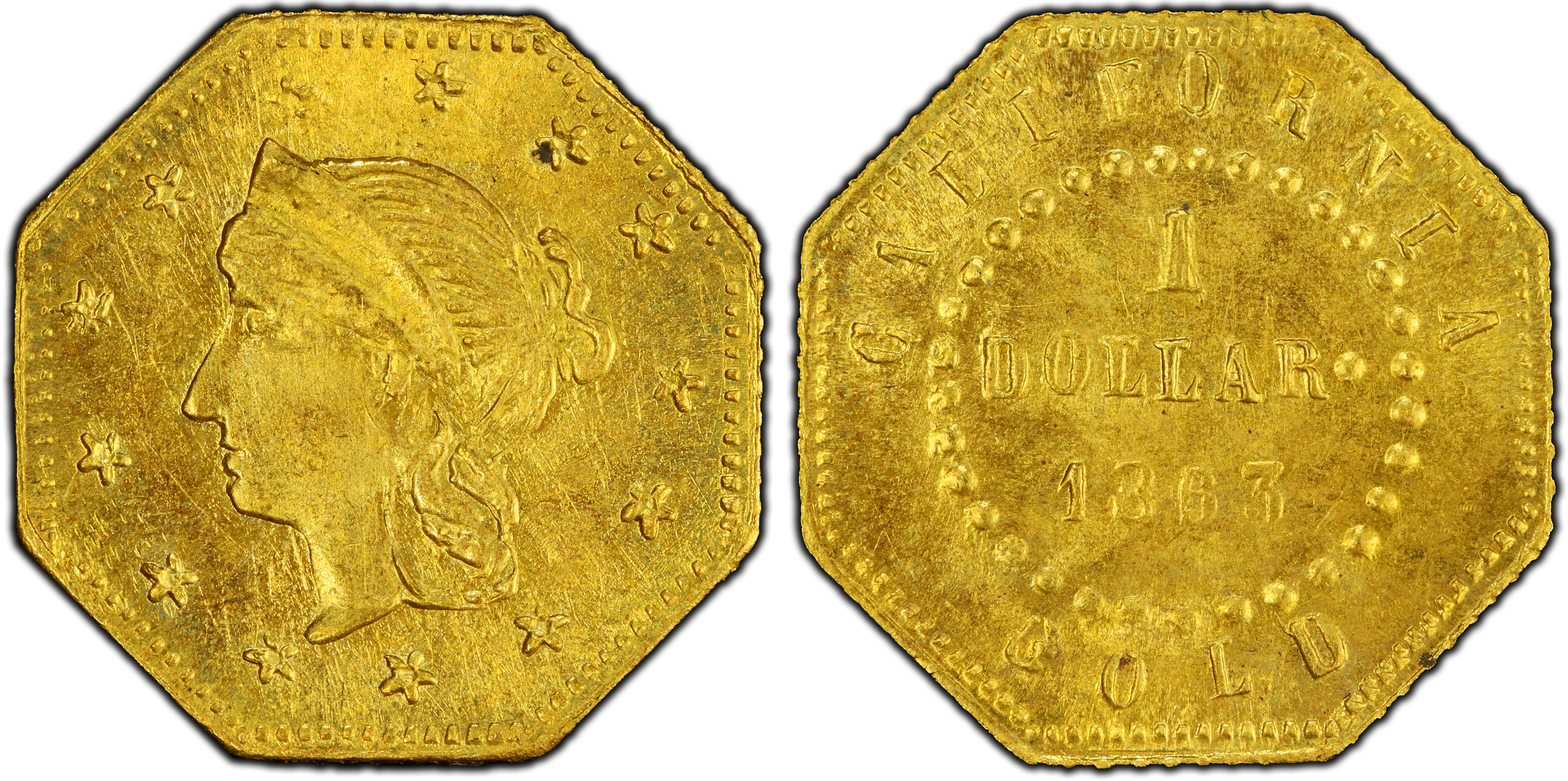
Obverse & Reverse
The story of the BG-1307A is not one of the dusty streets of Gold Rush San Francisco, but rather a fascinating epilogue that speaks to the enduring collector interest in that romantic era. The original California Fractional Gold pieces, struck from 1852 to 1882, were a direct response to a severe shortage of small-denomination coinage on the West Coast. The influx of over 300,000 people during the Gold Rush created a booming economy where gold dust was plentiful but circulating coins for everyday transactions were scarce. Jewelers and private minters stepped into the breach, creating tiny quarter, half-dollar, and dollar coins. These 'Period One' (1852-1857) issues are believed to have genuinely circulated, while 'Period Two' (1858-1882) pieces were increasingly made as souvenirs for tourists and those back East. The Coinage Act of 1864 made private currency illegal, but the law was not strictly enforced against these small tokens until 1883, which brought the original era to a close. Decades later, around 1906-1907, a New York coin and stamp dealer named Herman Kroll acquired a set of discarded or unfinished dies from the California Fractional Gold era. Recognizing a commercial opportunity, Kroll produced a series of 'restrikes' and fantasy pieces using these dies, often mixing and matching them to create new varieties. The BG-1307A is widely considered by numismatists like Walter Breen and Ronald J. Gillio to be one of these Kroll productions. It is technically a 'mule'—a coin struck with dies not originally intended to be paired—using an obverse die similar to one used in the 1850s and a newly created reverse die bearing the 1863 date. These were not intended for circulation but were struck expressly for the burgeoning collector market of the early 20th century, sold as nostalgic links to the 'Wild West'. They are classified as 'Period Three' issues and, while not contemporary to the Gold Rush, have become a historically significant and collectible series in their own right, illustrating the transition of these pieces from utilitarian currency to cherished collectibles.
Associated EventCalifornia Gold Rush (historical basis); Early 20th Century Numismatic Collecting (direct context)
Reason For MintingStruck as a collectible numismatic item for sale to early 20th-century collectors, not for circulation.
Minter HistoryHerman Kroll was a New York-based coin and stamp dealer active in the early 20th century. He is not known to have been a Gold Rush-era minter. His significance to the California Fractional Gold series comes from his acquisition of original and discarded dies, which he used to strike a variety of restrikes and fantasy pieces, including the BG-1307A, for the collector market. These are often referred to as 'Kroll copies' or 'Kroll restrikes' and form the bulk of what is known as 'Period Three' of the series.
Historical SignificanceThe BG-1307A is significant not as a product of the Gold Rush, but as an early example of a 'restrike' created specifically for the numismatic market. Its existence highlights the high demand for Gold Rush-era coins among early collectors and represents a distinct, later phase of the California Fractional Gold story. It is a tangible link between the original period of production and the modern era of collecting.
BG-1307A
Denomination$1
Minting PeriodCirca 1906-1907
Assayer/MinterHerman Kroll (attributed)
Geographic OriginNew York, New York (place of striking), though related to San Francisco, California history
Obverse DescriptionA Liberty Head, facing left, closely resembling the style of the official U.S. gold coinage of the period. The portrait is surrounded by thirteen five-pointed stars.
Obverse Inscription Reverse DescriptionThe denomination '1 DOLLAR' and the date '1863' are centrally located within a beaded circle. The legend 'CALIFORNIA GOLD' is arranged in an arc around the periphery, with 'CALIFORNIA' at the top and 'GOLD' at the bottom. The piece is octagonal in shape.
Reverse InscriptionCALIFORNIA GOLD 1 DOLLAR 1863
CompositionGold
Stated Fineness Actual FinenessVariable, as with most Period Three issues. While original native California gold was about .880 fine, the purity of these restrikes can fluctuate.
EdgePlain
Unknown
Survival EstimateRelatively common for a Cal Gold issue, likely several hundred or more.
Rarity ScaleR-1 (Common in the context of California Fractional Gold)
This piece appeals to collectors as an accessible and affordable example of the popular Liberty Head Octagonal Dollar design. Its status as a Kroll-era restrike makes it an interesting part of the California Fractional Gold story, distinct from the more expensive Period One and Two issues. High-grade examples are plentiful, allowing collectors to acquire a visually impressive piece without the cost of a true Gold Rush-era coin.
Key VarietiesThe BG-1307A itself is the key variety. It is a 'restrike' and should not be confused with original, dated 1863 issues from Period Two, which are cataloged separately and are much rarer. There are no known major variations of the BG-1307A from its striking period, nor are there any later collector restrikes of this specific Kroll issue.
Authentication TipsAuthenticity is less of a concern than with Period One pieces, as these are collector issues. However, one should look for the known die markers for BG-1307A. The strike is typically sharp and well-defined, unlike many of the cruder, original Gold Rush pieces. The surfaces often have a slightly prooflike or reflective quality. Any specimen appearing cast, with mushy details or a porous surface, should be viewed with suspicion.
Shopping ConsiderationsA 'premium quality' example for this issue is defined by pristine, mark-free surfaces and a sharp strike. Buyers should look for coins graded MS-64 or higher, as they are relatively available and offer superb eye appeal. Check for distracting copper spots or carbon flecks, which can sometimes appear on these issues. Luster is a key component; seek out examples with booming, vibrant luster rather than those with a dull or subdued finish. Avoid coins that have been cleaned or polished, as this significantly impairs their value, even if they are in a high-grade holder. The price jump to grades above MS-66 is significant, making MS-64 and MS-65 the sweet spot for most collectors.
A coin's grade is its condition, rated on a 1-70 scale. For rare coins, this is the most critical factor in determining value, as a tiny difference in preservation can mean a huge difference in price.
Relevant Grade TypesAll known examples of BG-1307A are business strikes (Regular Strikes) intended for collectors and were never circulated. Therefore, they are typically found and graded in Mint State (MS, 60-70). Circulated examples (1-58) would be exceptionally unusual and likely the result of mishandling. No original Proof (PR/PF) examples were struck during the Kroll period.
Mint State CharacteristicsUncirculated examples of BG-1307A are characterized by a sharp, uniform strike, as they were produced with better technology than their Gold Rush-era predecessors. The luster is typically bright and satiny, sometimes with semi-prooflike fields. Due to being made for collectors, they were generally well-preserved, but light contact marks from handling over the decades are common. The high points, such as Liberty's hair and the digits of the date, should be fully struck up.
Circulated Wear PatternsAs these coins were not intended for circulation, wear is not a primary grading concern. However, if a specimen were to show wear, it would first appear on the highest points of the design: the hair above Liberty's eye and ear, her cheekbone, and the numerals of the date on the reverse. Any friction would quickly dull the lustrous fields.
Key Factors For ValueThe primary value drivers for this specific coin are grade and surface quality. Since they are common in uncirculated grades, value is highly sensitive to small gradations (e.g., MS-64 vs. MS-65). A coin with pristine surfaces, free of distracting marks or copper spots, will command a significant premium. Eye appeal is crucial; examples with bright, unimpaired luster are highly sought after. A CAC sticker, indicating premium quality for the grade, adds a strong premium for this issue as it helps differentiate the best examples.
PCGS Price Guide
| Grade | Price | Population |
|---|---|---|
| 53 | N/A | 1 |
| 58 | N/A | 1 |
| 62 | N/A | 1 |
| 63 | N/A | 4 |
| 64 | N/A | 27 |
| 64+ | N/A | 1 |
| 65 | N/A | 13 |
| 66 | N/A | 4 |