1854 G25C BG-220 Defiant Eagle (Regular Strike)
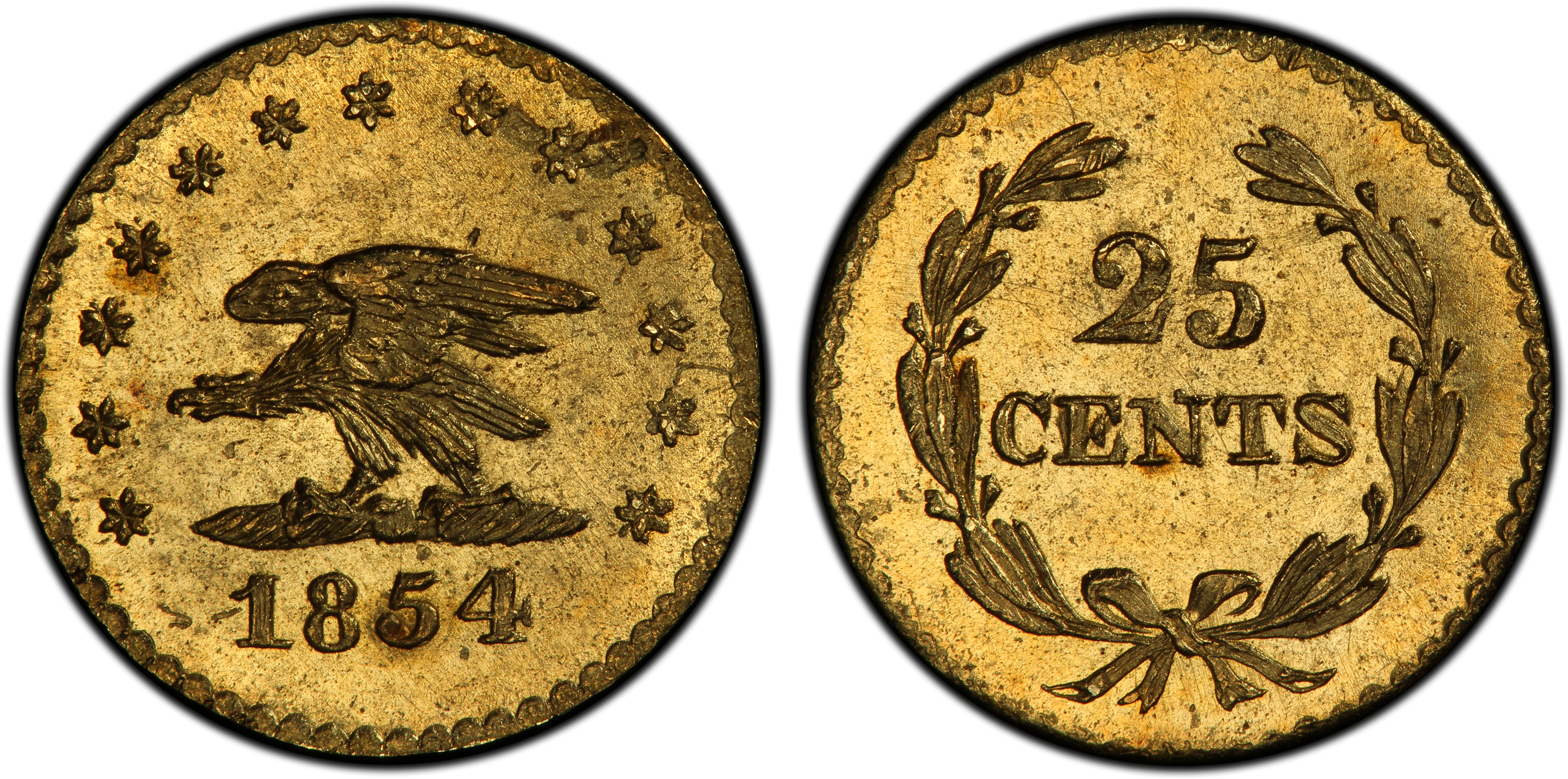
Obverse & Reverse
The 1854 BG-220 'Defiant Eagle' 25 Cent piece is a landmark issue within the fascinating series of California Fractional Gold. These small, privately-issued coins were born of pure necessity during the chaotic early years of the California Gold Rush. Following the discovery of gold in 1848, a massive influx of prospectors and merchants flooded into California, but the monetary system failed to keep pace. Gold dust became the primary medium of exchange, an inefficient and often inaccurate system. While large-denomination private gold coins and federal assay office bars handled significant transactions, there was a severe, crippling shortage of small denomination coinage for everyday purchases. Into this void stepped a number of jewelers and metalsmiths, primarily in San Francisco, who began striking their own fractional gold coins in quarter dollar, half dollar, and dollar denominations starting in 1852. These 'Period One' issues (1852-1856) were intended for actual circulation and were generally produced with weights and fineness that, while inconsistent, were close enough to their stated value to be accepted in the region's inflated economy. The BG-220 is unique among its contemporaries. Unlike the many varieties that used a standard Liberty Head motif mimicking federal coinage, the BG-220 features a highly stylized and unique design on both obverse and reverse. Research by numismatists like Robert Leonard suggests a possible connection to a San Francisco business known as 'Jordan's' at 130-1/2 Montgomery Street, with the coins perhaps serving as pattern or promotional pieces. Its unique design and status as the only 25-cent variety struck to a near-correct weight standard set it apart. The opening of the official San Francisco Branch Mint in April 1854 spelled the beginning of the end for these private issues. As federal silver and gold coins became more plentiful, the need for the privately-struck fractional gold diminished, and production of circulating types ceased by 1856. The BG-220, therefore, represents a brief but vibrant period of private enterprise meeting a crucial economic need before the establishment of federal monetary authority in the West.
Associated EventCalifornia Gold Rush
Reason For MintingTo alleviate a severe shortage of small-denomination coinage for daily commerce in Gold Rush-era California.
Minter HistoryThe specific minter of BG-220 is not definitively known, as is the case with many Period One fractional gold varieties. The dies are anonymous and show no identifying initials. However, its unique design and quality have led researchers to speculate it was the work of a highly skilled engraver. One prominent theory suggests the pieces were struck for or by a business named 'Jordan's' in San Francisco, possibly as a high-quality pattern or advertisement to showcase their capabilities before the new U.S. Branch Mint fully saturated the market with official coinage.
Historical SignificanceThe BG-220 is historically significant for being a unique design type among Period One fractional gold and for its distinction as the only 25-cent issue struck at a weight approaching its intrinsic value. It stands as a prime example of the private sector's response to a currency crisis on the American frontier and represents the pinnacle of artistic and manufacturing quality for this denomination before such private issues were rendered obsolete by the San Francisco Mint.
BG-220
DenominationG25C (Gold 25 Cents)
Minting Period1854
Assayer/MinterUnknown Private Minter (Possibly associated with 'Jordan's')
Geographic OriginSan Francisco, California
Obverse DescriptionA stylized head of Liberty faces left, with hair tied in a bun at the back. Thirteen stars encircle the portrait within a beaded border. The date 1854 is below the truncation of the neck. The engraving style is distinct and not copied from contemporary federal issues.
Obverse Inscription1854
Reverse DescriptionThe central device is a powerful, stylized eagle with outstretched wings, head turned to its left, clutching an olive branch and arrows in its talons. The eagle's defiant posture is reminiscent of the eagle on Feuchtwanger Cents. The inscription 'CALIFORNIA GOLD' appears above, and the denomination '25 CENTS' is below, separated by dots.
Reverse InscriptionCALIFORNIA GOLD / 25 CENTS
CompositionGold
Stated Fineness Actual FinenessTypically around .880 fine, consistent with native California gold which contained a high proportion of silver.
Weight0.44 grams
Diameter10.50 mm
EdgePlain
Unknown
Survival EstimateFewer than 15 known
Rarity ScaleR-7 (Very Rare)
The BG-220 is a classic rarity and one of the most desirable of all California Fractional Gold coins. Its appeal stems from its status as a unique, one-year-only design type, its extreme rarity, and its reputation as the only 'honest weight' coin of its denomination from the period. It is a key piece for advanced collectors of pioneer gold.
Key VarietiesThe BG-220 is itself a singular variety with no major subtypes struck for circulation in 1854. There are no known patterns, trial pieces, or official restrikes associated with this issue. All known examples are considered original business strikes from the Gold Rush era.
Authentication TipsAuthentication requires expert examination. A genuine BG-220 will have a weight very close to the theoretical 0.438 grams, distinguishing it from typically underweight fractionals. The strike is usually sharp, and the style of the engraving on both the Liberty head and the 'Defiant Eagle' is very distinctive. The fabric should be consistent with Period One issues, often showing a slightly lighter gold color due to the natural silver alloy. Compare to high-resolution images from major auction archives. Beware of modern replicas, which often have incorrect details, a soapy or cast appearance, and lack a proper denomination like 'CENTS' or 'DOLLAR'.
Shopping ConsiderationsAcquiring a BG-220 is a significant challenge due to its rarity. When an example appears at auction, bidding is typically fierce. A premium quality example would exhibit a bold strike, particularly on the eagle's feathers and Liberty's hair. Look for clean, original surfaces with some remaining luster; many surviving examples are in circulated grades. Avoid specimens that have been harshly cleaned, tooled, or mounted as jewelry, as this severely impacts value. Given the coin's tiny size, even minor imperfections are magnified, so eye appeal is critical. Third-party certification from PCGS or NGC is essential for any transaction involving this rarity.
A coin's grade is its condition, rated on a 1-70 scale. For rare coins, this is the most critical factor in determining value, as a tiny difference in preservation can mean a huge difference in price.
Relevant Grade TypesAll original BG-220 issues were business strikes intended for circulation and are found in Circulated (AU-58 and lower) and, very rarely, Mint State (MS, 60-70) grades. No proofs were struck during the original minting period, and there are no known later-date collector restrikes. Any coin described as a 'Proof' would not be an original 1854 issue.
Mint State CharacteristicsA true Mint State BG-220 is a major rarity. Such a piece would exhibit full, frosty mint luster across its surfaces. The strike is typically sharp for this issue, so an uncirculated specimen should show crisp details on the highest points of the eagle's head and wings, and on the strands of Liberty's hair. Due to the small size and private minting process, minor planchet flaws or strike imperfections may be present but should not detract from the overall eye appeal. Contact marks, even small ones, will be a significant factor in the final grade.
Circulated Wear PatternsOn this specific coin, wear first appears on the highest points. For the obverse, this is the hair above Liberty's eye and ear, and the cheekbone. On the reverse, the eagle's head, breast, and the upper edges of the wings will show the first signs of friction and flatness. In lower grades (VF and below), the finer details of the feathers and the date will begin to soften and merge.
Key Factors For ValueFor the BG-220, the primary value driver is simply its existence, followed closely by grade. An example with problem-free surfaces is paramount; coins that have been cleaned, polished, or damaged are worth significantly less. Sharpness of the strike is crucial, as well-defined details are highly prized. Finally, eye appeal, including any hint of original luster and a pleasing, consistent color, can add a substantial premium. Given its rarity, a CAC sticker verifying quality for the grade would be highly desirable and would command a strong premium in the marketplace.
PCGS Price Guide
| Grade | Price | Population |
|---|---|---|
| 50 | $27,500.00 | N/A |
| 50+ | $30,000.00 | N/A |
| 53 | $37,500.00 | N/A |
| 53+ | $45,000.00 | N/A |
| 55 | $62,500.00 | 1 |
| 55+ | $67,500.00 | N/A |
| 58 | $72,500.00 | N/A |
| 58+ | $77,500.00 | N/A |
| 60 | $82,500.00 | N/A |
| 61 | $87,500.00 | N/A |
| 62 | $95,000.00 | 1 |
| 62+ | $100,000.00 | N/A |
| 63 | $105,000.00 | 1 |
| 63+ | $110,000.00 | N/A |
| 64 | $120,000.00 | 1 |