1856 G25C BG-230 (Regular Strike)
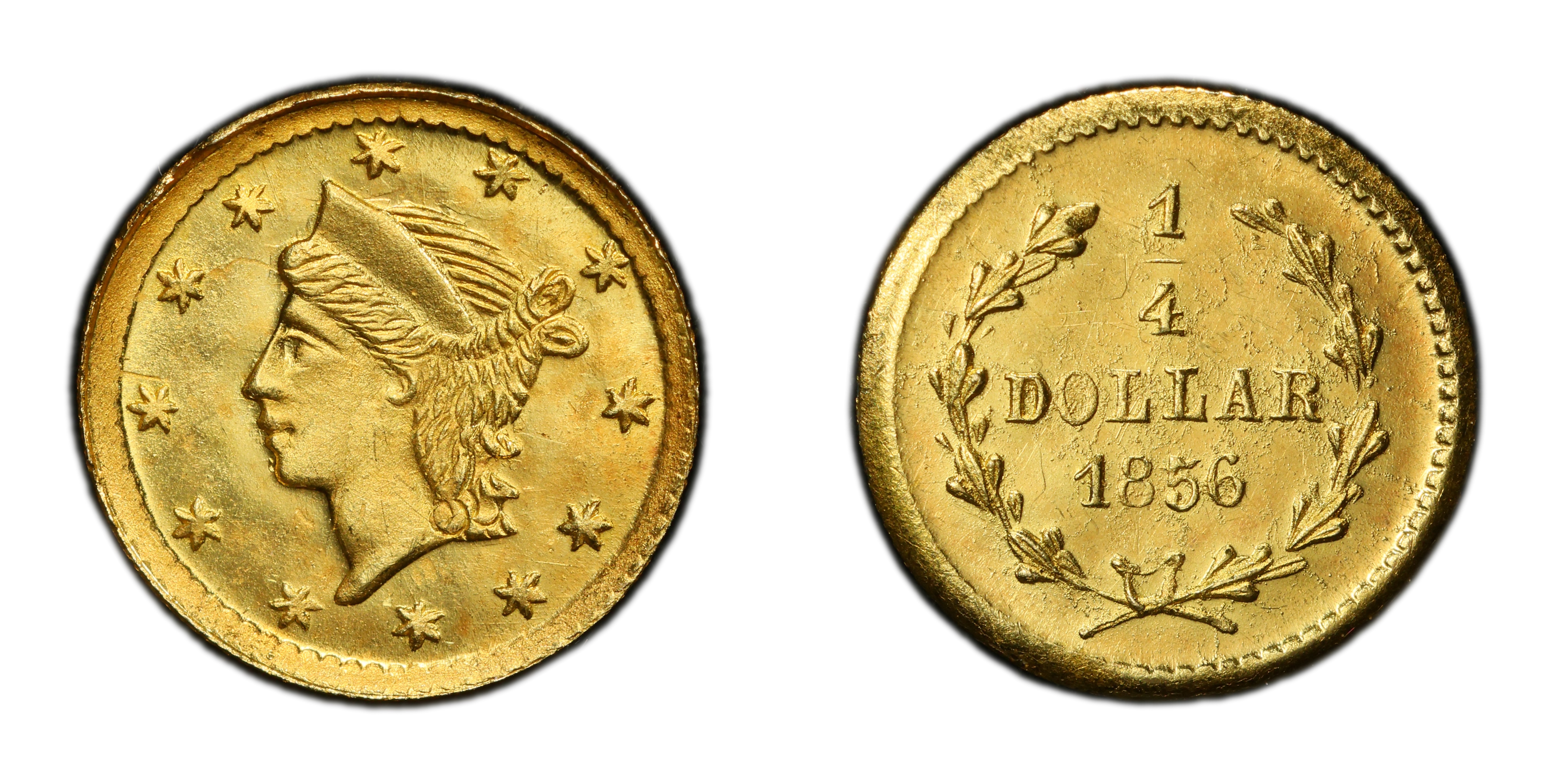
Obverse & Reverse
The 1856 BG-230 quarter dollar is a tangible relic from the chaotic and economically vibrant era of the California Gold Rush. Following the discovery of gold at Sutter's Mill in 1848, a massive influx of over 300,000 people descended upon California, creating an instant and immense demand for goods and services. This explosive population growth, however, was not matched by an adequate supply of circulating coinage, particularly for small, everyday transactions. The nearest U.S. Mint was in Philadelphia, a perilous and time-consuming journey away. While larger private firms like Moffat & Co. began producing five, ten, and twenty-dollar gold pieces, the economy was starved for small change. A pinch of gold dust, an inexact and often contentious method, was the common medium of exchange for minor purchases. To fill this critical monetary void, various jewelers and metalsmiths in San Francisco began striking their own small-denomination coins in 1852. These 'California Fractional Gold' pieces, issued in 25-cent, 50-cent, and one-dollar values, were intended to facilitate commerce. The BG-230 is a 'Period One' issue (1852-1857), a crucial distinction signifying it was produced during the period of genuine commercial need. These early issues were generally made with a high gold content, closely resembling federal issues in design, and were widely accepted in local trade despite being underweight relative to their face value. The production of these fractional pieces began to wane as the new San Francisco Mint, which opened in 1854, ramped up production of official silver and gold coinage by 1856, finally satisfying the region's demand for small change. After this point, the nature of fractional gold changed; 'Period Two' (1859-1882) and later issues were largely produced as souvenirs for tourists and were often debased. The BG-230, as one of the last issues of Period One, represents the closing chapter of this fascinating episode in American monetary history, a private solution to a public economic crisis.
Associated EventCalifornia Gold Rush
Reason For MintingTo alleviate a severe shortage of small-denomination coinage for daily commercial transactions in Gold Rush-era California.
Minter HistoryThe specific minter of the BG-230 variety is not definitively known, a common trait for many California Fractional Gold issues. These coins were produced by a number of competing jewelers and artisans located in San Francisco who possessed the skills for die-sinking and striking. These private minters operated outside of federal authority, responding directly to the market's needs. Their work was often anonymous, though some pieces bear initials or symbols of known makers like Deriberpe, Nouizillet, Frontier, and Deviercy. The lack of a specific maker's mark on BG-230 is typical of the period, where the coin's utility and acceptance were based more on its gold content and recognizable form than on the reputation of a specific assayer.
Historical SignificanceThe BG-230 and its fellow Period One fractional gold coins are historically significant as a prime example of private currency filling a vacuum left by the federal government. They are a direct monetary byproduct of the Gold Rush, demonstrating the ingenuity and adaptability of commerce on the American frontier. Their existence highlights the severe logistical challenges of the era and their eventual replacement by official U.S. Mint coinage marks the economic maturation and integration of California into the United States.
BG-230
Denomination25 Cents
Minting Period1856
Assayer/MinterUnknown San Francisco Jeweler
Geographic OriginSan Francisco, California
Obverse DescriptionThe obverse features a bust of Liberty facing left, her hair tied in a bun. She is surrounded by thirteen stars, representing the original colonies. The date '1856' appears below the bust. The design is a miniature version of the Liberty Head motif found on contemporary U.S. gold coins.
Obverse Inscription1856
Reverse DescriptionThe reverse design consists of a wreath of two olive branches tied with a bow at the bottom. Inside the wreath is the denomination '25 CENTS'. The inscription 'CALIFORNIA GOLD' appears along the upper periphery, outside the wreath.
Reverse InscriptionCALIFORNIA GOLD 25 CENTS
CompositionGold
Stated Fineness Actual FinenessPeriod One issues are generally of high-purity gold, often around .880 to .900 fine, consistent with native California gold which contained a natural silver alloy.
EdgePlain
Unknown
Survival Estimate76-200 coins
Rarity ScaleR-4- to R-5. Numismatic references vary, with some listing it as R-4- (161-200 known) and others as high as R-5 (47-63 known). A consensus suggests it is a very scarce variety.
The BG-230 is highly sought after as a genuine 'Period One' circulating issue, representing the last year of this important period. Its appeal lies in its direct connection to the California Gold Rush, its status as a private territorial issue, and the challenge of collecting the over 500 Breen-Gillio varieties. It is an affordable entry point into the world of territorial gold compared to the larger denominations.
Key VarietiesThere are no major, widely recognized varieties of the BG-230 itself struck during 1856. Unlike some other territorial issues, there are no known later-date Proof restrikes or special collector strikings associated with this specific Breen-Gillio number.
Authentication TipsGenuine Period One pieces like the BG-230 are almost always denominated (e.g., '25 CENTS' or 'DOLLAR'). Be wary of pieces that lack a denomination, as these are often later souvenir tokens. The style should be consistent with mid-19th century minting; details may be soft, but the engraving is typically finer than on crude, modern replicas. Period One coins were struck in gold, not gold-plated base metal. Precise weight can be a key diagnostic, though it varies; they are typically underweight for their face value but should not feel suspiciously light. Authentication by a major third-party grading service (PCGS or NGC) is highly recommended.
Shopping ConsiderationsWhen acquiring an 1856 BG-230, look for a specimen with a sharp, well-defined strike, which is uncommon as many were weakly struck, particularly in the center of the obverse on Liberty's head. Premium quality examples will retain some original mint luster, often described as having a 'hazy' or 'green-gold' appearance due to the natural silver alloy. Check for common problems such as harsh cleanings, which will appear as fine, parallel hairlines, or jewelry mounting damage. A single, honest abrasion on the cheek is not uncommon and may be acceptable, but extensive surface marks will detract significantly from the value and eye appeal. Coins with original, unmolested surfaces command a significant premium.
A coin's grade is its condition, rated on a 1-70 scale. For rare coins, this is the most critical factor in determining value, as a tiny difference in preservation can mean a huge difference in price.
Relevant Grade TypesAll original 1856 BG-230 coins were struck as business strikes intended for commerce and are found in Circulated (1-58) and Mint State (MS, 60-70) grades. No Proofs were struck during the original minting period, and there are no known later-date Proof restrikes. Any coin described as a 'Proof' would be highly suspect and not a genuine Period One issue.
Mint State CharacteristicsUncirculated examples of BG-230 are characterized by their luster, which is typically satiny and can have a slightly reflective or prooflike quality in the fields. The strike is a key determinant of quality; many are soft in the centers, so a sharply struck Liberty Head is rare and desirable. Due to the softness of the gold and rudimentary handling, it is common to find small contact marks, even on high-grade Mint State examples. A small planchet flaw or a single abrasion on Liberty's cheek can be grade-defining.
Circulated Wear PatternsWear first appears on the highest points of the design. On the obverse, look for flattening on Liberty's hair bun and cheekbone. On the reverse, the high points of the wreath's leaves and the bow will show the first signs of friction. In lower grades (VF and below), the finer details of the hair and leaves will merge, and the legends will begin to soften.
Key Factors For ValueFor the BG-230, the primary value drivers are grade and surface quality. An example with original, lustrous 'skin' is far more valuable than a harshly cleaned or polished one of the same grade. Strike quality is paramount; a coin with a full strike will command a substantial premium over a weakly struck counterpart. Eye appeal, driven by attractive original color and minimal distracting marks, is crucial. Finally, a CAC sticker, indicating premium quality for the grade, will add a significant premium, as discerning collectors highly prize quality-verified examples in this series.
PCGS Price Guide
| Grade | Price | Population |
|---|---|---|
| 45 | $260.00 | 1 |
| 45+ | $265.00 | N/A |
| 50 | $270.00 | N/A |
| 50+ | $275.00 | N/A |
| 53 | $280.00 | 1 |
| 53+ | $285.00 | N/A |
| 55 | $290.00 | 6 |
| 55+ | $295.00 | N/A |
| 58 | $300.00 | 16 |
| 58+ | $305.00 | N/A |
| 60 | $315.00 | 3 |
| 61 | $350.00 | 11 |
| 62 | $375.00 | 33 |
| 62+ | $400.00 | N/A |
| 63 | $450.00 | 48 |
| 63+ | $475.00 | N/A |
| 64 | $600.00 | 24 |
| 64+ | $800.00 | N/A |
| 65 | $1,750.00 | 5 |
| 65+ | $2,000.00 | N/A |
| 66 | $3,250.00 | N/A |