1852 G50C BG-407 (Regular Strike)
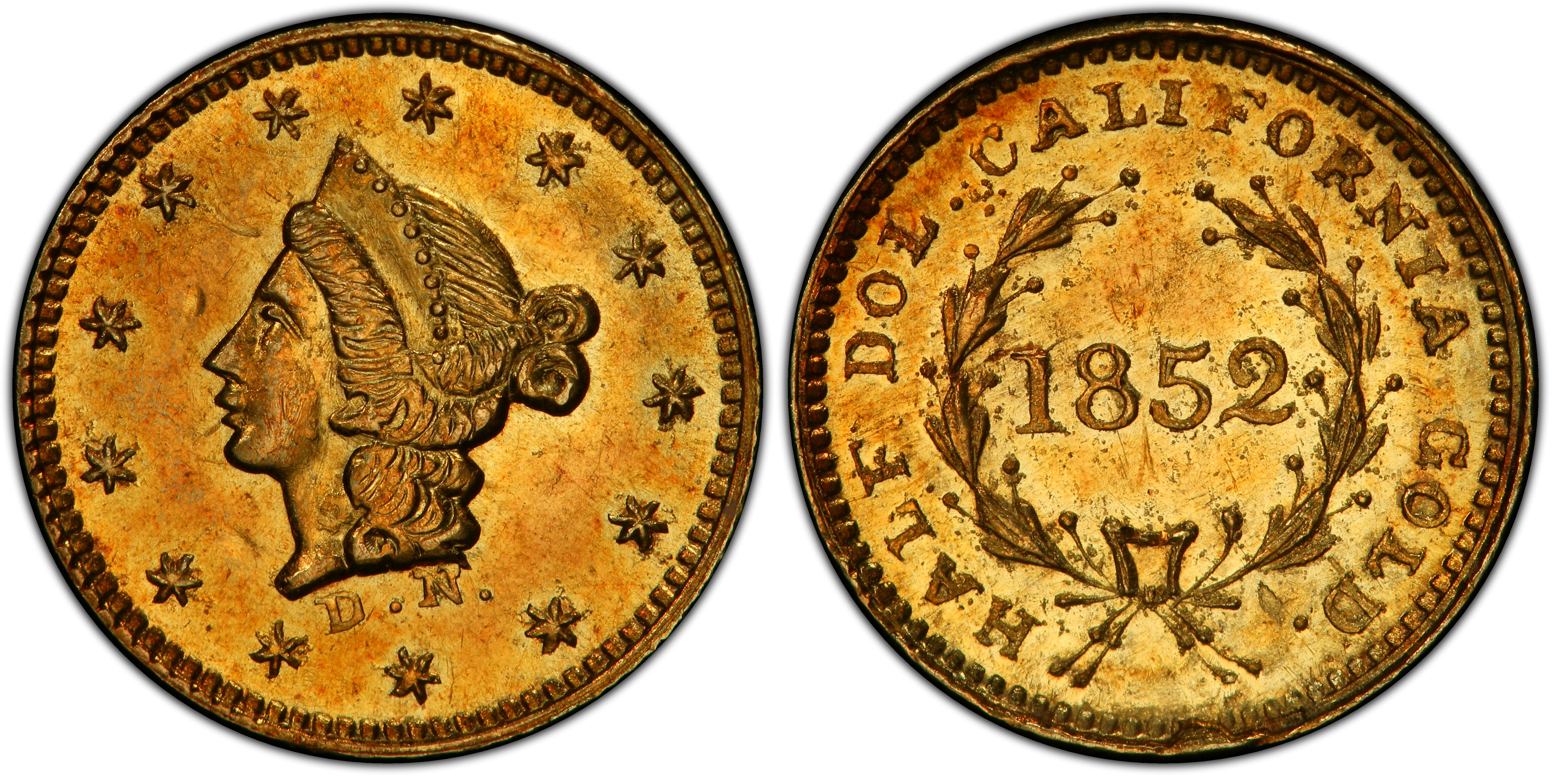
Obverse & Reverse
The 1852 Liberty Head 50 Cents, cataloged as Breen-Gillio 407, stands as a tangible relic from the chaotic and economically vibrant apex of the California Gold Rush. Following the discovery of gold at Sutter's Mill in 1848, a massive influx of prospectors and merchants flooded into California, creating a booming economy almost overnight. However, this rapid growth far outpaced the supply of official United States coinage, leading to a severe, debilitating shortage of small change. Commerce was often conducted with pinches of gold dust, a highly imprecise and contentious method. Private assayers and minters like Moffat & Co. and Wass, Molitor & Co. addressed the need for larger denomination coins, but the critical lack of fractional currency for everyday transactions—paying for a meal, a drink, or small goods—persisted. Into this void stepped a number of San Francisco jewelers and artisans, who, beginning in 1852, began striking their own small-denomination gold coins. These pieces, now known as 'Period One' California Fractional Gold, were intended for actual circulation and were generally made with a high gold content to inspire public trust. The BG-407 is a fascinating example of the collaborative, and sometimes confusing, nature of this private enterprise. Numismatic analysis, notably by Walter Breen and Ronald Gillio, suggests a 'muling' of dies from different makers. The obverse, featuring a distinctive 'Narrow Liberty head' design, is attributed to the firm of Frontier & Deviercy. The reverse, however, bears the small initials 'D.N.' below the bust, which are believed to represent the short-lived partnership of M. Deriberpie and Antoine Louis Nouizillet, both French jewelers active in San Francisco. This suggests either a transfer of dies between firms or that one entity produced the coins using dies created by others. These tiny gold pieces circulated out of sheer necessity, readily accepted by a commerce-starved public despite their unofficial status. Their production ceased around 1856-1857 as the newly established San Francisco Mint began to issue sufficient quantities of federal silver and gold coinage, rendering the private issues obsolete. Today, the BG-407 is prized not only for its rarity but as a direct link to the ingenuity and desperation that characterized one of America's most transformative economic periods.
Associated EventCalifornia Gold Rush
Reason For MintingTo alleviate a severe shortage of small-denomination circulating coinage for daily commerce in Gold Rush-era California.
Minter HistoryThe BG-407 is linked to multiple San Francisco jewelers. The obverse die is attributed to Pierre Frontier and Eugene Deviercy (Frontier & Deviercy), who were active from 1852-1856. The prominent 'D.N.' on the obverse is attributed to M. Deriberpie and Antoine Louis Nouizillet, French jewelers who were briefly in partnership. These artisans were central figures in the production of Period One fractional gold, creating the necessary tools and dies to convert raw gold dust into functional currency for the region's booming population before the San Francisco Mint became fully operational.
Historical SignificanceThis coin is historically significant as a direct product of the economic chaos of the California Gold Rush, representing a private solution to a government failure in supplying adequate currency. It is a prime example of a Period One fractional gold piece, struck with the intent to circulate and facilitate commerce, unlike many later issues which were made as souvenirs. The muling of dies from different makers provides a fascinating insight into the collaborative and competitive environment of San Francisco's private minters.
N/A
Denomination50 Cents
Minting Period1852
Assayer/MinterAttributed to Frontier & Deviercy (obverse die) and Deriberpe & Nouizillet (reverse die)
Geographic OriginSan Francisco, California
Obverse DescriptionThe obverse features the 'Narrow Liberty head' design attributed to Frontier & Deviercy. A bust of a female figure representing Liberty faces left, her hair tied in a bun. She wears a coronet, though the inscription 'LIBERTY' is not present. The portrait is surrounded by thirteen six-pointed stars. Below the bust are the initials 'D.N.' (for Deriberpie & Nouizillet).
Obverse InscriptionD.N.
Reverse DescriptionThe reverse is dominated by a wreath composed of two branches tied together at the bottom with a ribbon. The date, '1852', is located in the center of the wreath. The inscription 'CALIFORNIA GOLD' follows the upper curvature of the coin, outside the wreath, while the denomination 'HALF DOL.' is inscribed along the lower curvature.
Reverse InscriptionCALIFORNIA GOLD / HALF DOL. / 1852
CompositionGold
Stated Fineness Actual FinenessTypically .800 to .900, using native California gold which contained significant amounts of silver.
Weight0.83 grams
Diameter11.50 mm
EdgePlain
Unknown
Survival EstimateFewer than 100 known. Population reports from PCGS and NGC combined show approximately 60-70 examples graded.
Rarity ScaleR-5 (31-75 Known). Some sources, notably Greysheet, list it as R-4 (76-200 Known), but auction records and population data increasingly support the higher rarity.
The BG-407 is highly sought after as a representative of the earliest, circulating California Fractional Gold. Its appeal lies in its direct connection to the Gold Rush, the unusual muling of dies from different makers (Frontier & Deviercy and Deriberpe & Nouizillet), and its relative scarcity. The simple, classic Liberty Head design makes it a favorite among type collectors.
Key VarietiesNo major die varieties of the BG-407 are widely recognized or collected. Period One fractional gold coins were business strikes and no proofs were made. There are no known official restrikes. Some dealer listings have used the term 'pattern,' but this appears to be a marketing embellishment rather than a formal numismatic designation, as there is no evidence of trial pieces for this variety.
Authentication TipsGenuine examples are struck in gold, not brass or gilt base metal. The dies were hand-cut, so the details, while sharp on high-grade examples, lack the uniformity of federal coinage. Look for characteristic traces of die rust within the fields, a known diagnostic for this variety. The 'D.N.' initials should be clear and correctly formed. Counterfeits are often soapy in appearance, have incorrect weights, or may display incorrect design details, such as the wrong number or style of stars.
Shopping ConsiderationsA premium quality example of BG-407 is defined by a sharp, well-centered strike. Look for strong details in Liberty's hair and the leaves of the wreath. Many specimens exhibit prooflike or semi-prooflike fields, which command a significant premium. Traces of original die rust are a positive indicator of authenticity and originality. The surfaces should be clean and free of distracting marks, cleaning, or jewelry mounting evidence. Rich, original reddish-gold or orange-gold toning is highly desirable and adds to eye appeal. Given the coin's small size, even minor surface impairments can be magnified, so careful inspection is crucial.
A coin's grade is its condition, rated on a 1-70 scale. For rare coins, this is the most critical factor in determining value, as a tiny difference in preservation can mean a huge difference in price.
Relevant Grade TypesAll original BG-407 coins are business strikes, intended for circulation. They are found in Circulated grades (AG-3 to AU-58) and Mint State grades (MS-60 to MS-70). No proofs were struck during the original minting period, and there are no known later-date proof restrikes. Coins described as 'Prooflike' (PL) are business strikes with highly reflective fields, not a special striking.
Mint State CharacteristicsUncirculated examples of BG-407 are known for an unusually sharp strike compared to many other fractional gold issues. The fields are often semi-prooflike or fully prooflike, with a distinct contrast against the frosted devices. Luster is typically bright and satiny. Common, acceptable imperfections include minor planchet flaws and faint traces of die rust in the fields, which are characteristic of the issue and do not necessarily detract from the grade if minimal.
Circulated Wear PatternsWear first appears on the highest points of the design. On the obverse, this includes Liberty's cheek, the hair above her eye, and the bun. On the reverse, the high points of the wreath's leaves and the bow will show the first signs of friction. In lower grades (Fine and below), the stars on the obverse will begin to lose their sharpness and the finer details of the wreath will merge.
Key Factors For ValueThe primary value driver is grade, with a sharp increase for Mint State examples, especially those with the Prooflike designation. Beyond the numerical grade, surface quality is paramount; examples with clean, original, lustrous surfaces will always command a premium over those that have been cleaned, polished, or repaired. Strike quality is also key; a coin with a full, sharp strike on both sides is more desirable than a weakly struck example in the same grade. Finally, eye appeal, driven by attractive original toning and prooflike contrast, can add a significant premium. A CAC sticker for this issue is highly valued as confirmation of quality for the assigned grade.
PCGS Price Guide
| Grade | Price | Population |
|---|---|---|
| 50 | N/A | N/A |
| 53 | $300.00 | 3 |
| 53+ | $325.00 | N/A |
| 55 | $350.00 | 10 |
| 55+ | $375.00 | N/A |
| 58 | $400.00 | 31 |
| 58+ | $425.00 | N/A |
| 60 | $500.00 | 1 |
| 61 | $575.00 | 5 |
| 62 | $650.00 | 35 |
| 62+ | $700.00 | N/A |
| 63 | $950.00 | 18 |
| 63+ | $1,100.00 | N/A |
| 64 | $1,650.00 | 3 |