No Date G25C BG-209A (Regular Strike)
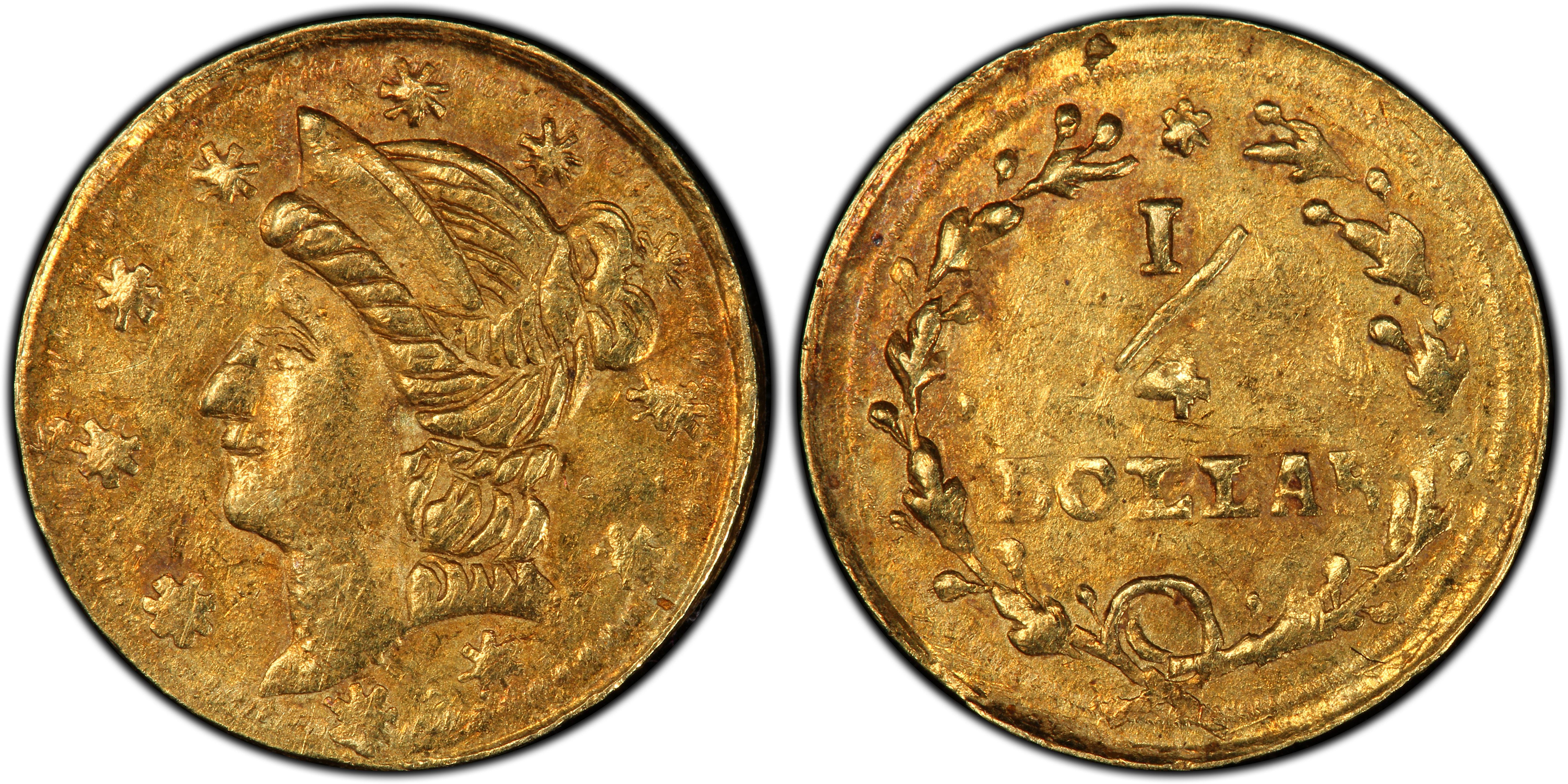
Obverse & Reverse
The No Date Quarter Dollar, cataloged as Breen-Gillio 209A, is a fascinating and extremely rare artifact from the chaotic, formative years of the California Gold Rush. Its story is intrinsically linked to the severe shortage of circulating small change that plagued the booming economy of San Francisco in the early 1850s. While the region was awash in raw gold dust and large-denomination private ingots, the simplest daily transactions were crippled by the absence of federal silver and copper coins. This monetary vacuum prompted local entrepreneurs, primarily jewelers and metallurgists, to fill the void. Among these were the Frenchmen Pierre Frontier and Eugene Deviercy, who operated a jewelry business and private mint. They produced a variety of small-denomination gold pieces, including this Liberty Head quarter dollar, to facilitate commerce. These 'Period One' fractionals (1852-1857) were not mere tokens, but were intended to, and did, circulate as money, albeit unofficially. The BG-209A is a product of the crude but functional minting technology of the day, likely struck by hand using a drop hammer press. The planchets were cut from gold strips of varying thickness and fineness, leading to inconsistent weights and strikes. This specific variety, lacking a date, is a testament to the expediency of production. The public's reception of fractional gold was mixed; while useful, the pieces were tiny, easily lost, and often underweight, leading to mistrust. By 1857, the arrival of sufficient quantities of federal coinage from the newly established San Francisco Mint rendered these private issues obsolete for circulation. Many were melted, lost, or kept as souvenirs, contributing to their immense rarity today. The BG-209A, with its unique 'No Date' feature and questionable composition, stands as a numismatic enigma, representing a brief, exuberant period of monetary improvisation on the American frontier.
Associated EventCalifornia Gold Rush
Reason For MintingTo alleviate a severe shortage of small-denomination coinage for daily commercial transactions in Gold Rush-era San Francisco.
Minter HistoryFrontier, Deviercy & Co. was a partnership of two French jewelers, Pierre Frontier and Eugene Deviercy, active in San Francisco during the Gold Rush. Like several other French expatriate jewelers (such as Antoine Louis Nouizillet and Deriberpe), they leveraged their metallurgical skills to meet the region's desperate need for small change. They operated from approximately 1852 to 1856, producing a range of fractional gold coins in 25-cent, 50-cent, and one-dollar denominations, in both round and octagonal shapes. Their issues are identified by the initials 'F.D.' on some varieties, though many, like the BG-209A, are unattributed by mark but identified by die characteristics. Their operation ceased as the San Francisco Mint ramped up production of federal coinage, making private issues no longer necessary or profitable.
Historical SignificanceThis coin is a tangible remnant of a period of private, localized currency production driven by necessity. It represents a solution to an economic crisis and highlights the entrepreneurial spirit of the Gold Rush. As a 'Period One' issue, it was intended for actual circulation, unlike later souvenir pieces, making it a crucial piece of evidence in the study of early California's economic history.
K-Unlisted
Denomination25 Cents
Minting Periodc. 1853
Assayer/MinterFrontier, Deviercy & Co.
Geographic OriginSan Francisco, California
Obverse DescriptionA crudely rendered head of Liberty facing left, her hair tied in a bun. The portrait is surrounded by ten five-pointed stars. The overall execution is typical of the early, rushed production of fractional gold, often showing a soft strike.
Obverse Inscription Reverse DescriptionA simple wreath composed of two branches tied with a bow at the bottom. Within the wreath is the denomination '1/4'. Outside the wreath, at the top, is the legend 'CALIFORNIA GOLD'.
Reverse InscriptionCALIFORNIA GOLD 1/4
CompositionGold, possibly of low fineness or gold-plated.
Stated Fineness Actual FinenessThe composition of BG-209A is noted as suspect in numismatic literature. The closely related variety, BG-209B, is known to be thinly gold-plated over a base metal or very low-grade gold planchet. While BG-209A has not been definitively tested and reported, collectors should be aware that it might not be of high-purity gold.
Weight0.30 grams
Diameter10.00 mm
EdgePlain
Extremely Low
Survival EstimateFewer than 10
Rarity ScaleR-7 (4 to 12 known)
The BG-209A is a highly coveted numismatic rarity due to its status as a 'Period One' fractional intended for circulation, its extreme rarity, and its unique 'No Date' obverse. It appeals to specialists in territorial gold and collectors who appreciate the raw, historical nature of Gold Rush coinage.
Key VarietiesThe primary variety is the BG-209, which bears the date 1853. The BG-209A is the 'No Date' variety. The BG-209B is a related issue, also without a date, which is known to be gold-plated. No later-date restrikes or special collector issues are known for this specific die marriage.
Authentication TipsAuthenticity is paramount. Genuine Period One fractionals are characteristically very thin. The strike is often weak in areas, particularly in the center or on peripheral lettering, a feature rarely seen on modern replicas which tend to have sharp, uniform strikes. The lettering style should be hand-cut and slightly irregular. The surfaces of genuine pieces often have a slightly wavy or uneven quality due to crude planchet preparation and striking. Replicas are often thicker, have a soapy or prooflike luster, and may feature a bear on the reverse, which is a fantasy element never found on genuine denominated issues.
Shopping ConsiderationsWhen acquiring a BG-209A, third-party certification by PCGS or NGC is essential. Given its R-7 rarity, any available specimen is a major acquisition. A 'premium quality' example would be one that, despite the typically crude strike, shows clear details on Liberty's portrait and the reverse denomination. Look for original, uncleaned surfaces with a hint of reddish-gold patina. Avoid examples that are bent, holed, or show signs of being mounted in jewelry, as was common. Pay close attention to the planchet's integrity and avoid pieces with significant laminations or edge splits. Given the questions about its composition, the coin's value lies in its historical rarity rather than its intrinsic metal content.
A coin's grade is its condition, rated on a 1-70 scale. For rare coins, this is the most critical factor in determining value, as a tiny difference in preservation can mean a huge difference in price.
Relevant Grade TypesOriginal period issues were business strikes intended for circulation and are found in Circulated (1-58) and Mint State (MS, 60-70) grades. Due to their brief time in commerce and subsequent use as keepsakes, many survivors are in high circulated or even Uncirculated condition. No Proofs were struck during the original period of issue, and no later-date Proof restrikes of this variety are known to exist.
Mint State CharacteristicsAn uncirculated BG-209A will still exhibit the manufacturing characteristics of the type. The strike is almost always weak, particularly on Liberty's cheek and hair details, and on the '1/4' on the reverse. Luster on these pieces is typically subdued and satiny rather than bright and flashy. Small planchet flaws, such as tiny laminations or adjustment marks, are common and generally accepted. Contact marks may be present but should not be overly distracting from the main design elements.
Circulated Wear PatternsWear first appears on the highest points of the design: Liberty's cheek, the high strands of her hair above the ear, and the leaves of the wreath on the reverse. On more worn examples, the stars on the obverse and the letters in 'CALIFORNIA GOLD' will begin to lose their sharpness and merge with the fields. In lower grades (VF and below), the denomination '1/4' can become faint.
Key Factors For ValueFor the BG-209A, rarity is the primary value driver. Beyond that, surface preservation is key; an example with original, uncleaned 'skin' commands a significant premium over one that has been harshly cleaned or polished. Strike quality is a major consideration; a coin that is better-struck than average for the variety, showing more facial detail or a clearer denomination, is highly desirable. Finally, eye appeal, which encompasses toning and the absence of distracting marks or planchet flaws, plays a significant role. A CAC sticker would provide strong confirmation of quality for the assigned grade.
PCGS Price Guide
| Grade | Price | Population |
|---|---|---|
| 61 | $22,500.00 | 1 |
| 62 | $27,500.00 | N/A |
| 62+ | $32,500.00 | N/A |
| 63 | $45,000.00 | 1 |