1853 G$1 BG-521 (Regular Strike)
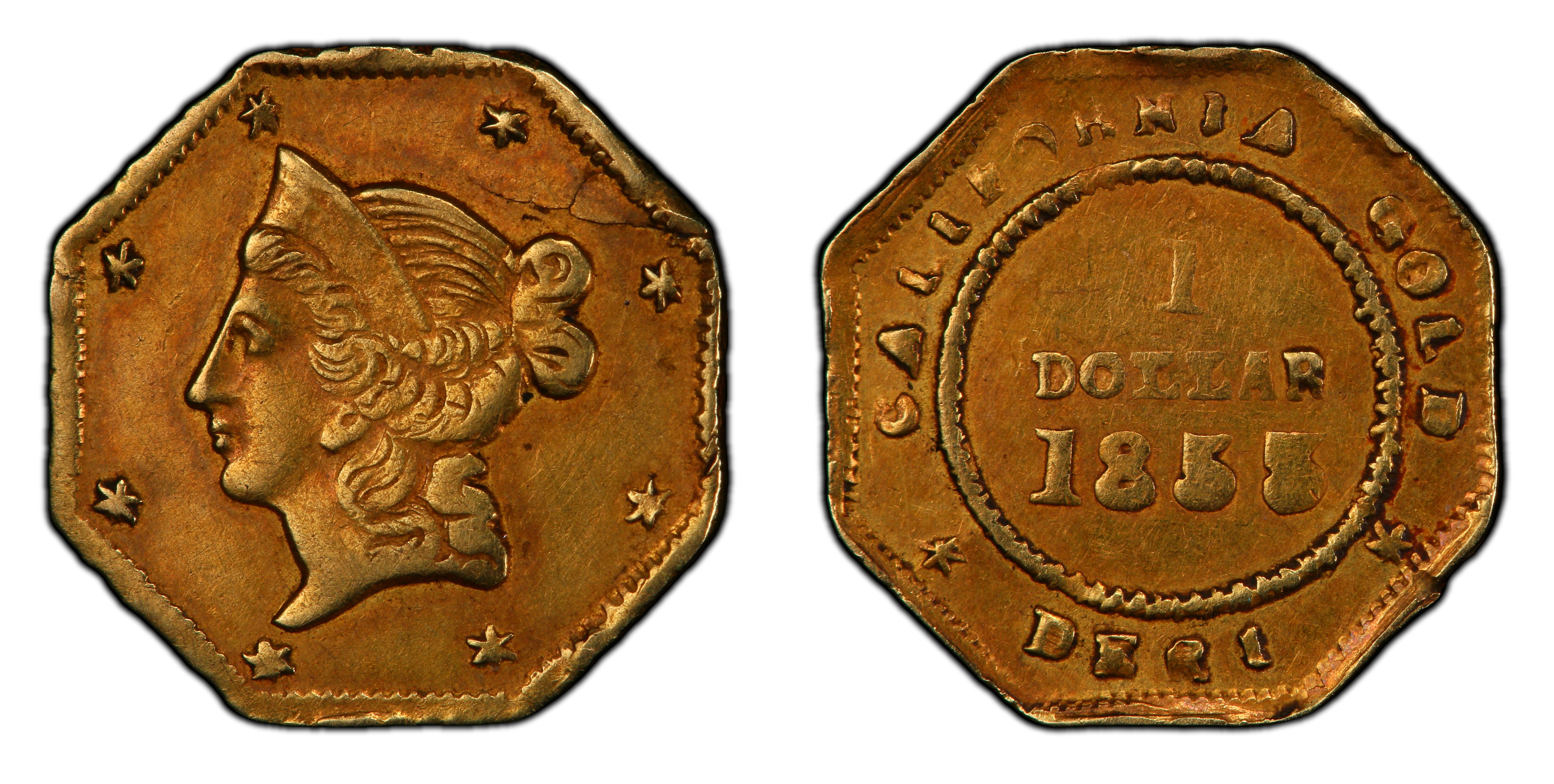
Obverse & Reverse
The 1853 BG-521 One Dollar piece emerged from the chaotic and economically vibrant crucible of the California Gold Rush. Following the discovery of gold at Sutter's Mill in 1848, a massive influx of prospectors and merchants descended upon the region, creating a dynamic, yet unstable, economy. The primary medium of exchange was gold dust, which was inconvenient, prone to spillage, and difficult to value accurately for small, everyday transactions. While the U.S. government was slow to establish an official branch mint in San Francisco (which it did in 1854), private minters stepped in to fill the void, producing a variety of coins from raw gold dust. However, even the smallest official U.S. gold coin, the dollar, was too large for minor purchases like a loaf of bread or a drink. This created an acute need for small-denomination currency, a need fulfilled by jewelers and assayers who began striking fractional gold pieces in quarter dollar, half dollar, and one dollar sizes. These were not official U.S. coins but privately issued tokens whose value was derived from their gold content. The BG-521 is a prime example of this genre. Attributed to Antoine Louis Nouizillet, a French-born die-sinker and jeweler active in San Francisco, this piece features a distinctive eagle design. The 'Period One' California fractional gold pieces, minted from 1852 to 1857, were generally made with care and contained gold of relatively high purity, intended to circulate and facilitate local commerce. Their production was a direct market response to the failure of government coinage to meet the practical needs of the frontier economy. These tiny coins were widely used until the establishment of the San Francisco Mint and subsequent federal legislation in 1864, which prohibited the private issuance of coinage, eventually pushed them out of circulation. Today, they are cherished as tangible relics of the Gold Rush, representing the ingenuity and entrepreneurial spirit that defined the era.
Associated EventCalifornia Gold Rush
Reason For MintingTo satisfy the extreme commercial need for small-denomination coinage for everyday transactions in an economy saturated with high-value gold dust.
Minter HistoryAntoine Louis Nouizillet was a prominent French engraver, diesinker, and jeweler who arrived in San Francisco during the Gold Rush. He is believed to be the craftsman behind several of the most artistically accomplished early fractional gold designs, including those with the eagle motif. Though his name does not appear on the coins, stylistic analysis and historical records connect him to their creation. His work is noted for its higher quality and more refined engraving compared to some of the cruder pieces of the era. Nouizillet's business likely operated as both a jewelry store and a private mint, converting customers' gold dust into these practical and transportable coins.
Historical SignificanceThe BG-521, like other 'Period One' fractional gold pieces, is historically significant as a direct monetary solution to a problem unique to the Gold Rush economy. It represents the private sector's role in creating a functional currency system in the absence of adequate federal infrastructure. These coins are a physical testament to the daily economic life of miners, merchants, and settlers in mid-19th century California.
N/A
DenominationG$1
Minting Period1853
Assayer/MinterProbably by Antoine Louis Nouizillet
Geographic OriginSan Francisco, California
Obverse DescriptionA heraldic eagle with outstretched wings, head turned to its right. A shield is emblazoned on its breast. The eagle clutches an olive branch in its right talon and arrows in its left. Thirteen stars are arranged above the eagle's head.
Obverse InscriptionCALIFORNIA GOLD
Reverse DescriptionThe denomination '1' is centered, surrounded by a wreath of two oak branches tied together with a bow at the bottom. The date is below the bow.
Reverse Inscription1 / DOLLAR / 1853
CompositionGold
Stated Fineness Actual FinenessApproximately .875 to .900 fine, consistent with many Period One issues.
Weight0.97 grams
Diameter13.90 mm
EdgePlain
Unknown
Survival Estimate50-75
Rarity ScaleR-6 (31-75 Known)
The BG-521 is highly prized for its large size (for a fractional), its classic and attractive Eagle design, its status as a genuine 'Period One' circulating issue, and its direct connection to the height of the California Gold Rush. Its R-6 rarity ensures it is a significant prize for specialists.
Key VarietiesThis is a 'Regular Strike' from the original minting period (1853), intended for circulation. No major varieties are widely recognized for the BG-521 die marriage itself. It is crucial to distinguish these original issues from later 'Period Two' (1858-1882) souvenir pieces, which were made for the tourist and jewelry trade and are typically smaller, thinner, and of lower gold content. No known proof restrikes or patterns exist for this specific variety.
Authentication TipsGenuine BG-521 pieces have a specific 'die state' and strike character. Look for sharp, well-defined details on the eagle's feathers and the leaves in the wreath, though some central weakness is common. The numerals of the date should match known exemplars precisely in style and position. Counterfeits are often cast, showing a porous or soapy surface texture, or are struck from incorrect dies with poorly rendered details. Weight and diameter are key; originals should be close to the specified 0.97 grams and 13.9 mm. Any piece that is significantly underweight or has a brassy, unnatural color is suspect.
Shopping ConsiderationsA premium quality example for its grade will possess a sharp strike, especially on the eagle's head and the bow on the reverse wreath, which are often weak. Look for pleasing, original surfaces with some remaining mint luster; a soft, satiny glow is characteristic. Avoid examples that have been harshly cleaned, polished, or used as jewelry, as evidenced by rim damage, solder marks, or excessive scratching. Toning can range from a light yellow-gold to a deeper reddish-orange, with original, attractive color commanding a significant premium. Check carefully for tooling or re-engraving in the fields or on the design elements, as this is sometimes done to 'improve' a coin's appearance but drastically reduces its numismatic value.
A coin's grade is its condition, rated on a 1-70 scale. For rare coins, this is the most critical factor in determining value, as a tiny difference in preservation can mean a huge difference in price.
Relevant Grade TypesOriginal period issues like the BG-521 were business strikes intended for circulation and are found in Circulated (AU-58 and below) and Mint State (MS, 60-70) grades. The vast majority of surviving examples are circulated. No Proof (PR/PF) examples were struck during the original period of issue, and no later-date Proof restrikes of this specific variety are known to exist. Any piece described as a 'Proof' should be regarded with extreme skepticism and is likely a misattribution or a modern fantasy piece.
Mint State CharacteristicsAn uncirculated BG-521 is exceedingly rare. Such a coin would exhibit full mint luster, typically soft and satiny rather than bright and flashy. The strike is often somewhat soft in the centers, so a full strike on the eagle's breast shield and the details of the wreath's bow would be a significant feature. Due to the softness of the gold and the nature of their production, even Mint State examples may show minor planchet flaws or small, light contact marks from handling at the time of minting.
Circulated Wear PatternsWear first appears on the highest points of the design. On the obverse, this is the eagle's head, the upper edge of its wings, and the high points of the shield. On the reverse, the bow and the edges of the wreath leaves will show the first signs of friction. In lower grades (VF and below), the finer feather details and the individual leaves will merge, and the legends and date will begin to lose their sharpness.
Key Factors For ValueFor the BG-521, value is driven by several key factors. Grade is paramount, with Mint State examples carrying an enormous premium. Surface quality is critical; an example with original, uncleaned 'skin' and minimal distracting marks is far more desirable than a cleaned or polished coin of the same grade. Strike sharpness is a major consideration, with well-struck pieces commanding more. Finally, eye appeal, which includes factors like attractive toning and the overall visual harmony of the coin, plays a significant role. A sticker from CAC (Certified Acceptance Corporation) indicates a premium quality coin for its grade and adds a significant premium to its value.
PCGS Price Guide
| Grade | Price | Population |
|---|---|---|
| 50 | $25,000.00 | 1 |
| 50+ | $25,750.00 | N/A |
| 53 | $26,250.00 | N/A |
| 53+ | $26,500.00 | N/A |
| 55 | $27,000.00 | 1 |
| 55+ | $27,500.00 | N/A |
| 58 | $28,500.00 | N/A |
| 58+ | $30,000.00 | N/A |
| 60 | $32,000.00 | N/A |
| 61 | $35,000.00 | N/A |
| 62 | $37,500.00 | N/A |