1853 G$1 BG-604 Eagle (Regular Strike)
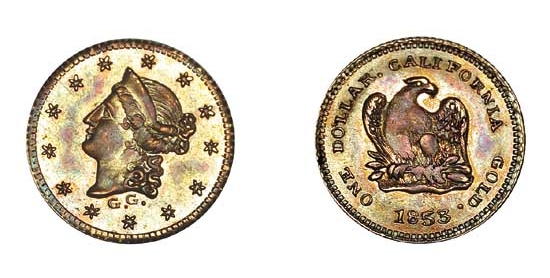
Obverse & Reverse
The 1853 G$1 BG-604 'Crested Eagle' stands as one of the most enigmatic and desirable issues within the entire corpus of U.S. private and territorial coinage. It was born of the acute economic necessity that defined California in the early 1850s. The torrent of humanity drawn by the Gold Rush had created a booming economy, yet the supply of official United States small-denomination coinage was hopelessly inadequate for daily commerce. Gold dust, the primary medium of exchange, was imprecise and prone to waste and theft. Into this monetary vacuum stepped a number of enterprising jewelers and metalsmiths, primarily in San Francisco, who began striking their own small-denomination gold coins. These 'Period One' issues, struck from 1852 to 1857, were generally intended for actual circulation and were made with a good-faith effort to contain a reasonable portion of their face value in gold, unlike the later, debased souvenir issues. The BG-604 is a paramount example of this fascinating period. The identity of its creator, known only by the hallmark 'GG' found on the obverse, is lost to history—a common fate for many of these private minters who operated in a legally gray area and often avoided explicit identification. The coin's design, particularly its distinctive 'Crested Eagle' reverse, suggests a die-sinker of considerable skill, setting it apart from cruder contemporary issues. The incredible rarity of the BG-604, with only two or three examples known to survive, suggests an infinitesimally small original mintage. Perhaps the dies failed quickly, or the minter 'GG' produced only a trial run before ceasing operations. Whatever the reason, its scarcity was established from the outset. These coins likely saw limited circulation before being saved as curiosities. Their modern numismatic significance is immense, representing the pinnacle of rarity in a widely collected series. The finest known specimen, graded PCGS MS-62, was a highlight of the legendary Jay Roe Collection, sold by Bowers and Merena in 2003, cementing its status as a world-class numismatic treasure.
Associated EventCalifornia Gold Rush
Reason For MintingTo alleviate a severe shortage of small-denomination coinage for daily commercial transactions in Gold Rush-era California.
Minter HistoryThe minter of the BG-604 is unknown, identified only by the initials 'GG' punched into the obverse die. Like many private minters of the 1852-1857 period, this individual or firm was likely a San Francisco-based jeweler or artisan with the skill to create dies and the equipment to strike coins. The anonymity was likely intentional, as the legality of private coinage was ambiguous and would be explicitly outlawed by the Coinage Act of April 22, 1864. No definitive historical records have yet surfaced to positively identify 'GG'.
Historical SignificanceThe BG-604 is a tangible artifact of the chaotic and entrepreneurial monetary environment of the California Gold Rush. It represents a private solution to a government failure in supplying adequate currency for a burgeoning economy. Its extreme rarity makes it a key indicator of the ephemeral nature of many of these private minting operations and elevates it to a position of prime numismatic importance, serving as a landmark variety for advanced collectors of Territorial gold.
N/A
DenominationG$1
Minting Period1853
Assayer/MinterUnknown (Hallmark 'GG')
Geographic OriginSan Francisco, California
Obverse DescriptionA well-executed head of Liberty facing left, her hair tied in a bun. She is surrounded by thirteen six-pointed stars. The date, 1853, is below the truncation of the neck. To the left of the date, the minter's hallmark 'GG' is punched into the die.
Obverse InscriptionGG 1853
Reverse DescriptionA distinctive eagle with outstretched wings, head turned to its right. The eagle has a prominent crest of feathers on its head, giving the variety its 'Crested Eagle' nickname. The legend CALIFORNIA GOLD encircles the eagle above, and the denomination DOLLAR is inscribed below.
Reverse InscriptionCALIFORNIA GOLD DOLLAR
CompositionGold
Stated Fineness Actual FinenessNot specifically determined, but Period One issues were typically struck from native California gold, which naturally contained silver, resulting in fineness generally ranging from .800 to .900.
EdgePlain
Extremely small; likely less than 20.
Survival Estimate2-3 known specimens.
Rarity ScaleR-8 (Unique or Nearly Unique)
This coin represents the ultimate rarity in the popular and historically rich field of California Fractional Gold. Its unique 'Crested Eagle' design, mysterious 'GG' hallmark, and near-mythical scarcity make it a centerpiece acquisition for the most advanced collectors of U.S. private and territorial coinage.
Key VarietiesThe BG-604 is a unique variety unto itself. No major variations from the original minting period are known, which is unsurprising given its minuscule mintage. No restrikes, patterns, or trial pieces are known to exist, making any confirmed original specimen an extraordinary treasure.
Authentication TipsAuthentication requires expert examination. Key diagnostics include the precise style and placement of the 'GG' hallmark, the specific die characteristics of the Liberty portrait, and the unique engraving of the 'Crested Eagle' on the reverse. The coin should exhibit the manufacturing characteristics of a Period One fractional, including a somewhat crude but sharp strike from hand-cut dies. The planchet may show parallel striations from the rolling process. Due to its rarity, any new discovery would warrant extreme scrutiny and comparison to the known examples.
Shopping ConsiderationsAcquiring a BG-604 is a once-in-a-generation opportunity. A potential buyer should expect to purchase one of the two or three known examples, likely at a major, named-collection auction. The finest known piece (ex-Jay Roe, PCGS MS-62) sets the standard for quality. A 'premium quality' example would be defined simply by its existence and authenticity. Any buyer must prioritize a clear provenance and certification by a top-tier grading service (PCGS or NGC). Minor planchet flaws or a less-than-perfect strike are to be expected for the issue and would not significantly detract from its immense value. The primary consideration is authenticity, followed by the coin's history and grade.
A coin's grade is its condition, rated on a 1-70 scale. For rare coins, this is the most critical factor in determining value, as a tiny difference in preservation can mean a huge difference in price.
Relevant Grade TypesOriginal examples of BG-604 were business strikes intended for circulation and are found in both Circulated (1-58) and Mint State (MS, 60-70) grades. Given the known population, specimens exist in high grades (MS-62 and AU Details). No Proof (PR/PF) examples were struck during the original period of issue, and no later-date restrikes or special collector strikings are known to exist.
Mint State CharacteristicsAn uncirculated BG-604 would be judged on the sharpness of its strike, particularly on the highest points such as Liberty's hair and the eagle's crest and wing feathers. The luster would likely be satiny rather than deeply frosty, characteristic of privately minted gold of the era. As with all California fractionals, some minor planchet imperfections or adjustment marks made prior to striking would not be unusual. The surfaces, being soft gold, would be highly susceptible to contact marks, making any 'clean' example exceptionally desirable.
Circulated Wear PatternsOn this specific design, wear would first appear on the high points of Liberty's hair above the ear and on her cheek. On the reverse, the highest points of the eagle's head, crest, and the upper portions of the wings would show the first signs of friction. In lower grades (e.g., VF or F), the fine feather details and the individual strands of hair would begin to merge, and the sharpness of the stars and lettering would diminish.
Key Factors For ValueFor a coin of this magnitude, authenticity and provenance are the paramount factors of value. Assuming the coin is genuine, the primary driver is its grade and surface quality. The difference between a problem-free AU and the MS-62 is substantial. An example with original, unmolested surfaces and a sharp strike would command a significant premium. While toning is not a major factor on gold, a piece with attractive, original reddish-gold coloration would be highly prized. A CAC sticker on an existing graded example would provide further elite validation and add a considerable premium.
PCGS Price Guide
| Grade | Price | Population |
|---|---|---|
| 62 | $115,000.00 | 1 |
| 63 | N/A | N/A |