1873 G25C BG-727 (Regular Strike)
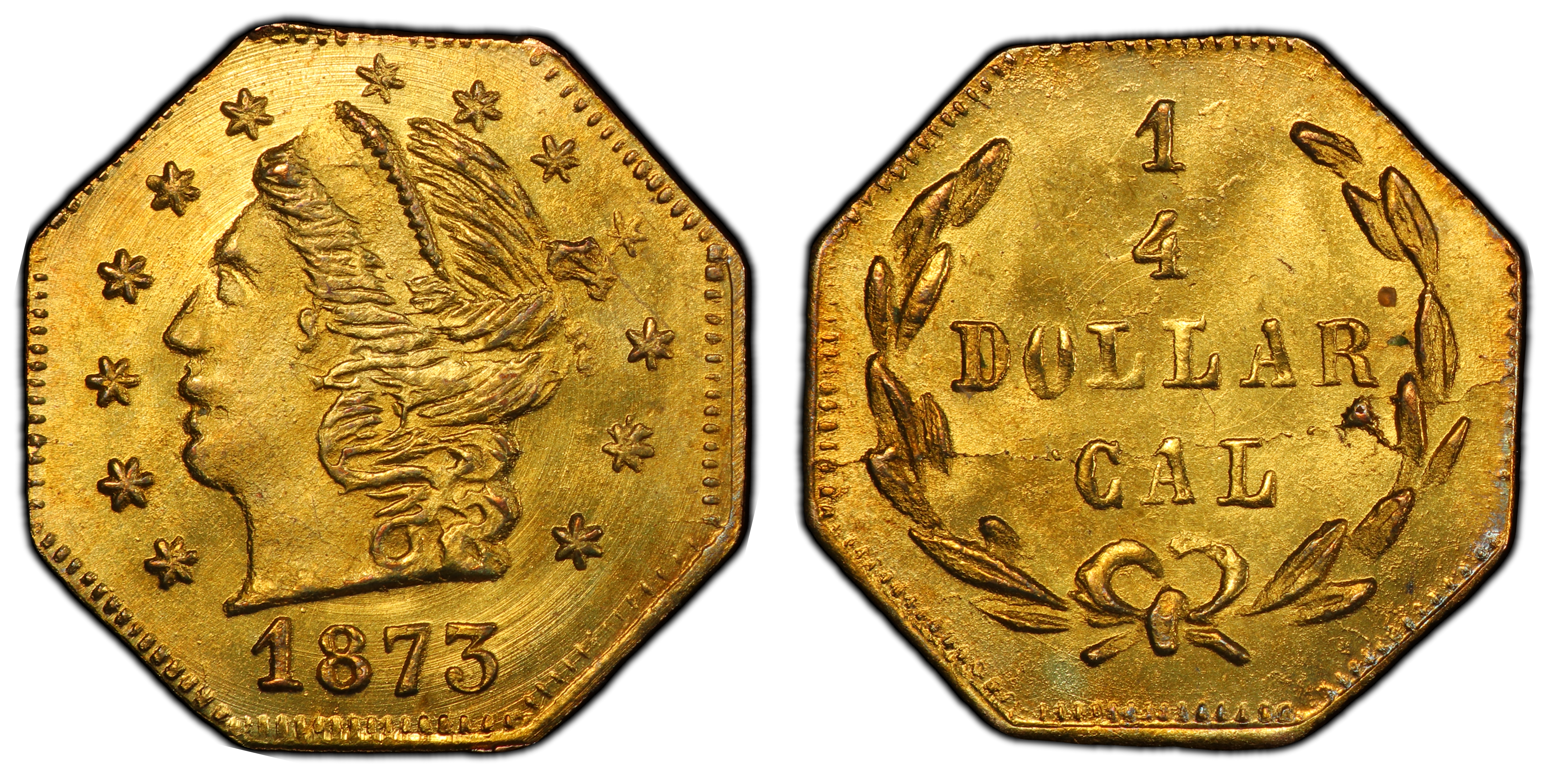
Obverse & Reverse
The 1873 G25C BG-727 octagonal 25-cent piece emerged from the third distinct period of California Fractional Gold production (1872-1882). By this era, the initial, desperate need for small denomination coinage that characterized the Gold Rush aftermath had subsided. The United States Mint in San Francisco was fully operational, and federal coinage was more readily available. However, a different market had developed for these miniature gold pieces: the souvenir and jewelry trade. While the earlier issues of the 1850s were intended to, and did, circulate to alleviate a chronic shortage of small change, the pieces from the 1870s and 80s were largely created as mementos of the California Gold Rush. They were popular with tourists and locals alike, often incorporated into rings, pins, and watch fobs. This particular variety, cataloged by Walter Breen and Ron Gillio as BG-727, was struck in 1873. The identity of the specific private minter is lost to history, a common trait for this series, as many were produced by jewelers who operated without prominent mintmarks. These pieces were manufactured in workshops, likely using manual screw presses or even simple hammer-striking methods, which accounts for the variability in strike quality. The legal environment was also precarious; an 1864 federal law prohibited private coinage, but its enforcement against these small, low-value 'tokens' was inconsistent. Many producers circumvented the law by omitting the word 'DOLLAR' or 'DOL,' though this variety explicitly includes 'CENTS.' Despite their primary role as keepsakes, their gold content gave them intrinsic value, and they undoubtedly saw some limited use in small-scale transactions, continuing a uniquely Californian numismatic tradition long after its original purpose had faded.
Associated EventPost-Gold Rush California economic development
Reason For MintingPrimarily created to satisfy the demand for souvenirs and jewelry items, rather than to alleviate a coinage shortage as earlier issues had.
Minter HistoryThe specific minters of most Period Three California Fractional Gold, including BG-727, are unknown. They were typically jewelers and metalworkers located in San Francisco who produced these small items for the robust souvenir market. Unlike the prominent assayers of the 1850s (e.g., Moffat & Co., Wass, Molitor & Co.), these later producers operated on a smaller, more anonymous scale, leaving behind no detailed records of their operations or mintages.
Historical SignificanceThe BG-727 represents the evolution of California Fractional Gold from a necessary circulating medium to a commercial souvenir. It is a tangible link to the romanticized memory of the Gold Rush and the burgeoning tourism industry of 19th-century California. Its existence highlights a numismatic gray area where privately-issued tokens with intrinsic value continued to be produced and used, despite federal prohibitions.
N/A
Denomination25 Cents
Minting Period1873
Assayer/MinterUnknown, likely various San Francisco jewelers
Geographic OriginSan Francisco, California
Obverse DescriptionA Liberty Head motif, similar in style to contemporary U.S. gold coinage but cruder in execution. The head faces left, adorned with a coronet, and is surrounded by thirteen stars representing the original colonies.
Obverse InscriptionNo inscription.
Reverse DescriptionThe denomination '25 CENTS' is framed within a continuous wreath of leaves. The date '1873' is positioned at the bottom, just below the wreath's opening.
Reverse Inscription25 CENTS 1873
CompositionGold
Stated Fineness Actual FinenessVaries, typically between .500 and .750 fine, significantly less than federal coinage.
Weight0.25 grams
Diameter9.80 mm
EdgePlain
Unknown
Survival Estimate76-150
Rarity ScaleR-4+
This variety appeals to collectors of California history, Gold Rush memorabilia, and exonumia. Its small size, octagonal shape, and clear date make it a popular and relatively attainable representative of the later-period fractional gold series.
Key VarietiesThe primary variety is the regular business strike. No known proof strikings or official restrikes from the original dies exist for this specific Breen-Gillio number. The major variations in the broader series relate to Period 1 (1852-1857, for circulation), Period 2 (1858-1871, transitional), and Period 3 (1872-1882, primarily souvenirs). BG-727 is a classic Period 3 issue.
Authentication TipsGenuine pieces are very thin and light. Fakes and modern replicas are often thicker, heavier, and have a soapy or cast-like appearance. The strike on genuine pieces can be uneven, with some areas being weaker than others, a result of crude hammer or early press striking. Replicas often have unnaturally sharp, uniform details. Look for a fineness and color consistent with lower-purity gold alloy, not the bright yellow of pure gold or the brassy look of plated fakes. Any piece without a denomination that includes 'CENTS' or 'DOLLAR' (or an abbreviation) is likely a souvenir token and not a 'coin' in the numismatic sense.
Shopping ConsiderationsA premium quality example for BG-727 will exhibit a sharp strike, particularly on the stars of the obverse and the numbers of the date and denomination. Original, uncleaned surfaces are paramount; many of these pieces were used as jewelry and may show signs of soldering, harsh polishing, or holes. Look for specimens with minimal distracting marks and a pleasing, original reddish-gold luster. Given the crude manufacturing, perfectly struck pieces are rare, so a well-centered strike with most details present is considered high grade. Avoid examples that are bent, have significant rim damage, or exhibit evidence of tooling or repair.
A coin's grade is its condition, rated on a 1-70 scale. For rare coins, this is the most critical factor in determining value, as a tiny difference in preservation can mean a huge difference in price.
Relevant Grade TypesOriginal issues of BG-727 were business strikes, intended for sale as souvenirs but technically available for commerce. They are found in Circulated (1-58) and Mint State (MS, 60-70) grades. No Proofs (PR/PF) were struck during the original period of issue, and there are no known later-date Proof restrikes for this variety.
Mint State CharacteristicsAn uncirculated BG-727 often displays a soft, satiny luster rather than a hard, frosty one. The strike is a key variable; many Mint State examples will still show some weakness in the center of the design or on peripheral stars. Planchet quality can be irregular, with minor striations or adjustment marks being common and not necessarily detrimental to the grade unless severe. Bag marks are less common than handling marks due to their sale as individual keepsakes.
Circulated Wear PatternsWear first appears on the high points of Liberty's hair, cheek, and coronet. On the reverse, the highest points of the wreath and the numerals in '25' will show initial friction. In lower grades (VF and below), the stars on the obverse begin to merge with the fields, and the date can become faint.
Key Factors For ValueSurface preservation is the most critical factor. An example with original, undisturbed luster and minimal marks will command a significant premium over a cleaned or polished piece of the same grade. Strike quality is second; a sharply struck coin with full details is highly desirable. Eye appeal, including attractive original toning, also plays a major role. For this series, a CAC sticker is a significant value-add, confirming both the grade and the quality of the surfaces for the assigned grade.
PCGS Price Guide
| Grade | Price | Population |
|---|---|---|
| 58 | $250.00 | 2 |
| 58+ | $265.00 | N/A |
| 60 | $300.00 | 1 |
| 61 | $325.00 | N/A |
| 62 | $375.00 | 5 |
| 62+ | $395.00 | N/A |
| 63 | $425.00 | 10 |
| 63+ | $475.00 | N/A |
| 64 | $575.00 | 23 |
| 64+ | $650.00 | N/A |
| 65 | $800.00 | 12 |
| 65+ | $850.00 | N/A |
| 66 | $1,000.00 | 9 |
| 66+ | $1,500.00 | N/A |
| 67 | $2,000.00 | 2 |