1853 G25C BG-210 (Regular Strike)
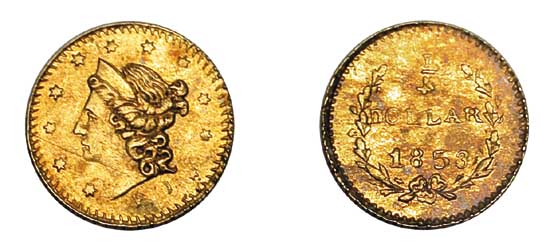
Obverse & Reverse
The 1853 BG-210 25 Cents represents a fascinating and critical chapter in American economic history, born from the chaotic expediency of the California Gold Rush. Following the discovery of gold at Sutter's Mill in 1848, a massive influx of over 300,000 people descended upon California, creating a vibrant but haphazard economy. While miners extracted vast quantities of raw gold, the region suffered from a severe, chronic shortage of small-denomination coinage for daily transactions. A pinch of gold dust for a drink or a small nugget for supplies were imprecise and fraught with potential for dispute. Federal coinage was scarce on the isolated West Coast, and the U.S. Mint in San Francisco would not be fully operational until 1856. To fill this void, private jewelers, metallurgists, and entrepreneurs in San Francisco began striking their own coins in 25 cent, 50 cent, and one-dollar denominations, starting in 1852. These are collectively known as California Fractional Gold. The BG-210 is a 'Period One' issue (1852-1857), a designation for the earliest pieces that were genuinely intended to circulate and alleviate the small change crisis. Unlike later 'Period Two' issues, which were often underweight and made primarily as souvenirs, Period One coins were struck with a closer adherence to their face value and were accepted, albeit unofficially, in local commerce. These coins were typically hand-struck using simple screw presses or even hammers, resulting in crude but functional pieces. The Liberty Head design on the BG-210 was likely an attempt to mimic the familiar appearance of federal gold coinage to inspire public confidence. However, the production of these private coins was a legal gray area, and they were eventually superseded by the arrival of official U.S. coins. The passage of the private coinage acts of 1864 effectively outlawed their manufacture, cementing their status as a temporary, emergency solution to a unique monetary problem. Today, the BG-210 is an exceptionally rare artifact, a tangible link to the vibrant, entrepreneurial, and often lawless environment of Gold Rush California.
Associated EventCalifornia Gold Rush
Reason For MintingTo alleviate a severe shortage of small-denomination coinage for everyday commercial transactions in Gold Rush-era California.
Minter HistoryThe specific minter or jeweler responsible for the BG-210 die marriage is not definitively known, a common trait for many Period One California Fractional Gold varieties. The work is attributed to one of the numerous, often French, jewelers and artisans operating in San Francisco during the 1850s. These individuals, such as Antoine Louis Nouizillet or M. Deriberpe, possessed the necessary skills in die-sinking and metallurgy. They operated outside of federal authority, creating coinage out of necessity that was vital to the region's economy. Their operations were typically small-scale, and their identities were not always stamped on the coins, leaving many varieties like the BG-210 as anonymous testaments to their crucial but unofficial role.
Historical SignificanceAs a Period One issue, the 1853 BG-210 is significant as one of the earliest privately-issued coins intended to function as money in the American West. It represents a grassroots solution to a major economic failure—the inability of the federal government to supply adequate coinage to a new and booming population center. Its existence highlights the adaptability and entrepreneurial spirit that characterized the Gold Rush and serves as a key artifact of American monetary history.
BG-210
Denomination25 Cents
Minting Period1853
Assayer/MinterUnknown Private Minter
Geographic OriginSan Francisco, California
Obverse DescriptionThe obverse features a small, simple Liberty Head facing left, modeled after the contemporary federal gold dollar. The portrait is somewhat crude, typical of private manufactures. Thirteen stars, representing the original colonies, encircle the portrait along the rim.
Obverse Inscription Reverse DescriptionThe reverse is dominated by a wreath composed of two branches tied with a bow at the bottom. The denomination '1/4' appears in the center of the wreath. The date '1853' is positioned below the wreath, near the lower rim. The design is simple and utilitarian.
Reverse Inscription1/4 1853
CompositionGold
Stated Fineness Actual FinenessTypically struck from native California gold, which naturally contained silver, resulting in a fineness of approximately .800 to .880 fine.
EdgePlain
Unknown
Survival EstimateFewer than 12 known
Rarity ScaleR-7 (Very Rare)
The 1853 BG-210 is highly sought after for its extreme rarity, its status as a genuine circulating Period One issue, and its direct connection to the California Gold Rush. It appeals to specialists in territorial gold, pioneer history, and collectors seeking the ultimate challenge in a historically significant series. Its crude, handmade nature adds to its charm and historical authenticity.
Key VarietiesThe primary variety is the regular business strike. No known patterns, proofs, or special collector restrikes from the original period or later dates are recorded for the BG-210 die marriage. The study of this series focuses on the die states and minor striking characteristics of the original issue.
Authentication TipsGenuine Period One fractionals like the BG-210 often have a slightly soft, somewhat crude strike, unlike modern, sharp-edged replicas. Look for characteristic weakness in some areas due to the hand-striking process. The gold color should be consistent with native California gold, often with a slightly lighter, brassy-yellow hue due to the natural silver content. Modern fakes are often brass-plated and may show a copper core where worn, or they may have a soapy, cast-like surface texture. Genuine pieces must have a denomination (e.g., '1/4', 'DOLLAR'). Pieces that say 'CALIFORNIA GOLD' without a denomination are almost always later souvenirs or fakes. Comparing the specific die characteristics of the lettering, stars, and wreath to high-resolution images of certified examples is crucial.
Shopping ConsiderationsFor an R-7 variety, any example offered is a major purchasing decision. 'Premium quality' is relative; focus on finding a piece with minimal damage, such as holes, heavy scratches, or bending, which are common. A well-struck coin for the variety, showing clear details in Liberty's hair and the wreath, is highly desirable. Original, uncleaned surfaces are paramount and command a significant premium. Be wary of coins that appear too clean or exhibit harsh, parallel hairlines from brushing. Given the high rarity and prevalence of counterfeits, purchasing an example certified by a top-tier grading service (PCGS or NGC) is not just recommended, it is essential for buyer protection.
A coin's grade is its condition, rated on a 1-70 scale. For rare coins, this is the most critical factor in determining value, as a tiny difference in preservation can mean a huge difference in price.
Relevant Grade TypesOriginal BG-210 coins were business strikes intended for circulation and are found in Circulated (1-58) and, very rarely, Mint State (MS, 60-70) grades. No Proofs were struck during the original period of issue. Any coin described as a 'Proof' would be a modern creation with no numismatic relationship to the original.
Mint State CharacteristicsAn uncirculated BG-210 is exceptionally rare. Quality is determined by the strength of the strike and the quality of the luster. These coins were hand-struck, so a fully-struck example with sharp details, particularly on Liberty's hair and the wreath leaves, is extraordinary. Luster is typically soft and satiny rather than deeply frosty. Due to the small size and soft gold, even Mint State examples will likely exhibit some minor contact marks or planchet imperfections, which should be expected and evaluated for their severity and location.
Circulated Wear PatternsWear first appears on the highest points of the design. On the obverse, friction will first dull the luster on Liberty's cheek, ear, and the hair above the eye. On the reverse, the high points of the wreath leaves and the bow will show wear first. In lower grades (VG and below), the finer details of the hair and wreath will be completely flat, and the stars and legends may become faint.
Key Factors For ValueFor the BG-210, rarity is the primary value driver. Beyond that, the key factors are condition and surface quality. An example with original, uncleaned surfaces and attractive, reddish-gold toning will always be worth more than a cleaned or damaged coin of the same grade. The sharpness of the strike is critical; a weakly struck example is typical, but a well-struck coin is a significant rarity. Eye appeal—the overall visual impact of the coin—is a major consideration. Certification by PCGS or NGC is mandatory for market acceptance, and a CAC sticker indicating premium quality for the grade would add a substantial premium.
PCGS Price Guide
| Grade | Price | Population |
|---|---|---|
| 40 | $1,350.00 | N/A |
| 45 | $1,500.00 | 1 |
| 45+ | $1,600.00 | N/A |
| 50 | $2,000.00 | N/A |
| 50+ | $2,150.00 | N/A |
| 53 | $2,400.00 | N/A |
| 53+ | $2,500.00 | N/A |
| 55 | $2,850.00 | 2 |
| 55+ | $3,000.00 | N/A |
| 58 | $3,250.00 | 2 |
| 58+ | $3,500.00 | N/A |
| 60 | $3,750.00 | N/A |
| 61 | $4,000.00 | 2 |
| 62 | $4,250.00 | 2 |
| 62+ | $5,000.00 | N/A |
| 63 | $10,750.00 | 2 |
| 63+ | $11,500.00 | N/A |
| 64 | $13,500.00 | N/A |