1854 G50C BG-404 (Regular Strike)
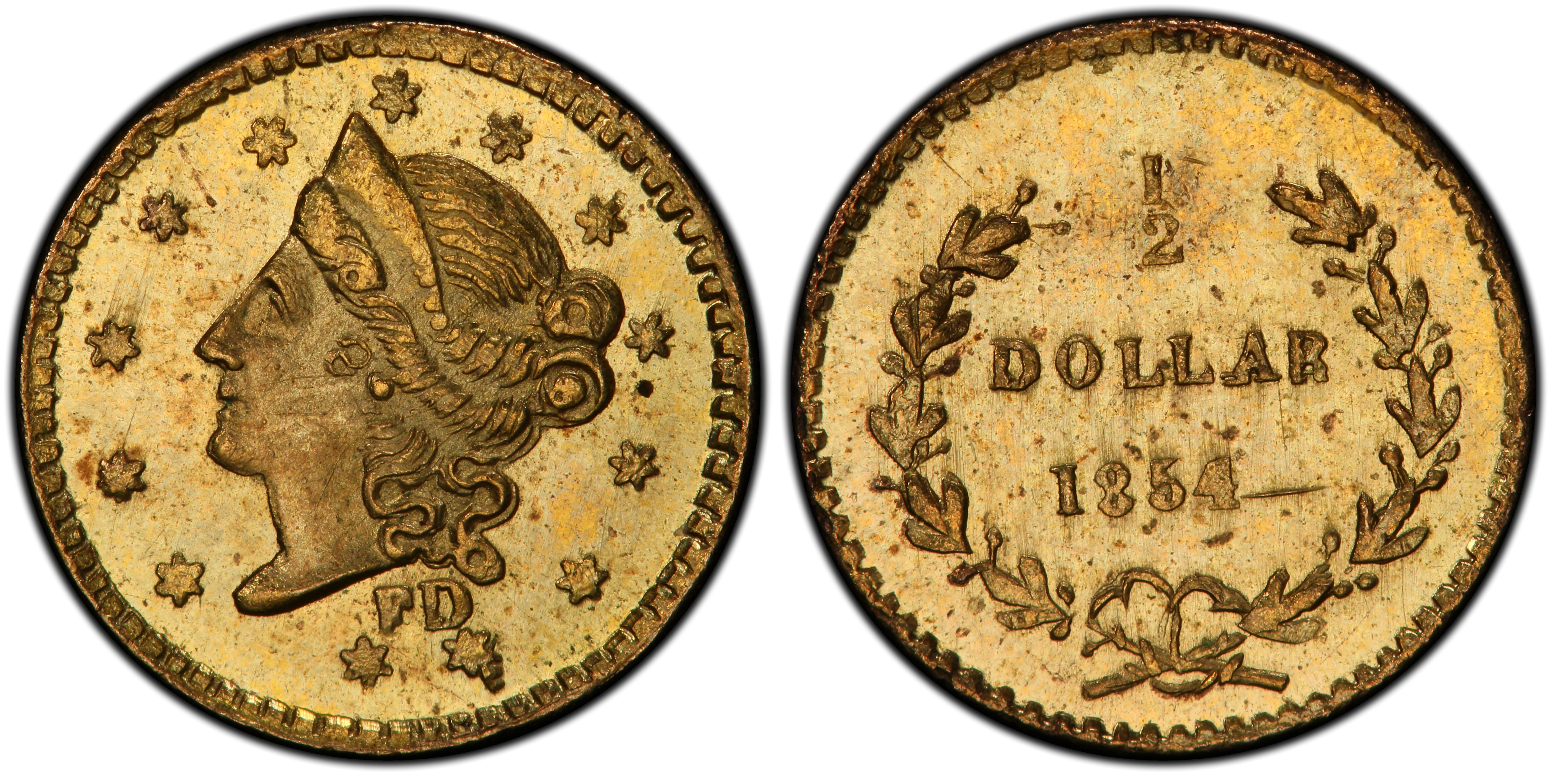
Obverse & Reverse
The 1854 G50C BG-404 is a numismatic artifact born from the economic crucible of the California Gold Rush. Following the discovery of gold at Sutter's Mill in 1848, a tidal wave of over 300,000 fortune-seekers descended upon California, transforming it from a sparsely populated territory into a chaotic, booming economy. This massive influx of population and gold dust created an acute and paradoxical crisis: a severe shortage of small-denomination coinage for daily commerce. Gold dust, weighed in 'pinches,' was an imprecise and often contentious medium of exchange for minor transactions. While private assayers like Moffat & Co. and Wass, Molitor & Co. produced larger denomination gold coins ($5 to $50), the need for pocket change remained unmet. The newly established San Francisco Mint, which opened in 1854, initially focused on larger coins and produced a mere 15,000 gold dollars that year, hardly enough to quench the economy's thirst. Into this void stepped enterprising jewelers and metalsmiths, many of French origin, who began striking their own fractional gold coins in quarter, half-dollar, and dollar denominations starting in 1852. These 'Period One' issues, including the BG-404, were intended for actual circulation. They were generally accepted in trade, their utility outweighing concerns about their often slightly underweight nature. The BG-404 was struck by the firm of Frontier, Deviercy & Co., one of the more prolific private minters in San Francisco. These pieces were typically produced by the 'hammer method,' where dies were struck by hand, leading to variability in strike quality. The passage of the private coinage act in 1864 eventually made these issues illegal, but their brief period of circulation serves as a tangible link to the vibrant and tumultuous economy of Gold Rush California.
Associated EventCalifornia Gold Rush
Reason For MintingTo alleviate a severe shortage of small-denomination coinage for everyday commercial transactions in Gold Rush-era California.
Minter HistoryPierre Frontier and Eugene Deviercy were San Francisco-based jewelers who formed the partnership Frontier, Deviercy & Co. They were among the most significant producers of 'Period One' California fractional gold, active in the mid-1850s. Their issues are often identified by the initials 'F.D.' on the coins. The firm was known for producing a variety of denominations and designs, contributing vital, albeit unofficial, currency to the local economy. After their partnership dissolved, the individuals were involved in other ventures, but their legacy is cemented by these tiny gold treasures that facilitated commerce during a pivotal moment in American history.
Historical SignificanceThe BG-404 is a prime example of a privately issued coin that functioned as necessary currency in the absence of sufficient federal coinage. It represents a solution to a specific economic problem driven by the Gold Rush and embodies the era's spirit of ingenuity and enterprise. As a 'Period One' issue, it is a genuine artifact of commerce from one of the most dynamic periods of American westward expansion.
K-Unlisted
Denomination50 Cents
Minting Period1854
Assayer/MinterFrontier, Deviercy & Co.
Geographic OriginSan Francisco, California
Obverse DescriptionA Liberty Head, facing left, modeled after the contemporary U.S. gold dollar designed by James B. Longacre. The portrait is surrounded by thirteen six-pointed stars, representing the original colonies. The date '1854' is positioned below the bust. This obverse die is shared with the BG-403 variety.
Obverse Inscription1854
Reverse DescriptionA simple wreath composed of two branches tied with a bow at the bottom. Within the wreath, the denomination is expressed as '1/2'. The legend 'CALIFORNIA GOLD' encircles the wreath, separated from the denomination. The initials 'F D' for Frontier & Deviercy are located below the bow, a key diagnostic for this minter.
Reverse InscriptionCALIFORNIA GOLD 1/2 F D
CompositionGold
Stated Fineness Actual FinenessTypically .800 to .900, often alloyed with native silver which imparts a lighter color.
Diameter11.20 mm
EdgePlain
Unknown
Survival Estimate4-6 known
Rarity ScaleR-7 (High)
The BG-404 is highly coveted as an extreme rarity from the historic 'Period One' of California fractional gold. Its connection to a known, important minter (Frontier, Deviercy & Co.), its status as a true circulating medium of the Gold Rush, and the sheer scarcity (R-7) make it a centerpiece for advanced collectors of territorial and private gold.
Key VarietiesThe BG-404 is a singular variety. Its primary diagnostic relationship is with BG-403, with which it shares an obverse die. No later-date restrikes or special collector issues of the BG-404 are known to exist.
Authentication TipsAuthentication requires careful examination. Verify the style of the Liberty head and stars, comparing them to known genuine examples; the obverse die is the same as BG-403. Look for the distinctive 'F D' initials on the reverse below the bow. Genuine Period One pieces have a specific fabric and strike character; they are often unevenly struck but should not have the porous or soapy look of modern cast fakes. Edges must be plain. Beware of common brass replicas, which often feature a bear on the reverse and lack a specific denomination like '1/2'. Any suspected piece should be authenticated by a major third-party grading service.
Shopping ConsiderationsFor a coin of this rarity, any example offered is a major event. A premium quality specimen would be one that, despite any circulation, retains clear legends, a bold date, and visible minter initials. Given that these were struck by hand, a well-centered and relatively sharp strike is highly desirable and commands a significant premium. Look for original, uncleaned surfaces, often displaying a slightly reddish or brassy-gold color from the native alloy. Avoid examples that have been tooled, harshly cleaned, or mounted for jewelry, as this severely impairs value. Due to the high rarity, even a problem-free circulated example in a grade like VF or XF is a major numismatic prize.
A coin's grade is its condition, rated on a 1-70 scale. For rare coins, this is the most critical factor in determining value, as a tiny difference in preservation can mean a huge difference in price.
Relevant Grade TypesAll known examples of the 1854 G50C BG-404 are original business strikes intended for circulation. They are found in Circulated grades (AG-3 to AU-58) and, very rarely, in Mint State (MS-60 to 70). No proofs were struck during the original period of issue, and there are no known later-date Proof restrikes or special collector strikings for this variety.
Mint State CharacteristicsA Mint State BG-404 is a legendary rarity. Quality would be judged by the sharpness of the strike, particularly on the highest points of Liberty's hair and the details of the wreath. Luster would likely be soft and satiny rather than deeply prooflike, reflecting the crude minting technology. Due to the softness of the gold and the primitive production, even uncirculated examples can be expected to have some minor planchet imperfections or light contact marks.
Circulated Wear PatternsWear first appears on the high points of the design: Liberty's cheek, the hair just above the ear, and the leaves and bow of the wreath on the reverse. On mid-grade examples, the finer hair strands will merge, and the individual leaves in the wreath will lose their definition. In lower grades (VG and below), the stars on the obverse and the letters in 'CALIFORNIA GOLD' will become weak and begin to merge with the rim.
Key Factors For ValueFor the BG-404, rarity is the dominant value factor. Beyond that, surface quality is paramount; an example with original, undisturbed skin is far more valuable than one that has been cleaned or polished. A sharp, well-centered strike adds immense eye appeal and value. Given the R-7 rating, simply acquiring a genuine, problem-free example is the primary goal for most collectors. A CAC sticker on a certified example of this issue would indicate premium quality for the grade and would command a substantial price increase in the marketplace.
PCGS Price Guide
| Grade | Price | Population |
|---|---|---|
| 45 | $1,450.00 | 1 |
| 45+ | $1,575.00 | N/A |
| 50 | $1,900.00 | N/A |
| 50+ | $2,100.00 | N/A |
| 53 | $2,250.00 | N/A |
| 53+ | $2,400.00 | N/A |
| 55 | $2,650.00 | 4 |
| 55+ | $2,850.00 | N/A |
| 58 | $3,250.00 | 2 |
| 58+ | $3,500.00 | N/A |
| 60 | $4,000.00 | 1 |
| 61 | $4,750.00 | N/A |
| 62 | $6,750.00 | 1 |
| 62+ | $7,500.00 | N/A |
| 63 | $8,500.00 | 2 |
| 63+ | $10,500.00 | N/A |
| 64 | $14,500.00 | 1 |
| 64+ | N/A | 1 |