(1853) G$1 BG-501, "Humbert" Eagle (Regular Strike)
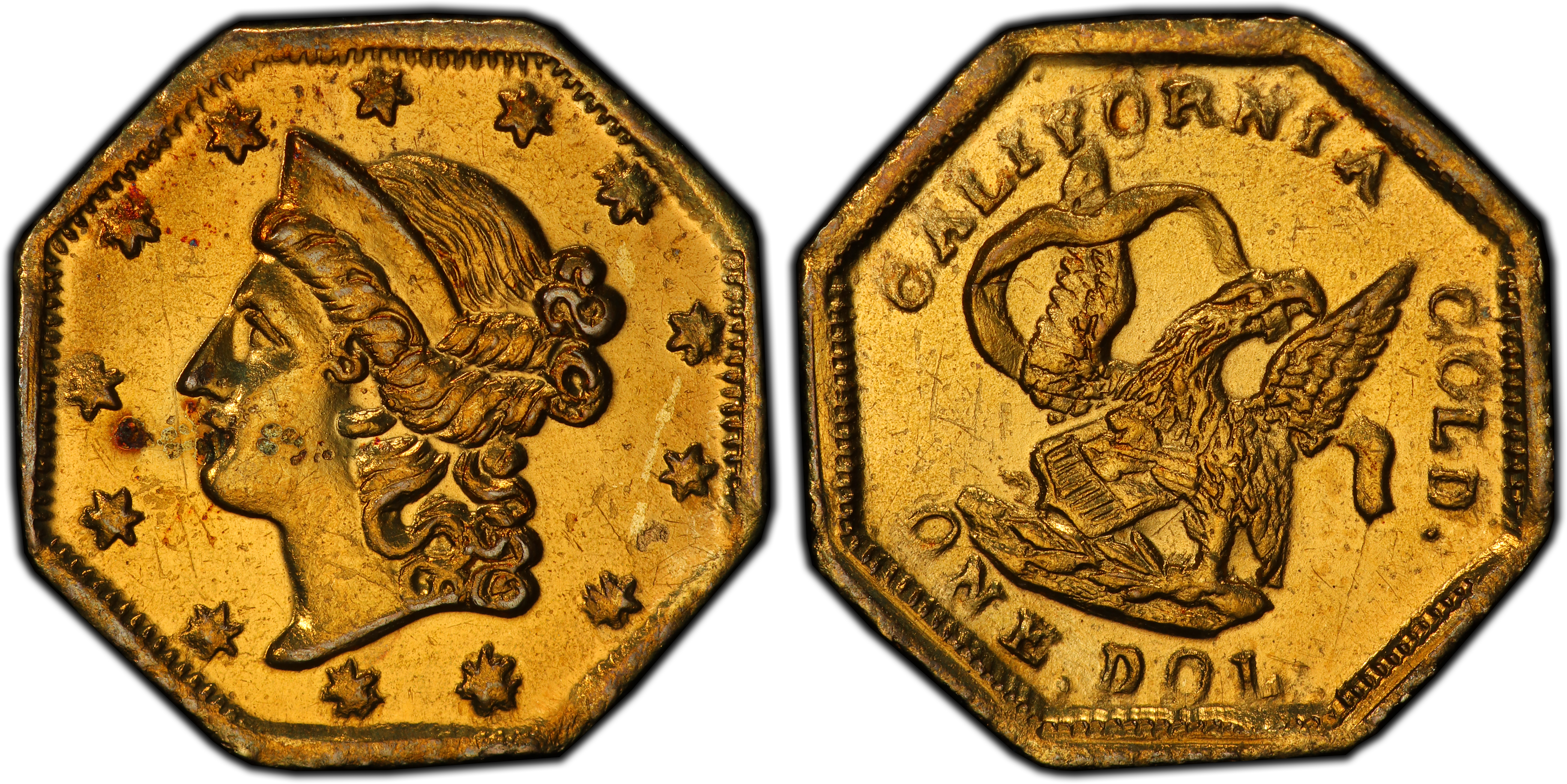
Obverse & Reverse
The BG-501 Gold Dollar stands as a fascinating artifact from the chaotic, economically vibrant, and numismatically fertile period of the California Gold Rush. Following the discovery of gold in 1848, a massive influx of population created a society rich in gold dust but critically deficient in circulating small-denomination coinage for daily transactions. While private firms like Moffat & Co. and the U.S. Assay Office (under Augustus Humbert) struck large-denomination coins and ingots, the need for pocket change remained acute. This void was filled by private individuals, often jewelers, who began striking their own fractional gold pieces in 25-cent, 50-cent, and one-dollar denominations starting in 1852. These issues, now classified as 'Period One' (1852-1857) California Fractional Gold, were intended for actual circulation and were generally accepted in commerce despite often being underweight compared to federal issues. The BG-501 emerged from this environment in 1853, struck by the firm of Frontier, Deviercy & Co. The coin's most distinctive feature is its reverse, which intentionally mimics the heraldic eagle design used by Augustus Humbert on the famous and trusted U.S. Assay Office $50 'slugs.' This was a clear marketing attempt to leverage the public's confidence in Humbert's official issues, lending an air of legitimacy to this private token. The piece is octagonal, another trait borrowed from the larger Assay Office ingots. As the only undated octagonal dollar variety of Period One, it holds a unique position. The production methods were often crude, with many fractionals being produced by the hammer method, leading to variations in strike quality. While these coins filled a vital role, their existence was short-lived. The establishment of the San Francisco Mint in 1854 and its subsequent full-scale production of federal silver and gold coinage by 1856 rendered the private fractionals obsolete for commerce. Most were eventually withdrawn from circulation and melted, contributing to their high rarity today.
Associated EventCalifornia Gold Rush
Reason For MintingTo alleviate a severe shortage of small-denomination coinage for everyday commerce in Gold Rush-era San Francisco.
Minter HistoryPierre Frontier and Eugene Deviercy were French jewelers who established a partnership in San Francisco in 1853. Their numismatic activities began almost immediately, though their initial foray into minting was reportedly controversial. A Sacramento newspaper report from September 3, 1853, warned of counterfeit plated half dollars circulating in the city, an issue attributed by numismatic scholars Walter Breen and Ronald Gillio to Frontier, Deviercy & Co. Despite this dubious start, the firm went on to produce a significant variety of fractional gold pieces, many of which were of solid gold, though often of a fineness below the federal standard of .900. Their work is characterized by ambitious and sometimes crude designs, such as the direct imitation of the Humbert eagle on the BG-501. The firm operated through the end of Period One (c. 1856-57) and their machinery, a vintage screw press, is believed to have survived and was sold at public auction in 2011, providing a direct link to the physical production of these historic pieces.
Historical SignificanceThe BG-501 is a prime example of a privately issued coin created out of necessity to facilitate local commerce. Its intentional design similarity to the official U.S. Assay Office issues of Augustus Humbert provides a tangible link to the larger, more famous territorial gold coins and illustrates the competitive and unregulated nature of coinage in pre-Federal Mint San Francisco. It represents the peak of the fractional gold phenomenon before the San Francisco Mint's coinage made them obsolete.
BG-501
DenominationG$1
Minting Period1853
Assayer/MinterFrontier, Deviercy & Co.
Geographic OriginSan Francisco, California
Obverse DescriptionA fairly crude depiction of a Liberty head facing left, her hair tied in a bun. She is surrounded by thirteen five-pointed stars, seven to the left and six to the right.
Obverse Inscription Reverse DescriptionA heraldic eagle with outstretched wings, reminiscent of the design on the U.S. Assay Office slugs, clutching an olive branch and arrows in its talons. A ribbon, typically indistinct, is in its beak. Above the eagle is the inscription CALIFORNIA GOLD; below is the denomination ONE DOL.
Reverse InscriptionCALIFORNIA GOLD / ONE DOL.
CompositionGold
Stated Fineness Actual FinenessVariable, often 14-22 karats (.583 to .917), generally below the .900 federal standard.
Weight1.10 grams
Diameter12.20 mm
EdgePlain
Extremely low; exact figures are unknown but certainly in the dozens or low hundreds.
Survival EstimateFewer than 20 believed extant.
Rarity ScaleR-6 (13 to 30 known)
The BG-501 is highly sought after for several reasons: its direct design connection to the famous 'Humbert slugs', its status as the only undated octagonal dollar of Period One, its high rarity, and its romantic association with the California Gold Rush. It is a key type coin within the popular and complex series of California Fractional Gold.
Key VarietiesThere are no major varieties of the BG-501 regular strike from the original minting period. As a Period One issue intended for circulation, no proof or special collector strikings were produced at the time. Later-date restrikes of Period One issues by other minters are known for some BG numbers, but none are recorded for the BG-501.
Authentication TipsAuthentic Period One fractionals like the BG-501 are always denominated; pieces that say 'CAL GOLD CHARM' or lack a value are later tokens. The fabric of genuine pieces is distinctive; they are often struck on thin planchets and can show evidence of manual production, such as weak or uneven strikes. Modern replicas are often unnaturally sharp, thick, and may have a soapy or prooflike finish. The reverse design should be closely compared to known genuine examples, as fakes often fail to capture the crude but specific style of the original dies. Beware of pieces with a bear on the reverse, a motif not used on any genuine 19th-century California Fractional Gold coins.
Shopping ConsiderationsA premium quality BG-501 will exhibit a bold strike for the issue, with as much detail as possible visible in Liberty's hair and the eagle's feathers. Many examples are softly struck in the centers, so a sharp example commands a significant premium. Look for pleasing, original surfaces with minimal distracting marks. The native California gold used often contained silver, giving it a lighter yellow or greenish-gold hue, which is considered attractive. Avoid examples that have been harshly cleaned, polished, or mounted in jewelry, as this is common for the series and severely impacts value. Pay close attention to the points of the octagonal corners, as wear and damage are often concentrated there. A CAC sticker is highly desirable for this issue, as it confirms both authenticity and quality for the assigned grade.
A coin's grade is its condition, rated on a 1-70 scale. For rare coins, this is the most critical factor in determining value, as a tiny difference in preservation can mean a huge difference in price.
Relevant Grade TypesOriginal BG-501 issues were business strikes intended for circulation and are found in Circulated grades (AG-3 to AU-58) and, very rarely, in Mint State (MS-60 to 70). No Proof (PR/PF) examples were struck during the original period of issue, and there are no known later-date Proof restrikes for this variety. Any piece described as a 'Proof' is likely a modern replica or a misattributed prooflike business strike.
Mint State CharacteristicsAn uncirculated BG-501 is exceptionally rare. Quality is defined by the strength of the strike, the originality of the luster, and the preservation of the surfaces. The luster is typically somewhat subdued and satiny, not deeply frosty like on federal issues. Due to the crude manufacturing process, even Mint State examples may exhibit softness in the central devices, particularly on the eagle's head and Liberty's ear. Planchet quality can be irregular, and small, mint-made imperfections are not uncommon. Contact marks are a major factor, as the soft gold was easily damaged.
Circulated Wear PatternsWear first becomes evident on the highest points of the design. On the obverse, this includes Liberty's cheek, ear, and the hair above her eye. On the reverse, the high points of the eagle's head, the upper portions of its wings, and the breast feathers will show the first signs of friction. On moderately worn examples (VF-XF), the finer details in the feathers will be smoothed over, and the stars on the obverse will begin to lose their sharpness. In lower grades, the legends become weak and can merge with the rim.
Key Factors For ValueFor the BG-501, value is driven by three main factors beyond the numerical grade. First is rarity; any example is a significant prize. Second is strike quality; a specimen with a sharp, well-defined eagle and clear legends will command a much higher price than a weakly struck counterpart of the same grade. Third is surface quality and eye appeal; an example with original, uncleaned surfaces and a pleasing reddish or greenish-gold toning is far more desirable than a bright, cleaned, or heavily marked piece. The integrity of the octagonal shape, with sharp, undamaged points, also contributes positively to its value.
PCGS Price Guide
| Grade | Price | Population |
|---|---|---|
| 25 | $1,250.00 | 1 |
| 30 | $1,750.00 | N/A |
| 35 | $2,250.00 | N/A |
| 40 | $2,750.00 | N/A |
| 45 | $3,250.00 | 3 |
| 45+ | $3,350.00 | N/A |
| 50 | $3,500.00 | N/A |
| 50+ | $3,750.00 | N/A |
| 53 | $4,000.00 | 3 |
| 53+ | $4,250.00 | N/A |
| 55 | $4,500.00 | 9 |
| 55+ | $4,500.00 | N/A |
| 58 | $4,750.00 | 19 |
| 58+ | $6,000.00 | 1 |
| 60 | $8,000.00 | 1 |
| 61 | $10,000.00 | 3 |
| 62 | $13,500.00 | 7 |
| 62+ | $14,500.00 | N/A |
| 63 | $17,000.00 | 5 |
| 63+ | $18,500.00 | N/A |
| 64 | $22,500.00 | 1 |