1872 25C BG-726 (Regular Strike)
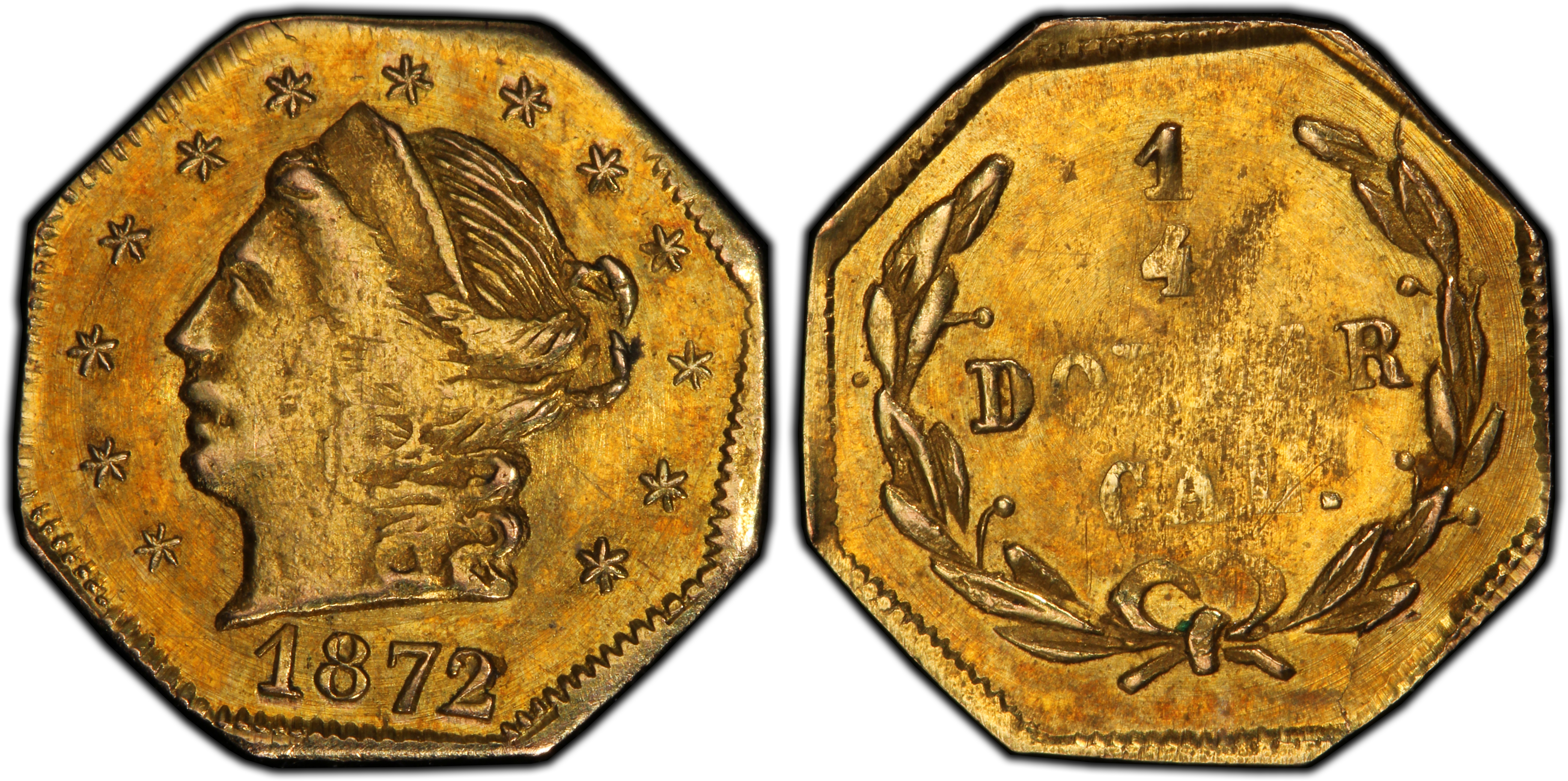
Obverse & Reverse
The 1872 25C Octagonal Liberty Head, cataloged as Breen-Gillio 726, is a quintessential example of a 'Period Two' California Fractional Gold piece. By the 1870s, the initial impetus for these miniature gold coins—a severe shortage of small-denomination federal coinage during the Gold Rush—had long since vanished. The San Francisco Mint, established in 1854, was in full production, supplying the region with ample circulating currency. Consequently, the fractional gold pieces of this era transitioned from being items of commercial necessity to objects of novelty and memorabilia. Struck by private jewelers in San Francisco, these tiny gold tokens were marketed primarily as souvenirs for tourists, charms for bracelets, and keepsakes of the romanticized Gold Rush era. Production of fractional gold actually increased in the 1870s, a testament to its popularity as a collectible. Unlike the 'Period One' (1852-1857) issues, which were generally of higher weight and fineness and saw actual circulation, Period Two pieces were often underweight and of lower, variable fineness, as their value was in their novelty, not their intrinsic worth. The Coinage Act of 1864 had made all private coinage illegal, but the law was not strictly enforced against these small souvenir pieces until a crackdown by the Secret Service, led by Chief James J. Brooks, who saw them as a potential for fraud. This enforcement action effectively ended the production of denominated fractional gold by 1883. The BG-726, with its classic Liberty Head design mimicking federal gold coinage, appealed to a sense of national identity and numismatic tradition, making it a popular choice for visitors to the West Coast. Because they were sold as souvenirs and intended for jewelry, a significant portion of the surviving population exists in high grades, often with prooflike surfaces, having never been subjected to the rigors of circulation.
Associated EventPost-Gold Rush California Tourism
Reason For MintingTo serve the growing market for souvenirs and jewelry items reminiscent of the California Gold Rush.
Minter HistoryThe specific minter of BG-726 is not definitively known, which is common for many 'Period Two' fractional gold varieties that do not bear a maker's initial. Prominent jewelers and firms known to have produced fractional gold during this period in San Francisco include Robert B. Gray & Co. and the California Jewelry Co. (Levison Brothers). However, the dies used for BG-726 are not attributed to any specific known maker. These minters were typically skilled craftsmen, often watchmakers or jewelers, who possessed the necessary equipment and expertise for die-sinking and striking small gold planchets. Their operations were commercial enterprises that capitalized on the romantic allure of the Gold Rush, producing a wide variety of designs to appeal to the tourist trade.
Historical SignificanceThe BG-726 represents the second phase of California Fractional Gold, where the pieces evolved from a privately issued circulating medium of necessity to a widely popular collectible and souvenir, reflecting California's growing tourism industry and the nation's romantic fascination with the Gold Rush.
K-N/A
Denomination25C
Minting Period1872
Assayer/MinterUnknown San Francisco Jeweler
Geographic OriginSan Francisco, California
Obverse DescriptionA classic Liberty Head design facing left, reminiscent of the federal gold dollar coinage designed by James B. Longacre. The portrait features hair tied in a bun with flowing curls. The field is surrounded by thirteen five-pointed stars, representing the original colonies.
Obverse Inscription1872
Reverse DescriptionThe central device is the denomination '1/4' positioned above the word 'DOLLAR', all enclosed within a simple wreath composed of two branches tied with a bow at the bottom. The word 'CAL.' for California is not present on this variety.
Reverse Inscription1/4 DOLLAR
CompositionGold
Stated Fineness Actual FinenessVariable, often lower than federal standards for Period Two issues.
EdgePlain
Unknown
Survival Estimate31-75 known
Rarity ScaleR-5+
The 1872 BG-726 is sought after for its classic octagonal shape, traditional Liberty Head design, and its status as a scarce (R-5+) 'Period Two' variety. Its appeal lies in its direct connection to the post-Gold Rush souvenir trade in San Francisco, making it a tangible piece of Western Americana. High-grade examples with prooflike surfaces are particularly prized.
Key VarietiesThere are no major die varieties, patterns, or official restrikes known for the BG-726. The entire issue consists of regular business strikes produced for private sale. Unlike some territorial issues, no later Proof restrikes were created by figures like J.J. Conway or others. Collectors should be aware of the general division of fractional gold into Period One (circulating), Period Two (souvenir), and Period Three (clandestine) issues, with BG-726 being a quintessential Period Two piece.
Authentication TipsGenuine examples of BG-726 will have sharp, albeit sometimes unevenly impressed, details from a die striking, not the soft, cast-like appearance of many modern replicas. The planchets are typically very thin. Look for characteristic die markers if known, and compare against high-resolution images from major auction archives. Replicas often have incorrect lettering styles, different wreath details, or a suspicious, uniform surface. The absence of a denomination like 'DOLLAR' or 'CENTS' is a major red flag for most pre-1883 pieces. Weak strikes are not uncommon on genuine pieces, whereas many fakes have an unnaturally strong and uniform appearance.
Shopping ConsiderationsA premium quality example of BG-726 is defined by a sharp strike, particularly on Liberty's hair details and the numerals of the date. Seek out coins with clean, original surfaces that retain some measure of original mint luster; many high-grade examples exhibit attractive prooflike or semi-prooflike fields. Common problems to avoid include scratches, rim bumps, signs of being mounted in jewelry (solder or evidence of removal), and harsh cleaning or polishing, which can strip the coin of its original skin and value. Eye appeal is paramount for this issue; a well-struck coin with pleasing original surfaces will always command a significant premium.
A coin's grade is its condition, rated on a 1-70 scale. For rare coins, this is the most critical factor in determining value, as a tiny difference in preservation can mean a huge difference in price.
Relevant Grade TypesOriginal issues of BG-726 were business strikes intended for private sale as souvenirs, not for circulation. They are found in Circulated (1-58) grades, though this is less common, and are most often encountered in Mint State (MS, 60-70) grades. No Proof (PR/PF) examples were struck during the original period of issue, and there are no known later-date Proof restrikes. Some Mint State examples are designated as 'PL' (Prooflike) or 'DMPL' (Deep Mirror Prooflike) by grading services if they exhibit highly reflective surfaces from being struck with polished dies.
Mint State CharacteristicsUncirculated examples of BG-726 typically feature a soft, satiny luster, though many exhibit desirable prooflike surfaces. The strike can be inconsistent; a sharp strike across the central devices (Liberty's head, wreath) is a key indicator of quality. Due to the nature of private production, planchet quality can vary, and it is not unusual to see minor striations or imperfections original to the minting process. Small, shallow contact marks are common, but large or deep marks will significantly detract from the grade and value.
Circulated Wear PatternsOn circulated examples, wear will first appear on the highest points of the design. For the obverse, this includes Liberty's cheek, the hair bun, and the strands of hair above the ear and eye. On the reverse, the highest points of the wreath's leaves and the bow will show the first signs of friction and flattening. In lower grades (VF and below), the stars on the obverse and the lettering on the reverse will begin to lose their sharpness.
Key Factors For ValueThe primary drivers of value for BG-726 are the numerical grade and surface quality. A significant premium exists for high-grade Mint State examples (MS-63 and above), especially those designated PL or DMPL. Original, uncleaned surfaces with attractive luster and eye appeal are paramount. Coins that have been cleaned, polished, or removed from jewelry will trade at a substantial discount. The sharpness of the strike is a critical factor, with well-struck specimens commanding a premium over those with weak details. Certification by a major grading service (PCGS or NGC) is essential for marketability, and a CAC sticker will add a further premium for coins that are considered high-end for their assigned grade.
PCGS Price Guide
| Grade | Price | Population |
|---|---|---|
| 50 | $250.00 | 1 |
| 50+ | $260.00 | N/A |
| 53 | $275.00 | N/A |
| 53+ | $280.00 | N/A |
| 55 | $300.00 | 3 |
| 55+ | $305.00 | N/A |
| 58 | $315.00 | 4 |
| 58+ | $320.00 | N/A |
| 60 | $335.00 | N/A |
| 61 | $345.00 | 3 |
| 62 | $400.00 | 6 |
| 62+ | $450.00 | N/A |
| 63 | $550.00 | 7 |
| 63+ | $675.00 | N/A |
| 64 | $950.00 | 6 |