1859 G25C BG-702 (Regular Strike)
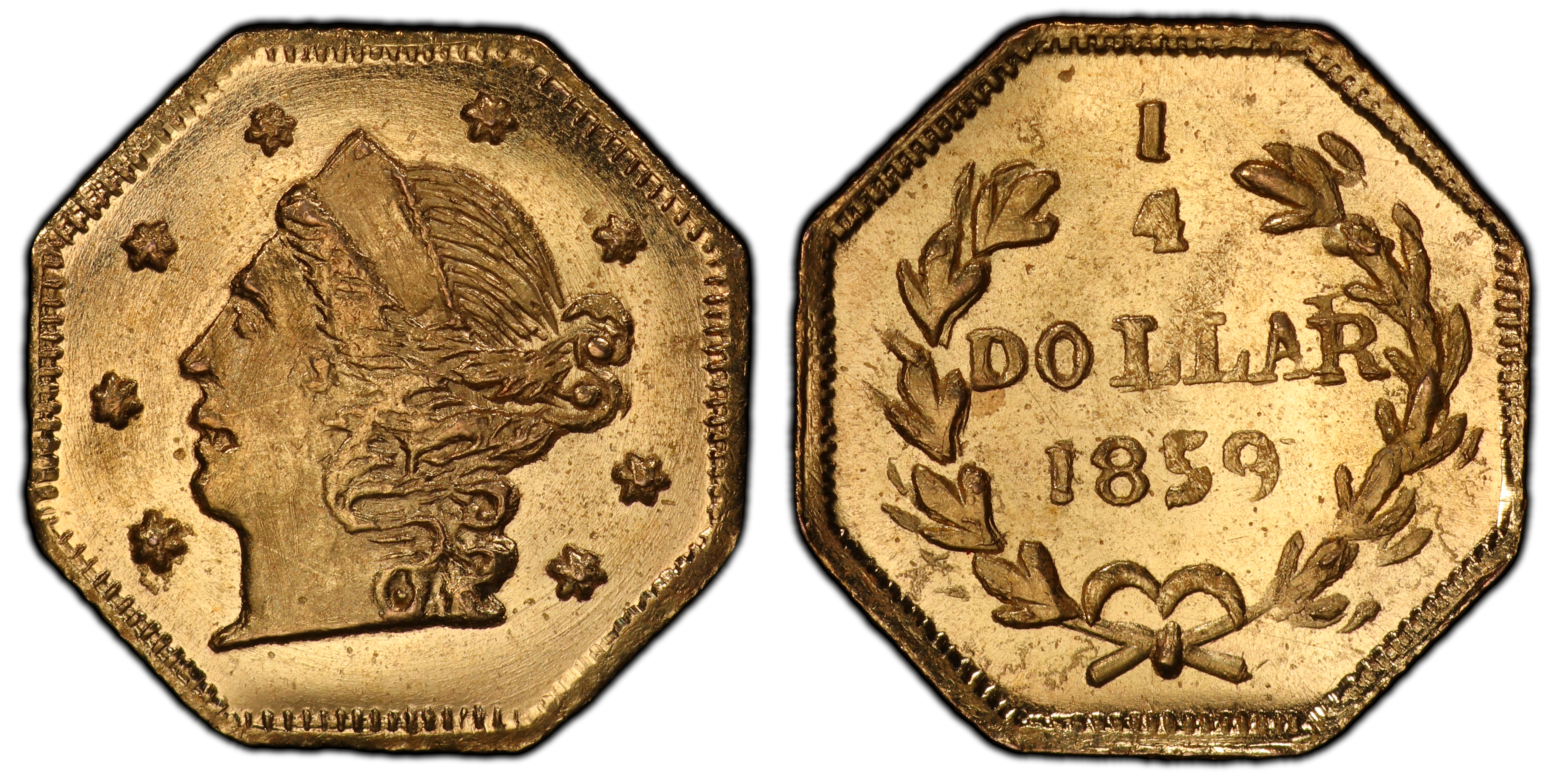
Obverse & Reverse
The 1859 BG-702 25 Cent piece is a quintessential example of a 'Period Two' California Fractional Gold coin. Unlike the earlier 'Period One' issues (1852-1857), which were struck to alleviate a severe shortage of small-denomination coinage in Gold Rush California and are believed to have circulated, Period Two pieces were created under different circumstances. By 1859, the San Francisco Mint was in full operation, supplying the region with ample federal coinage. The acute need for private fractional gold had subsided. Instead, these miniature gold coins transitioned into a new role as popular souvenirs and keepsakes. Jewelers and private minters, like the partnership of Pierre Frontier and Eugene Deviercy, recognized a robust market among tourists, miners wanting to send gold home in a novel form, and local citizens captivated by the charm of these tiny expressions of California's wealth. Struck by hand using a hammer method, the quality of these pieces could vary, but they were generally well-made and often featured designs that were more fanciful and less imitative of federal coinage than their predecessors. The BG-702 was produced during a time of immense growth and transformation in San Francisco, as the city shed its chaotic Gold Rush boomtown image and evolved into a major commercial and cultural center. These fractional pieces, while containing less than their face value in gold, served as tangible mementos of the great Western adventure. The practice of minting them continued until 1882, a year before the U.S. Secret Service began to enforce the Private Coinage Act of 1864 more rigorously, bringing an end to this fascinating chapter of American numismatic history.
Associated EventCalifornia Gold Rush Aftermath
Reason For MintingPrimarily struck to be sold as souvenirs and curiosities for tourists and locals in post-Gold Rush San Francisco.
Minter HistoryPierre Frontier and Eugene Deviercy were French jewelers operating in San Francisco during the mid-19th century. Their firm, Frontier, Deviercy & Co., was one of several private enterprises that produced California Fractional Gold pieces. Like many of their contemporaries, they were skilled artisans who applied their craft to meet a commercial demand. Their partnership is known for several varieties of fractional gold, particularly during the 'Period Two' era. Their maker's mark, 'F.D.', is found on some issues, though this specific variety (BG-702) is unattributed by initials but is confirmed through die analysis to be their work. They were part of a vibrant community of French entrepreneurs in early San Francisco who played a significant role in the city's luxury goods trade.
Historical SignificanceThe BG-702 is significant not as a circulating coin, but as a historical artifact representing the maturation of the California economy and the birth of its tourism industry. It demonstrates the transition of fractional gold from a necessary medium of exchange to a desirable souvenir, capturing the romantic allure of the Gold Rush for a new generation of visitors and residents. These pieces are a physical link to the private jewelers and metallurgists who defined a unique and iconic category of American exonumia.
BG-702
Denomination25 Cents
Minting Period1859
Assayer/MinterFrontier, Deviercy & Co.
Geographic OriginSan Francisco, California
Obverse DescriptionThe obverse features a small, classic Liberty Head facing left, her hair tied in a bun. The portrait is encircled by thirteen six-pointed stars, representing the original colonies.
Obverse Inscription Reverse DescriptionThe reverse is dominated by a wreath composed of two branches tied together with a bow at the bottom. The denomination '25 CENTS' and the date '1859' are inscribed within the wreath. An early die state shows the right branch connected to the bow, while later states show it disconnected after the die was lapped.
Reverse Inscription25 CENTS 1859
CompositionGold
Stated Fineness Actual FinenessTypically less than face value; varied by minter but generally ranged from 14 to 22 carats.
EdgePlain
Unknown
Survival Estimate201-500
Rarity ScaleR-3
The BG-702 is popular among collectors for its classic Liberty Head design, octagonal shape, and affordability relative to rarer varieties. As a 'Period Two' issue, it is commonly found in high Mint State grades, making it an attractive entry point for those looking to acquire a high-quality example of this fascinating series. Its connection to the romantic history of the Gold Rush adds significant historical appeal.
Key VarietiesThe primary variety distinction for BG-702 relates to the die state. Early strikes show the right branch of the reverse wreath connected to the bow. Later strikes, made after the die was polished (lapped), show a distinct gap between the branch and the bow. A Prooflike (PL) version is also recognized as a distinct variety by PCGS.
Authentication TipsAuthentic examples have a sharp, albeit sometimes uneven, strike from the hammering process. The stars on the obverse should be well-formed, and the digits in the date should match the known die characteristics. Counterfeits are common and often have a cast or mushy appearance, incorrect weight, or a soapy luster. Many modern replicas exist, often marked with a bear on the reverse or lacking a denomination, which authentic Period Two pieces always have. Reference a high-quality image from a major grading service to verify die markers.
Shopping ConsiderationsA premium quality example for its grade will exhibit a sharp strike, particularly on Liberty's hair details and the numerals of the date. Look for original, undisturbed surfaces with a pleasing satiny or sometimes prooflike luster. Deep olive-gold or reddish toning is considered attractive and desirable. Avoid specimens that have been harshly cleaned, which strips the surface of its original skin and imparts hairline scratches. Also, check the edges for any signs of having been removed from jewelry, a common fate for these small gold pieces.
A coin's grade is its condition, rated on a 1-70 scale. For rare coins, this is the most critical factor in determining value, as a tiny difference in preservation can mean a huge difference in price.
Relevant Grade TypesOriginal 1859 BG-702 issues were business strikes, although they were primarily sold as souvenirs and did not circulate extensively. They are found in both Circulated (1-58) and, more commonly, Mint State (MS, 60-70) grades. No true Proofs were struck during the original minting period. Some specimens exhibit highly reflective, prooflike (PL) surfaces as a result of being struck from freshly polished dies, and these are often designated as such by grading services, carrying a premium.
Mint State CharacteristicsUncirculated examples are relatively common for this variety. A typical Mint State specimen has a good strike, though perfect central striking is not guaranteed due to the hand-hammering process. Luster is typically bright and satiny. Because the gold is soft, even high-grade uncirculated coins may show small, scattered contact marks from handling over the years. The fields can be slightly wavy, a characteristic of hammered coinage. A key feature of a premium MS coin is the lack of distracting marks on the Liberty portrait.
Circulated Wear PatternsFor the few examples that did circulate, wear first appears on the highest points: Liberty's cheek, the hair above the ear, and the coronet. On the reverse, the leaves in the wreath and the bow will show the first signs of flattening. In lower grades (VF and below), the stars on the obverse and the lettering on the reverse will begin to lose their sharpness and merge with the fields.
Key Factors For ValueValue is primarily driven by grade. For a given numerical grade, surface quality is paramount; an MS-64 with clean, original surfaces and strong luster is far more desirable than one with excessive marks or dullness. Strike quality matters, with sharply struck examples commanding a premium. Eye appeal, encompassing attractive original toning and a pleasing overall look, can significantly increase value. Coins certified by top-tier services (PCGS or NGC) are standard for the market, and a CAC sticker for this issue indicates premium quality for the grade and will bring a strong premium.
PCGS Price Guide
| Grade | Price | Population |
|---|---|---|
| 50 | $175.00 | 1 |
| 50+ | $180.00 | N/A |
| 53 | $185.00 | N/A |
| 53+ | $190.00 | N/A |
| 55 | $200.00 | 2 |
| 55+ | $210.00 | N/A |
| 58 | $220.00 | 4 |
| 58+ | $230.00 | N/A |
| 60 | $240.00 | 2 |
| 61 | $265.00 | 8 |
| 62 | $300.00 | 27 |
| 62+ | $325.00 | N/A |
| 63 | $380.00 | 45 |
| 63+ | $425.00 | N/A |
| 64 | $550.00 | 78 |
| 64+ | $600.00 | 1 |
| 65 | $750.00 | 17 |
| 65+ | $875.00 | N/A |
| 66 | $1,350.00 | 2 |
| 66+ | $1,600.00 | N/A |
| 67 | $2,000.00 | 1 |