1853 G25C BG-209 (Regular Strike)
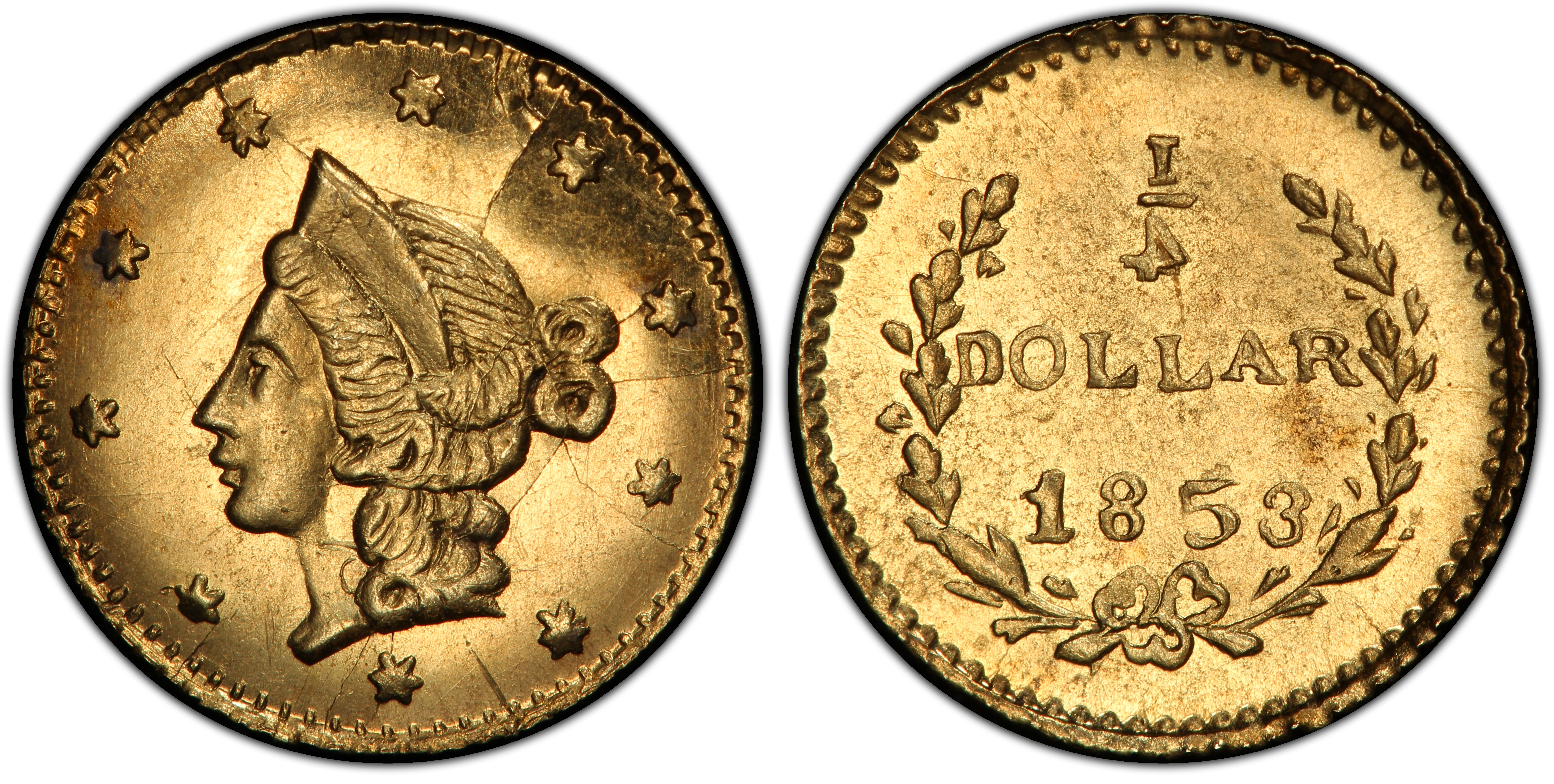
Obverse & Reverse
The 1853 BG-209 25 Cents piece is a quintessential artifact from the first period (1852-1857) of California's private gold coinage. Born from the chaotic and economically isolated environment of the Gold Rush, these tiny coins addressed a severe and pressing need for small-denomination currency. Following the discovery of gold at Sutter's Mill in 1848, a massive influx of over 300,000 'Forty-Niners' descended upon California, creating booming cities like San Francisco virtually overnight. While private minters and, eventually, the U.S. Assay Office produced large denomination gold coins ($5 to $50) from the abundant native gold, the smallest federally issued coin in the region was effectively the silver dollar, making everyday transactions for items like a drink, a meal, or a shave incredibly difficult. Miners and merchants resorted to using pinches of gold dust, a notoriously inaccurate and cumbersome system. Recognizing this commercial vacuum, entrepreneurial jewelers and metallurgists, many of French origin like Pierre Frontier and Eugene Deviercy, began striking their own fractional gold coins. These 'Period One' issues were not mere tokens but were intended to circulate as money, closely mimicking the design of federal gold coinage to inspire public confidence. They were struck by hand, using a hammer to force the dies together on a small gold planchet, resulting in crude but functional coins. Though they were indispensable for commerce, their intrinsic value was often less than their face value, and they were generally not accepted by banks. Two examples of the BG-209 were recovered from the wreck of the S.S. Winfield Scott, which sank in December 1853, providing tangible proof of their circulation during the era. By 1856, the new San Francisco Mint was producing enough federal coinage to render these private issues obsolete, ending the era of these fascinating and historically significant pieces of currency.
Associated EventCalifornia Gold Rush
Reason For MintingTo alleviate a severe shortage of small-denomination coinage for everyday commercial transactions in Gold Rush-era California.
Minter HistoryPierre Frontier and Eugene Deviercy were French jewelers operating in San Francisco during the Gold Rush. Like several of their contemporaries, they identified a critical market need for small change and applied their metallurgical skills to produce fractional gold coins. Their firm was one of the key issuers during 'Period One' (1852-1857), creating pieces that were essential lubricants for the burgeoning local economy. Their partnership and subsequent business configurations continued to produce 'Period Two' souvenir or 'jeweler's issues' into the 1870s, demonstrating a long-lasting presence in the San Francisco numismatic and jewelry scene.
Historical SignificanceThe BG-209 and its contemporaries represent a crucial, privately-driven solution to a government failure in supplying adequate currency for a rapidly expanding frontier economy. They are tangible links to the daily life of miners, merchants, and settlers during one of the most dynamic periods of American history, symbolizing the ingenuity and necessity that defined the California Gold Rush.
BG-209
Denomination$0.25
Minting Period1853
Assayer/MinterFrontier, Deviercy & Co.
Geographic OriginSan Francisco, California
Obverse DescriptionA Liberty Head, facing left, closely styled after the contemporary U.S. gold dollar designed by James B. Longacre. The portrait is surrounded by ten five-pointed stars.
Obverse Inscription Reverse DescriptionThe reverse features the denomination '1/4 DOLLAR' within a simple wreath or garland of leaves. The date '1853' appears below the wreath.
Reverse Inscription1/4 DOLLAR 1853
CompositionGold
Stated Fineness Actual FinenessVariable, typically made from native California gold which had a naturally high silver content, resulting in a fineness of approximately .800 to .900.
Weight0.30 grams
Diameter10.00 mm
EdgePlain
Unknown
Survival EstimateFewer than 30 known
Rarity ScaleR-7 (21-30 known)
This coin is highly prized as a genuine circulating issue from the earliest period of California fractional gold. Its connection to the Gold Rush, extreme rarity (R-7), and the charm of its miniature, handmade nature make it a trophy piece for specialists in Territorial gold and U.S. numismatics.
Key VarietiesBG-209 is the primary 'Regular Strike' variety. Two other closely related varieties exist: BG-209A, an undated variety of extreme rarity (R-9), and BG-209B, another undated issue also considered extremely rare (R-8). Research suggests BG-209A and BG-209B may be thinly gold-plated over a base metal or very low-grade gold, making their status as circulating coinage questionable and distinguishing them sharply from the solid gold BG-209.
Authentication TipsGenuine Period One fractionals like BG-209 are characteristically thin and were often weakly or unevenly struck due to the hand-hammering process. Look for a 'mushy' or soft detail, especially in the center of the design. The planchets are often crude and irregular. Modern replicas are typically thicker, have sharp, uniform strikes, and often exhibit a soapy or prooflike luster not seen on originals. Any piece with a bear on the reverse is a 20th-century souvenir. Given the high rarity and value, third-party authentication is essential.
Shopping ConsiderationsA premium quality example for this issue is one that retains a strong-for-the-type strike, particularly on the date and the word 'DOLLAR'. Original, uncleaned surfaces with a hint of reddish-gold toning are highly desirable. Because these coins circulated, evidence of honest wear is expected and acceptable. Avoid specimens that have been harshly cleaned, polished, or mounted in jewelry, as this drastically reduces value. Pay close attention to planchet quality; significant laminations or edge splits, while part of the coin's character, can be distracting and should be factored into the price.
A coin's grade is its condition, rated on a 1-70 scale. For rare coins, this is the most critical factor in determining value, as a tiny difference in preservation can mean a huge difference in price.
Relevant Grade TypesOriginal period issues like the BG-209 were business strikes intended for circulation. They are found in Circulated grades (AG-3 to AU-58) and, very rarely, in Mint State (MS, 60-70). No proofs were struck during the original minting period. Later-date restrikes or souvenir pieces are entirely different numismatic items and should not be confused with original 1853 business strikes.
Mint State CharacteristicsAn uncirculated BG-209 will still exhibit many of the characteristics of its manufacture. The strike is almost never full, with softness expected on Liberty's hair and the central part of the reverse wreath. Luster is typically subdued and satiny rather than bright and flashy. Contact marks are common due to the softness of the gold and the crude production methods; a 'choice' Mint State example is one with minimal, well-hidden marks and above-average strike detail.
Circulated Wear PatternsWear first appears on the highest points: Liberty's cheek, the hair above her eye, and the highest leaves of the wreath on the reverse. As wear progresses, the stars on the obverse will begin to lose their definition, and the numerals of the date and the letters in 'DOLLAR' will become faint. In lower grades (VG and below), the date may be partially or fully obliterated.
Key Factors For ValueFor the BG-209, rarity is paramount, so any example is valuable. After grade, the key factors are surface quality and eye appeal. A coin with original, undisturbed surfaces will command a significant premium over one that has been cleaned or polished, even if the latter is technically a higher grade. A sharp, well-centered strike is highly desirable and rare. Finally, a CAC sticker, indicating premium quality for the grade, adds a substantial premium for this and other Territorial issues, as it confirms the originality and desirable characteristics of the piece.
PCGS Price Guide
| Grade | Price | Population |
|---|---|---|
| 45 | $1,500.00 | 1 |
| 45+ | $1,625.00 | N/A |
| 50 | $1,800.00 | N/A |
| 50+ | $2,000.00 | N/A |
| 53 | $2,500.00 | 1 |
| 53+ | $2,650.00 | N/A |
| 55 | $2,800.00 | N/A |
| 55+ | $3,000.00 | N/A |
| 58 | $3,250.00 | 2 |
| 58+ | $3,500.00 | N/A |
| 60 | $3,750.00 | 1 |
| 61 | $4,250.00 | N/A |
| 62 | $5,500.00 | 5 |
| 62+ | $6,000.00 | N/A |
| 63 | $7,250.00 | 5 |
| 63+ | $8,500.00 | N/A |
| 64 | $12,500.00 | 1 |