No Date G25C BG-207 (Regular Strike)
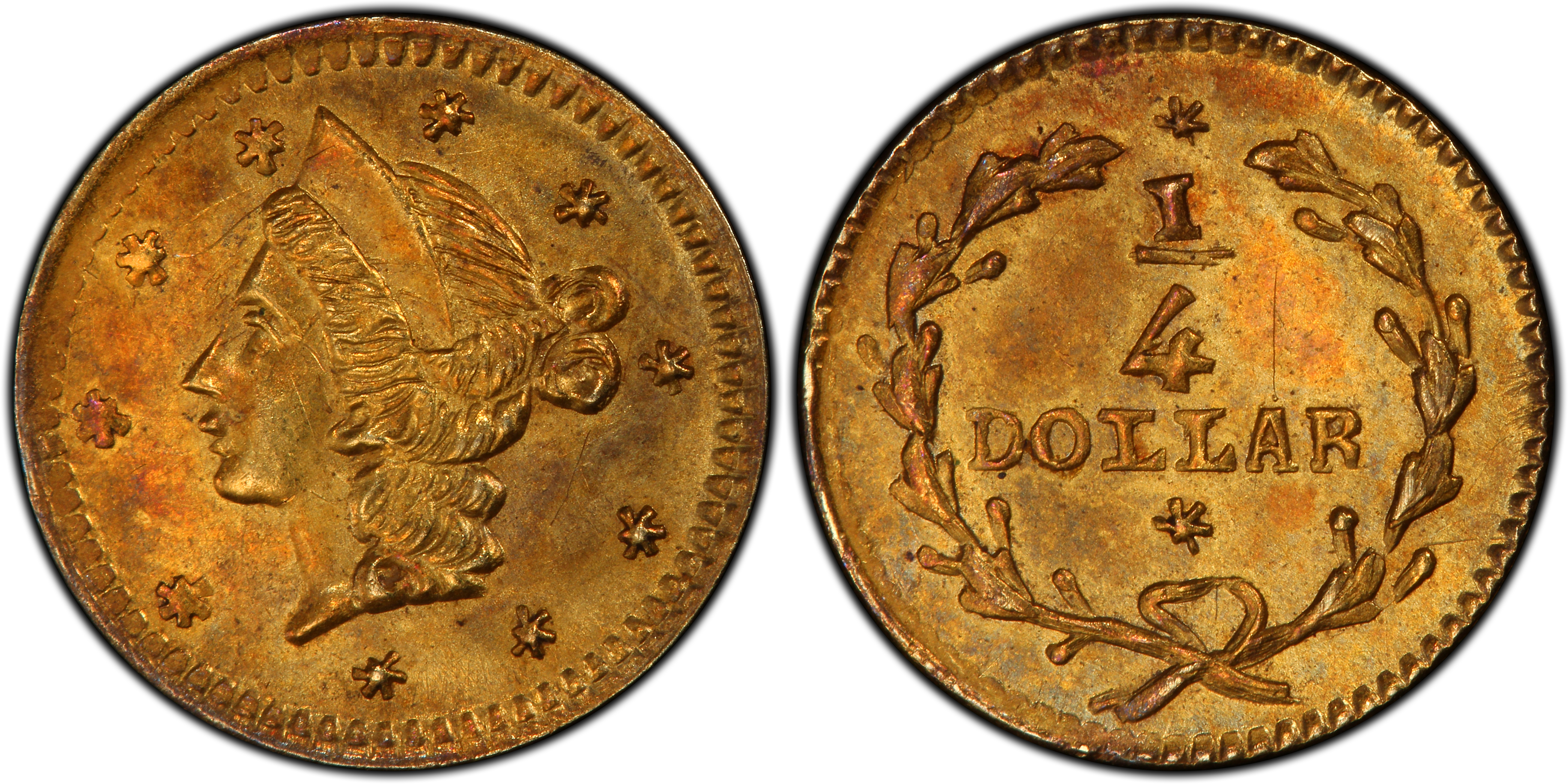
Obverse & Reverse
The BG-207 25 Cents is a quintessential example of 'Period One' California Fractional Gold, a fascinating and essential series born from the chaos and opportunity of the Gold Rush. Following the discovery of gold at Sutter's Mill in 1848, a massive influx of over 300,000 people descended upon California, creating a vibrant but chaotic economy. While miners extracted vast quantities of raw gold, the region suffered from a severe, chronic shortage of circulating small-denomination coinage. Daily transactions for basic goods and services were often conducted with pinches of gold dust, an inaccurate and inefficient system. Federal coinage was scarce on the isolated West Coast, and the newly established San Francisco Mint would not be fully operational until 1856. To fill this critical monetary void, private jewelers and metallurgists in San Francisco began striking their own small-denomination gold coins in 1852. These 'fractionals,' in 25-cent, 50-cent, and one-dollar values, served as a practical substitute for government-issued money. The Joseph Brothers, identified as the minters of the BG-207, were among these private entrepreneurs who responded to the commercial needs of the booming populace. Their coins, like others of the era, were not official legal tender but were widely accepted in local commerce due to necessity. These 'Period One' issues were generally made with a good-faith effort to contain a reasonable amount of gold relative to their face value and often mimicked the Liberty Head designs of contemporary federal gold coins to inspire public confidence. The minting process was rudimentary, often involving hand-cut dies and a sledgehammer-driven press, which resulted in coins of varying strike quality and irregular shapes. As federal coinage became more plentiful after 1856, the necessity for these private issues waned, and their production ceased. The passage of the private coinage act of 1864 officially outlawed their manufacture, cementing their status as a short-lived but historically vital aspect of American economic history. Today, the BG-207 is a tangible relic of the Gold Rush, representing a period of ambitious private enterprise and the forging of a new economy on the American frontier.
Associated EventCalifornia Gold Rush
Reason For MintingTo alleviate a severe shortage of small-denomination coinage for daily commercial transactions in Gold Rush-era California.
Minter HistoryThe Joseph Brothers were jewelers and watchmakers operating in San Francisco during the Gold Rush. Like several other skilled craftsmen with metallurgical experience, they recognized the critical need for small change in the gold-dust-fueled economy and leveraged their expertise to produce private gold coinage. They were responsible for a number of 'Period One' fractional gold varieties, characterized by their rudimentary yet functional designs. Their operations, along with those of other private minters, were crucial for the day-to-day functioning of commerce in the region before the U.S. Branch Mint in San Francisco could adequately supply it with federal coinage.
Historical SignificanceThe BG-207, as a 'Period One' issue, represents the most historically important phase of California Fractional Gold production, when these pieces were genuinely struck to facilitate commerce. Its existence is direct physical evidence of the economic growing pains of the American West and the private innovation required to solve them. It is a key artifact from one of the most significant migrations and economic booms in U.S. history.
BG-207
Denomination25 Cents
Minting Periodc. 1853
Assayer/MinterJoseph Brothers
Geographic OriginSan Francisco, California
Obverse DescriptionA crudely rendered bust of Liberty facing left, her hair tied in a bun. She is surrounded by thirteen five-pointed stars, which are often weakly struck or indistinct. The portrait is a simplified imitation of the design on contemporary federal gold coinage.
Obverse Inscription Reverse DescriptionA simple wreath composed of two branches tied together at the bottom with a bow. Within the wreath, the denomination is expressed.
Reverse Inscription1/4
CompositionGold
Stated Fineness Actual FinenessTypically .800 to .900, derived from native California gold which naturally contains silver.
Weight0.25 grams
Diameter9.50 mm
EdgePlain
Unknown
Survival Estimate31-45 known
Rarity ScaleHigh R-5
The BG-207 is highly sought after as a rare, undated 'Period One' representative of the historic California Fractional Gold series. Its appeal lies in its direct connection to the Gold Rush, its status as a product of private enterprise, and the challenge presented by its rarity and crudely artistic nature.
Key VarietiesNo major varieties, restrikes, or patterns are known for the BG-207. All known examples are considered regular business strikes from the original minting period. Collectors focus on die states and strike quality rather than distinct varieties.
Authentication TipsGenuine BG-207 coins are characteristically very thin and often weakly struck, particularly at the periphery (stars and wreath). Counterfeits are frequently thicker, heavier, and more sharply, uniformly struck. The surfaces of authentic pieces should show the unique texture of early, hand-operated presswork, not the smooth, lifeless fields of modern copies. Many fakes are gold-plated and may show a copper core in areas of wear. Compare the specific die characteristics of the Liberty portrait and wreath to high-resolution images of certified examples, as the style of the Joseph Bros. is distinct.
Shopping ConsiderationsA premium quality BG-207 is defined by several key factors. Look for a specimen with the strongest possible strike on the central devices, particularly Liberty's portrait, as this is where the design is most complete. While peripheral weakness is expected, examples with clearer stars and wreath details command a premium. Original, uncleaned surfaces with some remaining luster are highly desirable; many survivors are found cleaned or have been used in jewelry. Avoid examples that are holed, bent, or show evidence of tooling or harsh cleaning, as these issues significantly impair value. The natural reddish-gold or slightly brassy toning from the native alloy is considered attractive.
A coin's grade is its condition, rated on a 1-70 scale. For rare coins, this is the most critical factor in determining value, as a tiny difference in preservation can mean a huge difference in price.
Relevant Grade TypesOriginal BG-207 coins were business strikes intended for circulation and are found in Circulated (1-58) and Mint State (MS, 60-70) grades. No Proofs were struck during the original period of issue, and there are no known later-date Proof restrikes. Any piece described as a 'Proof' should be regarded with extreme suspicion and is likely a modern replica.
Mint State CharacteristicsAn uncirculated BG-207 will exhibit soft, satiny luster characteristic of the native gold alloy. The strike is almost invariably weak at the borders, with the wreath and stars often appearing soft or incomplete. The high point of the design, Liberty's portrait, should be relatively sharp and free of wear. Due to the rudimentary minting and handling process, small, scattered planchet marks or light adjustment marks are common and may not preclude a Mint State grade if they are not distracting.
Circulated Wear PatternsWear first appears on the highest points of the design. On the obverse, friction will first be evident on Liberty's cheek, the highest part of her hair bun, and her ear. On the reverse, the high points of the wreath's leaves and the bow will show initial wear. In lower grades (VG and below), the stars will begin to merge with the fields, and the details of the wreath will become flat and indistinct.
Key Factors For ValueFor the BG-207, value is driven by three main factors: surface preservation, strike quality, and eye appeal. A coin with original, uncleaned surfaces commands a significant premium over a cleaned or polished example of the same technical grade. The sharpness of the strike on the central Liberty portrait is paramount; a well-defined portrait can compensate for typical peripheral weakness. Finally, coins with attractive, original color and minimal distracting marks will always be prized. A CAC sticker for this issue is a strong indicator of superior quality for the grade and adds a considerable premium.
PCGS Price Guide
| Grade | Price | Population |
|---|---|---|
| 50 | $425.00 | 1 |
| 50+ | $435.00 | N/A |
| 53 | $450.00 | N/A |
| 53+ | $475.00 | N/A |
| 55 | $500.00 | 2 |
| 55+ | $545.00 | N/A |
| 58 | $575.00 | 4 |
| 58+ | $650.00 | N/A |
| 60 | $725.00 | 1 |
| 61 | $800.00 | 1 |
| 62 | $875.00 | 7 |
| 62+ | $950.00 | N/A |
| 63 | $1,350.00 | 11 |
| 63+ | $1,650.00 | N/A |
| 64 | $2,750.00 | 6 |
| 64+ | $3,250.00 | N/A |
| 65 | $4,250.00 | 1 |