1853 G25C BG-213 (Regular Strike)
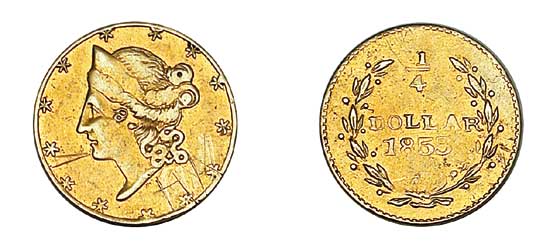
Obverse & Reverse
The 1853 BG-213 25 Cents is a numismatic ghost from the zenith of the California Gold Rush, a tangible artifact of a chaotic and transformative period in American history. Following the 1848 discovery of gold at Sutter's Mill, a massive influx of prospectors and merchants flooded into California, creating a vibrant but unstable economy. While gold dust and large-denomination private assayer coins served for significant transactions, the region suffered from a crippling shortage of small-denomination coinage for everyday commerce. A shave, a drink, or a meal could not be easily paid for with a pinch of gold dust, a notoriously inaccurate and contentious method of payment. Federal coinage was scarce on the West Coast, and the newly established San Francisco Mint would not begin operations until 1854, initially focusing on larger coins. Into this vacuum stepped numerous private jewelers and metallurgists, primarily in San Francisco. Between 1852 and 1857, a period numismatists classify as 'Period One,' these artisans produced a dizzying variety of fractional gold coins in 25-cent, 50-cent, and dollar denominations. These pieces were not government-sanctioned but were generally accepted in local trade out of sheer necessity. The BG-213 is a prime example of these early, functional issues. Struck with hand-cut dies and rudimentary presses, its quality was a far cry from official mint products, yet it served its purpose. These tiny coins, often containing gold alloyed with native silver, circulated freely, as evidenced by shipwreck finds like the S.S. Central America. However, their small size made them easy to lose, and their intrinsic value often fluctuated, leading many to be melted down over time. The BG-213 variety is one of the most elusive of all, a testament to the ephemeral nature of these privately issued coins. Its survival is a near-miracle, providing a direct link to the day-to-day economic struggles and ingenuity of the '49ers.
Associated EventCalifornia Gold Rush
Reason For MintingTo alleviate a severe shortage of small-denomination coinage for daily commercial transactions in Gold Rush-era California.
Minter HistoryThe minter of the BG-213 variety is unknown, a common trait for many Period One California Fractional Gold issues. Most were produced anonymously by San Francisco jewelers and artisans who saw a commercial opportunity to meet the region's desperate need for small change. These makers, some of whom were French immigrants, operated small, private facilities, hand-engraving dies and striking coins with screw or hammer presses. Their primary business was jewelry, but their minting operations, while unofficial, were a vital part of the local economy until federal coinage became plentiful.
Historical SignificanceAs a 'Period One' issue, the BG-213 represents the legitimate, circulation-focused era of California Fractional Gold, created to solve a genuine economic problem. Its immense rarity underscores the low survival rate of these privately minted coins and makes it a key representative of one of the most fascinating and complex chapters in American monetary history. It is a direct link to the resourcefulness of private enterprise on the American frontier.
K-Unlisted
Denomination25 Cents
Minting Period1853
Assayer/MinterUnknown
Geographic OriginSan Francisco, California
Obverse DescriptionA fairly crude rendering of a Liberty Head, facing left. The portrait is surrounded by thirteen small, five-pointed stars. The date, 1853, is positioned below the bust truncation. The die work is characteristic of the primitive methods used by private minters of the era.
Obverse Inscription1853
Reverse DescriptionThe reverse features the denomination '1/4' at the center, surrounded by the inscription 'CALIFORNIA GOLD'. The lettering is somewhat irregular. A key diagnostic is the distinct, large dot or period between CALIFORNIA and GOLD.
Reverse InscriptionCALIFORNIA GOLD 1/4
CompositionGold
Stated Fineness Actual FinenessTypically around .880 fine, consistent with unrefined California gold ore which naturally contained silver.
Weight0.25 grams
Diameter10.00 mm
EdgePlain
Extremely low; likely only a few dozen originally struck.
Survival Estimate2 known examples.
Rarity ScaleR-8 (per Breen-Gillio)
The BG-213 is a quintessential 'trophy coin.' Its appeal lies in its legendary rarity as one of only two known specimens, its direct connection to the authentic, circulating Period One fractional gold series, and the raw, tangible history it represents from the California Gold Rush. Acquiring it is a pinnacle achievement for the most advanced specialists in territorial gold.
Key VarietiesThere are no known varieties of the BG-213 itself. As a Period One business strike, there were no proofs or special collector issues produced. It should not be confused with the myriad of later 'Period Two' souvenir pieces (1859-1882) or modern replicas, which are common.
Authentication TipsAuthentication requires expert examination. Key diagnostics include the specific die characteristics of the Liberty head and stars, the exact shape and placement of the numerals in the date, and the prominent dot between CALIFORNIA and GOLD on the reverse. The fabric of the coin—its color, luster, and planchet characteristics—must be consistent with known genuine Period One issues. Weight should be approximately 0.25 grams. Most fakes are either gold-plated base metal or have incorrect weight, die work, and overall 'feel.' Given its rarity, any example offered should have an unbroken provenance and certification from a top-tier grading service.
Shopping ConsiderationsFor a coin of this rarity, the primary consideration is simply availability; it has only appeared at auction on exceedingly rare occasions. A 'premium quality' example would be one that is well-centered and sharply struck for the issue, with minimal surface impairments. Given that both known examples are in Mint State, the focus would be on luster, eye appeal, and the absence of distracting marks. Any cleaning, tooling, or damage would severely impact its value. Due to the primitive manufacturing, some planchet roughness or weakness in the strike on the highest points (hair, stars) might be inherent and should be evaluated by an expert to distinguish it from post-strike damage. A potential buyer must be prepared for fierce competition from the world's top collectors.
A coin's grade is its condition, rated on a 1-70 scale. For rare coins, this is the most critical factor in determining value, as a tiny difference in preservation can mean a huge difference in price.
Relevant Grade TypesOriginal period issues of BG-213 were business strikes intended for circulation, and are found in Circulated (1-58) and Mint State (MS, 60-70) grades. No Proof (PR/PF) examples were struck during the original minting period, nor are any later-date restrikes known. Both of the confirmed surviving examples are in Mint State condition, a remarkable feat for such a fragile and utilitarian coin.
Mint State CharacteristicsAn uncirculated BG-213 would be defined by its luster, which is typically soft and satiny rather than deeply prooflike, reflecting the nature of the planchets and dies. The strike is characteristically weak in areas, especially on the high points of Liberty's hair and some of the stars. The surfaces may exhibit minor planchet flaws or adjustment marks from the crude manufacturing process, which are generally accepted by specialists. The presence of original, undisturbed surfaces is paramount.
Circulated Wear PatternsWhile the known examples are uncirculated, if a circulated specimen were to surface, wear would first appear on the highest points of Liberty's hair, cheek, and the coronet. The stars would quickly lose their definition. On the reverse, the fraction '1/4' and the letters in the legend would be the first elements to show flatness and begin to merge with the fields in lower grades.
Key Factors For ValueFor the BG-213, value is driven almost entirely by its legendary rarity as one of only two known specimens. Within that context, the specific grade (e.g., MS63 vs. MS62) would be a key differentiator. Surface quality is crucial; an example with clean, lustrous, original surfaces will command a significant premium over one that has been cleaned, has distracting marks, or exhibits spotting. Eye appeal, meaning the overall visual attractiveness of the coin, plays a significant role. Finally, a CAC sticker, indicating premium quality for the grade, would add a substantial premium for an issue of this caliber.
PCGS Price Guide
| Grade | Price | Population |
|---|---|---|
| 30 | $6,500.00 | N/A |
| 63 | N/A | N/A |
| 64 | N/A | N/A |