1853 G$1 BG-525 (Regular Strike)
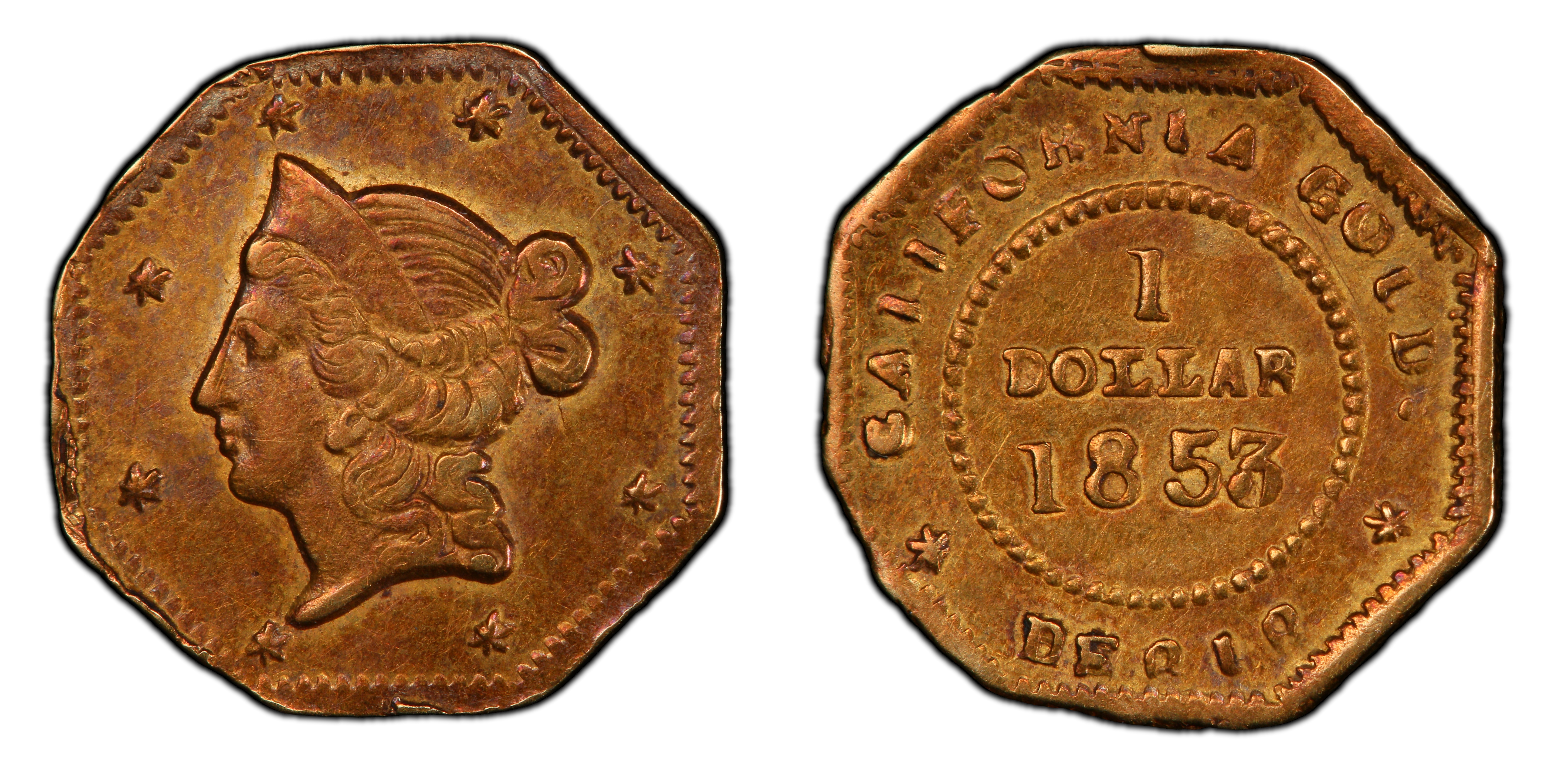
Obverse & Reverse
The 1853 BG-525 octagonal gold dollar is a tangible relic from the chaotic, formative years of the California Gold Rush. Following the discovery of gold at Sutter's Mill in 1848, a massive influx of prospectors and merchants flooded into California, creating a vibrant but monetarily starved economy. Gold dust and nuggets, the primary medium of exchange, were cumbersome, difficult to value precisely, and susceptible to theft and adulteration. While the U.S. Assay Office and private firms like Moffat & Co. produced larger denomination coins and ingots, a severe and persistent shortage of small change crippled daily commerce. Transactions for everyday goods and services became a logistical nightmare, forcing merchants to resort to barter or issue scrip. Into this void stepped a number of San Francisco jewelers and metallurgists who possessed the skills and equipment to mint small-denomination coinage. These 'California Fractional Gold' pieces, struck in quarter dollar, half dollar, and one-dollar denominations, were a direct market response to this critical economic need. The BG-525, attributed to the firm of Gaime, Guillemot & Co., is a 'Period One' issue, a designation for coins struck between 1852 and 1857 that were generally of good weight and fineness, and were clearly intended to circulate as currency. These pieces were struck by hand, using a hammer to impress the design from engraved dies onto a planchet, resulting in crude but functional coins. Despite their necessity, their legal status was ambiguous, and they were eventually supplanted by the establishment of the official San Francisco Branch Mint in 1854. Most fractional gold pieces were ultimately melted down, contributing to their high rarity today. The BG-525 stands as a testament to the ingenuity and frontier capitalism that defined one of the most dynamic periods in American history.
Associated EventCalifornia Gold Rush
Reason For MintingTo alleviate a severe shortage of small-denomination coinage for everyday commercial transactions in Gold Rush-era California.
Minter HistoryGaime, Guillemot & Co. was a firm of French jewelers and watchmakers operating in San Francisco during the early 1850s. Located at 140 Montgomery Street, the partnership likely consisted of J. Gaime and a Mr. Guillemot. Like other jewelers of the period, they possessed the requisite skills in metallurgy and die-making to venture into private coinage to meet the region's desperate need for small change. Their production was likely small and their operation short-lived, as the establishment of the San Francisco Mint in 1854 rendered most private mints obsolete. The firm's primary business remained jewelry and watchmaking, with coinage being a profitable but temporary sideline. Little else is definitively known about their operations or the individuals involved, but the surviving coins, like the BG-525, serve as the primary evidence of their numismatic contribution.
Historical SignificanceThe BG-525 is a quintessential example of 'Period One' California Fractional Gold, representing a private solution to a public monetary crisis. Its existence highlights the inadequacy of federal coinage distribution on the West Coast during the Gold Rush and the entrepreneurial spirit of the era. These pieces are historically significant as they were among the first privately-issued coins to circulate widely in California, facilitating commerce and helping to stabilize the local economy before the establishment of a permanent U.S. Mint branch.
K-
DenominationG$1
Minting Period1853
Assayer/MinterGaime, Guillemot & Co.
Geographic OriginSan Francisco, California
Obverse DescriptionA fairly crude representation of the Liberty Head, facing left, with hair tied in a bun. The portrait is surrounded by 13 five-pointed stars, which are often weakly struck and may appear as dots. The date '1853' appears below the bust, though it is often faint or partially effaced even on higher-grade specimens.
Obverse Inscription1853
Reverse DescriptionThe denomination '1' is centrally located, with the word 'DOLLAR' inscribed below it. The entire central device is enclosed within a wreath of two olive branches, with the stems tied at the bottom. At the top, between the tips of the branches, is the inscription 'CALIFORNIA GOLD'.
Reverse InscriptionCALIFORNIA GOLD 1 DOLLAR
CompositionGold
Stated Fineness Actual FinenessApproximately .880 to .900 fine, though it can vary.
Weight0.97 grams
Diameter11.20 mm
EdgePlain
Unknown
Survival Estimate16-30
Rarity ScaleR-6+
This variety appeals to serious collectors of Territorial gold and Gold Rush history. Its octagonal shape, high rarity, and direct connection to the chaotic San Francisco economy of 1853 make it a highly desirable and historically significant artifact. As a hand-struck 'Period One' issue, each example is unique in its own way.
Key VarietiesThe BG-525 is itself a specific die variety. No major sub-varieties from the original minting period are widely recognized. No later-date Proof restrikes or special collector issues are known to exist for this specific variety.
Authentication TipsAuthentic examples exhibit a crude, hand-struck appearance. Look for a specific die crack that often runs from the rim through the first 'A' in CALIFORNIA on the reverse. The style of the '5' in the date is also a key diagnostic. The overall fabric should feel correct for hammered gold of the period, lacking the uniform, sterile look of modern replicas. Many counterfeits are cast and will show pitting or a soapy appearance under magnification. Weight and size should be reasonably close to the known specifications, though slight variations are expected.
Shopping ConsiderationsWhen acquiring a BG-525, focus on surface originality and the clarity of the central design elements and legends. A premium quality example for its grade will possess minimal distracting marks, an even strike, and attractive original color. It is common for these pieces to be weakly struck, especially at the periphery (stars and parts of the legend). A coin with a bold date and clear 'CALIFORNIA GOLD' is highly desirable. Avoid examples that have been harshly cleaned, polished, or show evidence of tooling or repair, as this drastically reduces value. Third-party certification by PCGS or NGC is highly recommended for authenticity and to provide a standardized grade.
A coin's grade is its condition, rated on a 1-70 scale. For rare coins, this is the most critical factor in determining value, as a tiny difference in preservation can mean a huge difference in price.
Relevant Grade TypesOriginal period issues were business strikes intended for circulation and are found in Circulated (1-58) and Mint State (MS, 60-70) grades. No Proofs (PR/PF) were struck during the original period of issue, and no later-date restrikes or special collector strikings are known for this variety.
Mint State CharacteristicsAn uncirculated BG-525 will show some degree of original mint luster, often with a soft, satiny texture. The strike is almost never full; weakness on the stars, date, and peripheral legends is expected. The key is to find an example with better-than-average sharpness on the central Liberty head and the '1 DOLLAR' on the reverse. Bag marks and planchet flaws are common due to the crude manufacturing process and should be evaluated for severity and location.
Circulated Wear PatternsWear first appears on the highest points: Liberty's cheek, hair bun, and eyebrow. On the reverse, the '1' and 'DOLLAR' will show initial friction, followed by the high points of the wreath. In lower grades (below VF), the date and stars will become faint, and the legends will begin to merge with the fields.
Key Factors For ValueFor the BG-525, value is driven primarily by grade and surface quality. An example with original, unmolested surfaces and pleasing eye appeal will command a significant premium over a cleaned or damaged coin of the same numerical grade. Sharpness of strike is a major consideration; a well-struck specimen with a clear date is a rarity and highly prized. Given the coin's rarity, even low-grade, problem-free examples are sought after. A CAC sticker indicating superior quality for the grade would add a substantial premium.
PCGS Price Guide
| Grade | Price | Population |
|---|---|---|
| 45 | $1,750.00 | 1 |
| 45+ | $1,850.00 | N/A |
| 50 | $2,000.00 | 2 |
| 50+ | $2,015.00 | N/A |
| 53 | $2,050.00 | 1 |
| 53+ | $2,065.00 | N/A |
| 55 | $2,100.00 | 3 |
| 55+ | $2,250.00 | N/A |
| 58 | $2,500.00 | 3 |
| 58+ | $2,750.00 | N/A |
| 60 | $3,500.00 | N/A |
| 61 | $4,250.00 | 1 |
| 62 | $5,750.00 | 3 |
| 62+ | $6,250.00 | N/A |
| 63 | $7,000.00 | 1 |