1853 G$1 BG-502 Eagle (Regular Strike)
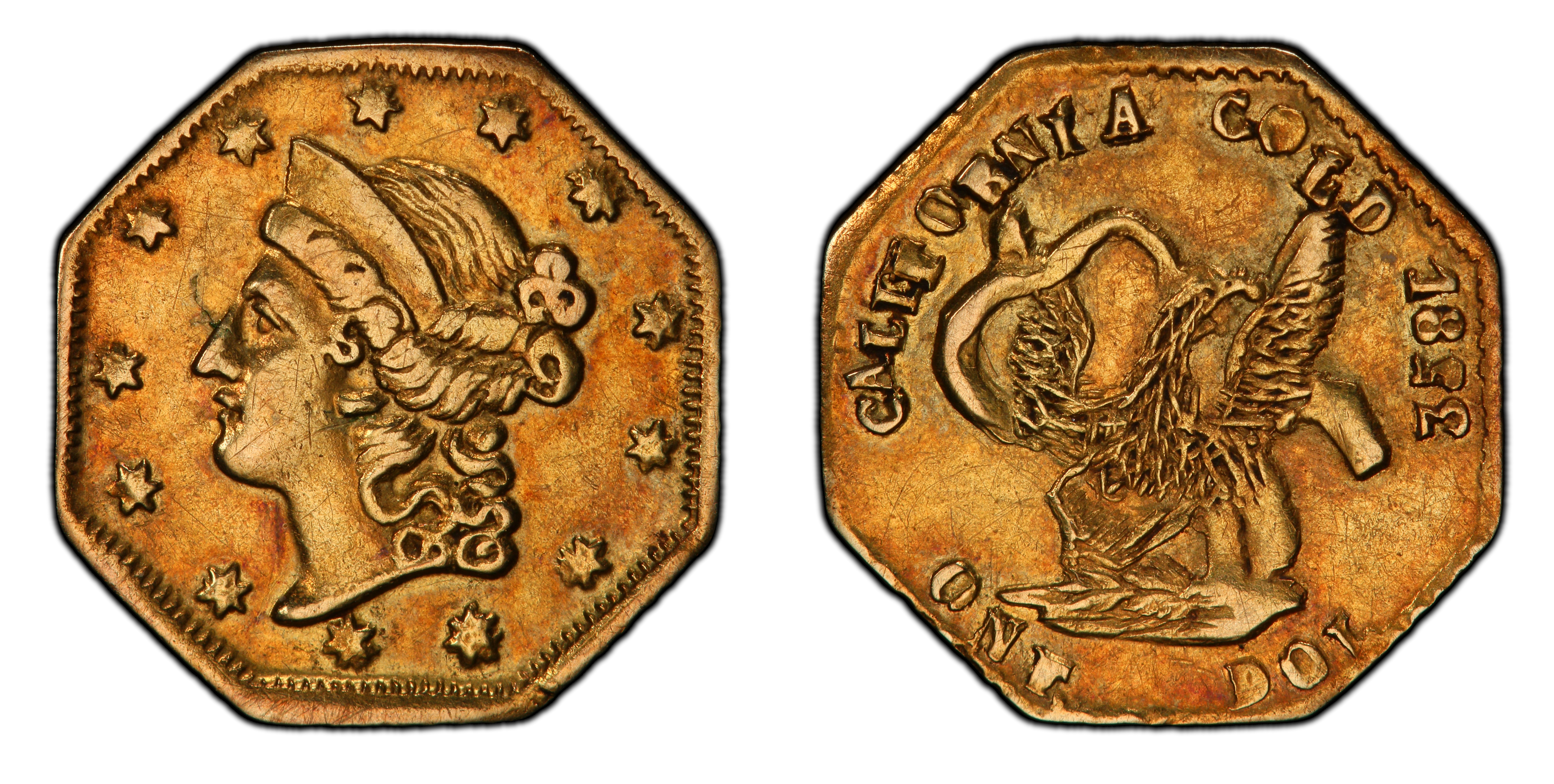
Obverse & Reverse
The 1853 G$1 BG-502 Eagle is a quintessential artifact from the chaotic, formative years of the California Gold Rush. Following the discovery of gold at Sutter's Mill in 1848, a massive influx of prospectors and merchants descended upon California, creating a vibrant but unstable economy. While gold dust and large-denomination private assayer coins served for major transactions, the region suffered from a crippling shortage of small-denomination coinage for daily commerce. Federal coins were scarce, and the newly established San Francisco Mint would not begin operations until 1854. This monetary vacuum created a unique opportunity for private enterprise. Jewelers and metalworkers in San Francisco, many of them recent French immigrants, began striking their own fractional-denomination gold coins in 25-cent, 50-cent, and one-dollar values, beginning in 1852. These 'Period One' issues, including the BG-502, were not novelty items but were struck with the genuine intent of serving as a circulating medium of exchange. The public, desperate for coinage, initially accepted them despite their typically being slightly underweight. The BG-502, attributed to French jeweler Antoine Louis Nouizillet, exemplifies this period's coinage. Struck by hand using a hammer on a simple screw press, these octagonal dollars were tiny, often crudely made, yet vital cogs in the commercial machine of Gold Rush San Francisco. Their practicality was short-lived; their diminutive size made them easy to lose, and the increasing supply of federal coinage from the San Francisco Mint after 1854 rendered them obsolete for circulation. However, their story did not end there. They quickly became popular keepsakes and souvenirs, tangible pieces of 'California Gold' that could be easily mailed back East to relatives. This second life as souvenirs ensured the survival of many examples that would have otherwise been lost or melted, preserving a direct link to the ingenuity and necessity that defined one of America's most dynamic historical eras.
Associated EventCalifornia Gold Rush
Reason For MintingTo alleviate a severe shortage of small-denomination coinage for everyday commercial transactions in Gold Rush-era San Francisco.
Minter HistoryAntoine Louis Nouizillet was a French jeweler and watchmaker who emigrated to San Francisco during the Gold Rush. He was one of the most prominent and skilled private minters of 'Period One' California Fractional Gold. Operating a shop in the bustling city, Nouizillet and his contemporaries applied their metallurgical and engraving skills to meet the region's pressing need for small change. His issues, often identified by style or specific punches, are noted for their relatively consistent quality and design, which emulated the motifs of official U.S. coinage to foster public acceptance. Nouizillet was a key figure among the group of French artisans who dominated the production of this fascinating and historically significant series of private coinage.
Historical SignificanceThe BG-502 and other 'Period One' fractional gold pieces are historically significant as a tangible solution to a critical economic problem on the American frontier. They represent a rare instance of privately issued coinage filling a void left by the federal government and are a direct monetary link to the California Gold Rush. Their transition from utilitarian currency to popular souvenirs charts the evolving economy and social landscape of mid-19th century California.
K-N/A
DenominationG$1
Minting Period1853
Assayer/MinterAntoine Louis Nouizillet
Geographic OriginSan Francisco, California
Obverse DescriptionA fairly crude depiction of a Liberty Head facing left, her hair tied in a bun. The portrait is surrounded by thirteen stars, representing the original colonies. The date '1853' is positioned below the bust.
Obverse Inscription1853
Reverse DescriptionA heraldic eagle with a shield on its breast, clutching an olive branch and arrows in its talons. The denomination '1' and 'DOLLAR' appear within a circle of beads or dots. The legend 'CALIFORNIA GOLD' is inscribed above the eagle, along the upper periphery.
Reverse InscriptionCALIFORNIA GOLD 1 DOLLAR
CompositionGold
Stated Fineness Actual FinenessVaries, but typically 14 to 22 karats, often containing native silver which gives a lighter color.
Weight0.90 grams
Diameter11.00 mm
EdgePlain
Unknown; likely several thousand
Survival Estimate150-250
Rarity ScaleR-5
This coin is highly sought after as a genuine 'Period One' issue, struck for circulation during the height of the Gold Rush. Its octagonal shape, Eagle reverse, and direct connection to a pivotal moment in American history make it a classic for collectors of pioneer gold and Western Americana.
Key VarietiesThe BG-502 is a specific die marriage. While there are no major varieties of the BG-502 itself from 1853, the broader series of California Fractional Gold dollars from the 1853-1854 period includes numerous die pairings (Breen-Gillio varieties) with subtle differences in lettering, star placement, and eagle design. No known special collector issues, such as proofs or restrikes, exist for the BG-502.
Authentication TipsAuthentic 'Period One' fractionals have a distinct character. Look for a somewhat crude, hand-struck appearance, not a modern, machine-made look. The gold should have a natural, often slightly pale or 'alloyed' color due to native silver. Edges are plain and often show irregularities. The most common fakes are modern tokens, often with a bear on the reverse, or brass counterfeits that lack the correct weight and metallic luster. Genuine pieces will say 'DOLLAR' or 'DOL.', whereas many tokens simply state 'CALIFORNIA GOLD' without a legal denomination.
Shopping ConsiderationsA premium quality example for this issue is defined by a bold, well-centered strike and minimal surface impairments. Look for sharpness on the highest points: Liberty's hair details and the eagle's head and wing feathers. Original, uncleaned surfaces with some remaining luster command a significant premium. Avoid examples that have been used as jewelry, indicated by solder marks, harsh polishing, or holes. Planchet quality can be inconsistent, so a smooth, problem-free planchet is a major plus. Pay close attention to the date and legends; weakness in these areas is common but excessively weak strikes are less desirable.
A coin's grade is its condition, rated on a 1-70 scale. For rare coins, this is the most critical factor in determining value, as a tiny difference in preservation can mean a huge difference in price.
Relevant Grade TypesOriginal period issues of BG-502 were business strikes intended for circulation and are found in Circulated (1-58) and Mint State (MS, 60-70) grades. Due to their brief time in commerce and subsequent use as souvenirs, many have survived in higher grades than might be expected. No Proof (PR/PF) examples were struck during the original period of issue, and no later-date restrikes are known to exist.
Mint State CharacteristicsAn uncirculated (MS) example of the BG-502 will exhibit original mint luster, which is typically soft and satiny rather than deeply prooflike. Strike is a key factor; many were struck with uneven pressure, so a piece with a sharp, well-balanced strike on both sides is rare and desirable. The tiny planchets are very susceptible to contact marks, so even a high-grade MS coin may show minor ticks. The key is to differentiate between circulation wear and minor mint-made imperfections or cabinet friction.
Circulated Wear PatternsWear first appears on the highest points of the design. On the obverse, friction will dull the luster and flatten the details on Liberty's cheek, hair bun, and the stars. On the reverse, the eagle's head, the upper portion of the wings, and the shield's high points will show the first signs of rub. In lower grades (VF and below), the finer details of the feathers will merge and the legends will start to become soft.
Key Factors For ValueThe primary drivers of value for an 1853 BG-502 are grade and surface quality. An example with original, uncleaned surfaces will always be worth significantly more than a cleaned or polished coin of the same grade. Strike sharpness is paramount; a well-struck coin is far more desirable than a weakly struck one. Eye appeal, encompassing attractive color and a lack of distracting marks, plays a major role. Finally, certification by a top-tier grading service (PCGS or NGC) is essential for market acceptance, with a CAC sticker adding a further premium for coins deemed superior for their grade.
PCGS Price Guide
| Grade | Price | Population |
|---|---|---|
| 50 | $17,500.00 | N/A |
| 50+ | $18,000.00 | N/A |
| 53 | $19,000.00 | 1 |
| 53+ | $19,500.00 | N/A |
| 55 | $21,000.00 | 1 |
| 55+ | $22,000.00 | N/A |
| 58 | $23,500.00 | 1 |
| 58+ | $25,000.00 | N/A |
| 60 | $27,500.00 | N/A |
| 61 | $30,000.00 | N/A |
| 62 | $35,000.00 | 1 |
| 63 | N/A | N/A |