1871 G$1 BG-1204 (Regular Strike)
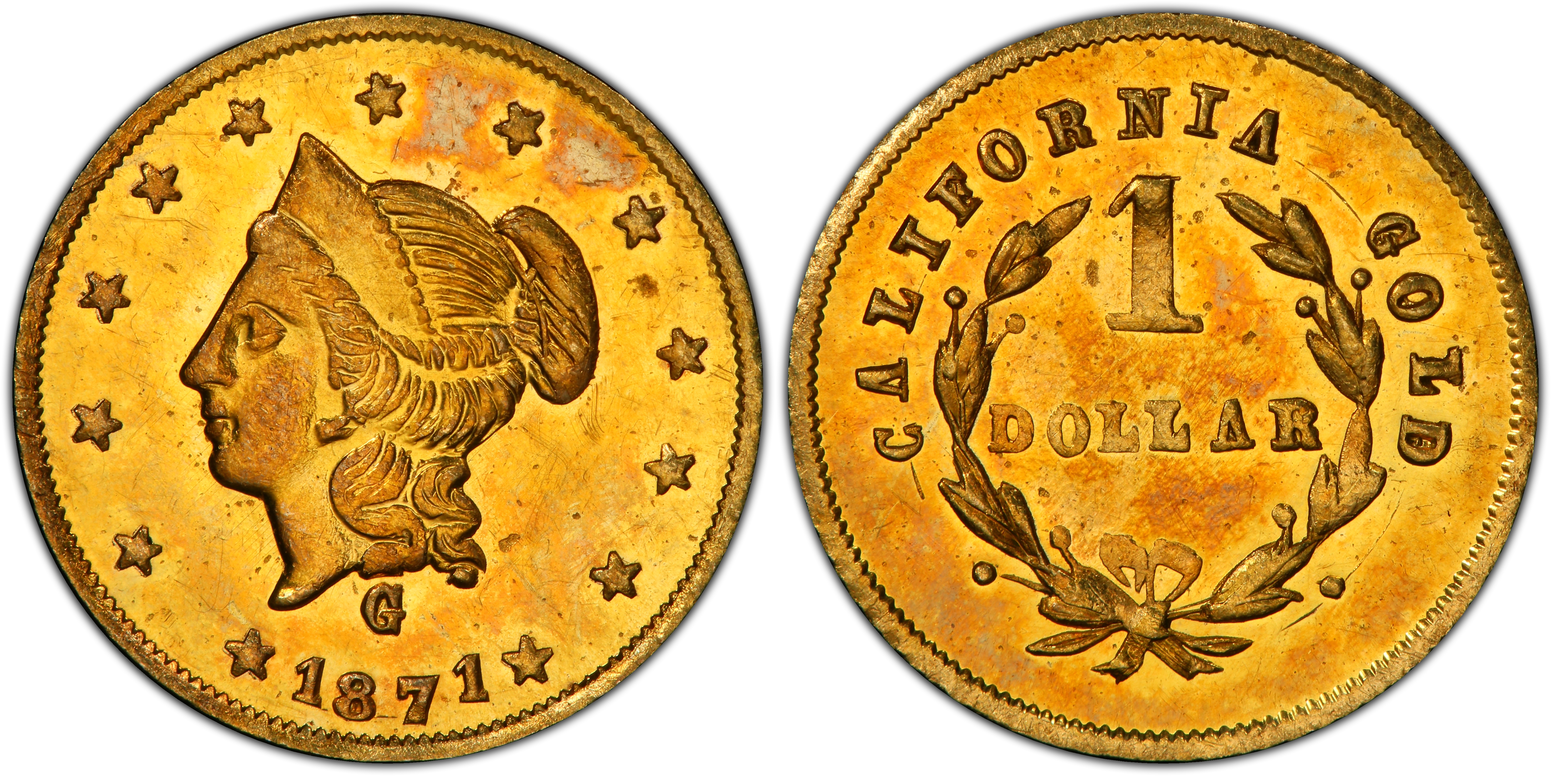
Obverse & Reverse
The 1871 G$1 BG-1204 is a quintessential example of a 'Period Two' California Fractional Gold piece, a series whose purpose had evolved significantly from its origins. By 1871, the initial, frantic days of the Gold Rush were over, and California's economy had matured. The acute shortage of small change that had prompted the creation of the first fractional gold pieces ('Period One,' 1852-1857) had been largely resolved by the output of the San Francisco Mint. Consequently, the private minting of fractional gold shifted from a necessity to a novelty. This era, from 1859 to 1882, was dominated by manufacturing jewelers who produced these miniature gold coins primarily as souvenirs, keepsakes, and curios for tourists and locals nostalgic for the Gold Rush era. These pieces were intentionally struck underweight, containing less than a dollar's worth of gold, making them profitable tokens rather than circulating currency. The BG-1204 variety is traced to a pivotal moment in the lineage of San Francisco jewelers. Robert B. Gray, who had purchased the business of pioneer minter Antoine Louis Nouizillet, sold his own operation in 1871 to the Levison Brothers, Herman and Jacob, who operated as the California Jewelry Company. The dies for BG-1204 were likely produced and used by them during this transitional year. This historical context is vital; the coin was never intended to be a monetary instrument but rather a commercial product, a memento of California's golden identity. The enforcement of the Private Coinage Act of 1864 was inconsistent, but pressure from the Secret Service was mounting around this time, leading many producers to be discreet. These 'jeweler's issues' are often characterized by more imaginative, if sometimes cruder, designs compared to the utilitarian style of Period One issues. The BG-1204, with its classic Liberty motif, represents a popular and readily salable design, perfect for its intended market. Its survival in relatively high numbers compared to earlier issues attests to its success as a collectible souvenir that was saved rather than spent.
Associated EventPost-Gold Rush California Commerce
Reason For MintingTo be sold as a popular and profitable souvenir or keepsake of the California Gold Rush era.
Minter HistoryThe BG-1204 is attributed to the California Jewelry Company, owned by Herman and Jacob Levison. In 1871, they purchased the jewelry manufacturing business of Robert B. Gray, who himself had succeeded another pioneer minter, Antoine Louis Nouizillet. This lineage provided the Levison Brothers with the equipment, dies, and expertise to continue the production of fractional gold. The California Jewelry Co. was a major San Francisco firm located at 134 Sutter Street, dealing in watches, diamonds, and fine jewelry. Their production of fractional gold was a small but notable part of their business, often using an 'L' mintmark for Levison, though this variety is unmarked.
Historical SignificanceThis coin is historically significant not as a circulating medium, but as a tangible artifact of how the Gold Rush was memorialized and commercialized. It represents the shift in the purpose of fractional gold from a functional monetary substitute to a nostalgic souvenir, reflecting a more settled and prosperous San Francisco that had begun to romanticize its own recent past.
BG-1204
DenominationG$1
Minting Period1871
Assayer/MinterCalifornia Jewelry Company (Levison Brothers)
Geographic OriginSan Francisco, California
Obverse DescriptionA head of Liberty faces left, her hair tied in a bun with trailing curls. She is encircled by thirteen six-pointed stars, representing the original colonies. The date '1871' is positioned below the truncation of the neck.
Obverse Inscription1871
Reverse DescriptionThe denomination '1 DOLLAR' is inscribed in two lines within a wreath. The wreath is composed of two branches tied together at the bottom by a bow.
Reverse Inscription1 DOLLAR
CompositionGold
Stated Fineness Actual FinenessVariable, but significantly less than the .900 standard of federal coinage; typical for Period Two jeweler's issues.
Weight0.50 grams
Diameter11.50 mm
EdgePlain
Unknown
Survival Estimate31-75 (per R-5 rating)
Rarity ScaleHigh R-5
The BG-1204 is sought after as a representative example of a Period Two fractional dollar from a historically significant year of transition between well-known minters. Its clear design, affordability relative to Period One issues, and known rarity make it an attractive piece for type collectors and specialists in California gold.
Key VarietiesThere are no major die varieties of BG-1204 from its period of issue. Unlike some earlier territorial issues, there are no known later-date Proof restrikes or special collector patterns associated with these specific dies. The primary variations among surviving examples relate to die state and strike quality.
Authentication TipsGenuine examples often exhibit a distinctive, slightly soft strike. A key diagnostic is the characteristic weakness of the letters 'OLL' in DOLLAR and the loop of the bow on the reverse; sharply struck examples in these areas should be viewed with suspicion. The planchets are typically thin. Counterfeits are common and often appear overly sharp, have incorrect weights and diameters, or display a soapy, cast-like surface texture. The style of the numerals in the date and the stars should be compared to known genuine examples.
Shopping ConsiderationsA premium quality example for its grade will display glossy, often prooflike or semi-prooflike surfaces, a hallmark of many Period Two issues. Look for minimal distracting marks, particularly on Liberty's cheek and the reverse fields. While some weakness on the reverse legend ('OLL') is expected and even diagnostic, examples where the rest of the design is sharply struck are highly desirable. Avoid pieces that have been harshly cleaned, which strips the original skin and luster, or examples that show evidence of being mounted in jewelry, a common fate for these souvenir pieces.
A coin's grade is its condition, rated on a 1-70 scale. For rare coins, this is the most critical factor in determining value, as a tiny difference in preservation can mean a huge difference in price.
Relevant Grade TypesOriginal issues were business strikes produced for commercial sale as souvenirs and are found in Circulated (1-58) and, more commonly, Mint State (MS, 60-70) grades. No true Proofs were struck during the original period of issue. The highly reflective, prooflike surfaces seen on many Mint State examples are a result of the planchet preparation and striking process for these jeweler's pieces, but they are not considered true Proofs.
Mint State CharacteristicsUncirculated examples of BG-1204 are known for their bright, flashy luster, often with deep, mirror-like fields (DMPL or PL). The overall strike is typically decent on the obverse portrait, but almost always shows some weakness on the reverse. The letters 'OLL' in DOLLAR are characteristically faint. The highest points, like the hair above Liberty's eye and the knot in the bow, may not be fully struck up. High-grade pieces are prized for having clean, 'mark-free' surfaces, as the soft gold is very susceptible to contact marks.
Circulated Wear PatternsOn circulated examples, wear first appears on the high points of Liberty's hair, particularly the strands above the ear and forehead, and on her cheek. On the reverse, the leaves and the knot of the bow will show initial flatness and smoothing. In lower grades (VF and below), the finer details of the hair and leaves merge, and the legends begin to soften.
Key Factors For ValueSurface preservation is the paramount factor. A coin with original, undisturbed prooflike luster will command a significant premium over a cleaned or abraded piece of the same grade. Strike sharpness, while allowing for the known central weakness on the reverse, is important; a bold obverse portrait adds to the eye appeal. Attractive, original toning, often a subtle reddish or orange-gold hue, is highly desirable. For this series, a CAC sticker carries a strong premium, as it confirms both the grade and the quality of the surfaces for the assigned grade.
PCGS Price Guide
| Grade | Price | Population |
|---|---|---|
| 45 | $1,200.00 | 2 |
| 45+ | $1,250.00 | N/A |
| 50 | $1,350.00 | N/A |
| 50+ | $1,400.00 | N/A |
| 53 | $1,450.00 | 1 |
| 53+ | $1,500.00 | N/A |
| 55 | $1,650.00 | 5 |
| 55+ | $1,700.00 | N/A |
| 58 | $2,200.00 | 6 |
| 58+ | $2,400.00 | N/A |
| 60 | $2,800.00 | N/A |
| 61 | $3,150.00 | 2 |
| 62 | $3,500.00 | 12 |
| 62+ | $4,000.00 | N/A |
| 63 | $6,000.00 | 3 |
| 63+ | $7,500.00 | 1 |
| 64 | $11,000.00 | N/A |