1869 G$1 BG-1106 (Regular Strike)
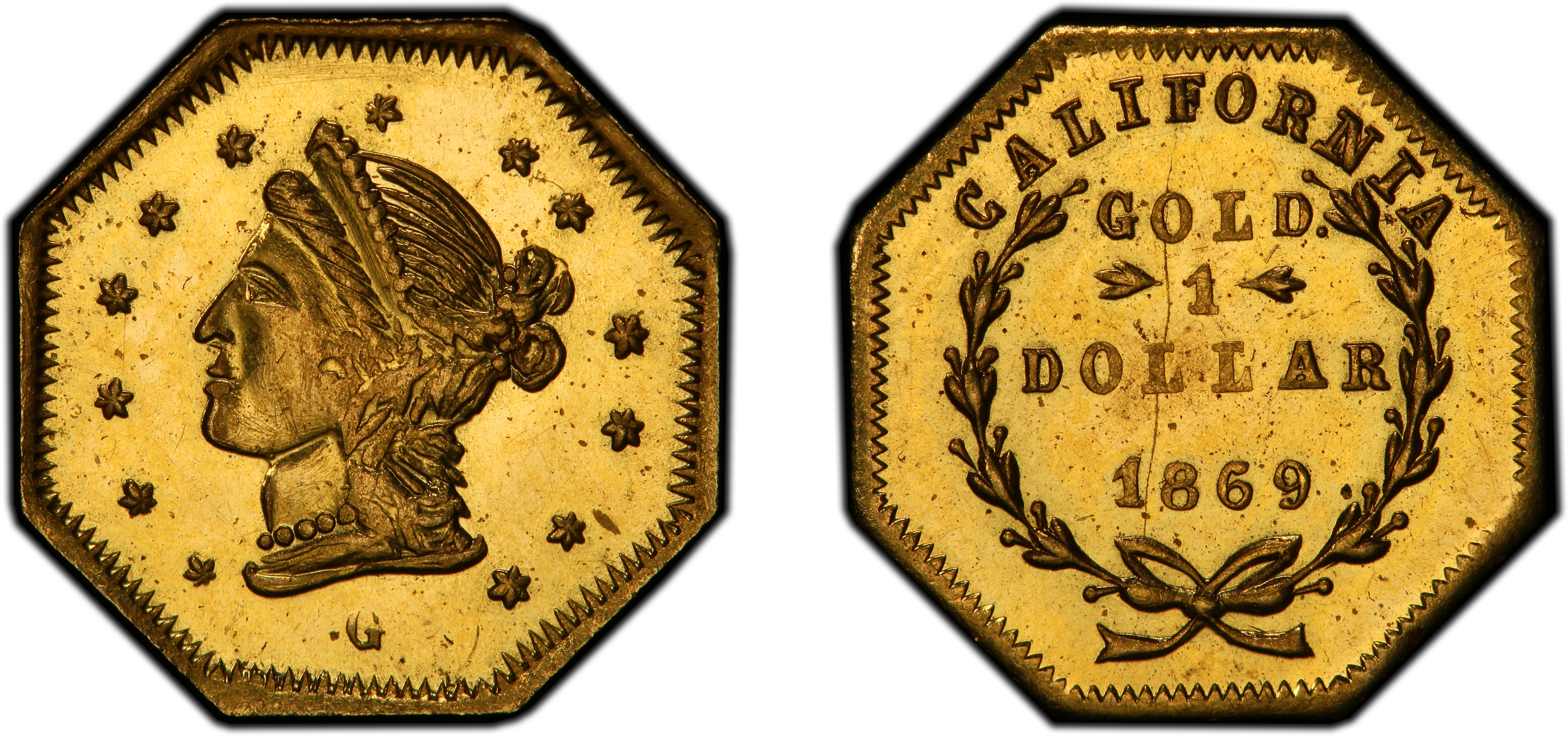
Obverse & Reverse
The 1869 BG-1106 one-dollar piece emerges from the second major phase of California Fractional Gold production (1859-1882), a period numismatically distinct from the initial, necessity-driven issues of the early 1850s. By the late 1860s, the acute shortage of small change that had plagued California during the Gold Rush had been largely resolved by the output of the United States Mint in San Francisco. The rationale for producing private fractional gold had thus shifted dramatically. The initial 'Period One' pieces were struck to facilitate commerce. In contrast, 'Period Two' issues, often termed 'jeweler's issues,' were primarily created to satisfy a burgeoning market for souvenirs and keepsakes. San Francisco was becoming a tourist destination, and these diminutive gold coins were affordable, easily transportable mementos of a visit to the Golden State. Struck by jewelers and artisans like Robert B. Gray, these later pieces were often underweight and made from debased gold, containing less than their face value in precious metal, functioning more as tokens than true circulating coinage. This was a tacit acknowledgment of their new role; they were not expected to pass as legal tender in day-to-day transactions but rather to be kept as curios. The Coinage Act of 1864 had explicitly outlawed private coinage, but enforcement was lax, allowing jewelers to continue producing these popular items, often backdating them to pre-1864 dates to feign legality. The 1869 BG-1106 is a classic example of this era's output: a privately struck, artistically rendered piece intended not for the merchant's till, but for the traveler's pocket, a tangible link to the fading romance of the '49ers.
Associated EventPost-Gold Rush California Tourism
Reason For MintingPrimarily struck to be sold as souvenirs and keepsakes to visitors in San Francisco, rather than to alleviate a coin shortage.
Minter HistoryRobert B. Gray was a San Francisco jeweler active in the production of fractional gold pieces during the 'Period Two' era. He is known to have produced dies marked with a 'G', as seen on the obverse of the BG-1106 variety. He acquired some dies from, and later sold his own interests to, other prominent figures in the trade, such as the California Jewelry Co. in 1871. His work is characteristic of the period's 'jeweler's issues,' which focused more on saleability as mementos than on intrinsic value for circulation.
Historical SignificanceThe BG-1106 is significant as a quintessential example of a 'Period Two' California Fractional Gold piece. It represents the transition of these private issues from utilitarian commercial coins to souvenir items, reflecting the economic and social maturation of California more than a decade after the initial Gold Rush. Its existence highlights the limited enforcement of federal anti-private-coinage laws and the enduring popular fascination with gold.
N/A
Denomination$1
Minting Period1869
Assayer/MinterRobert B. Gray
Geographic OriginSan Francisco, California
Obverse DescriptionA Liberty Head facing left, her hair tied in a bun. She wears a beaded necklace. Thirteen stars surround the portrait. The initial 'G' for the minter, Robert B. Gray, is located below the bust truncation.
Obverse InscriptionG
Reverse DescriptionThe octagonal coin features the denomination '1' and the word 'DOLLAR' within a wreath of leaves and berries. The date, 1869, is located below the bow of the wreath. A key diagnostic for the BG-1106 variety is the significant distance between the date and the word 'DOLLAR'.
Reverse Inscription1 DOLLAR 1869
CompositionGold
Stated Fineness Actual FinenessVariable; Period Two issues are frequently debased and contain significantly less than their face value in gold, often alloyed with silver and copper.
EdgePlain
Unknown
Survival EstimateFewer than 75 known
Rarity ScaleR-5 (31-75 known)
The BG-1106 is sought after for its specific attribution to minter Robert B. Gray, its distinctive octagonal shape, and its status as a high-rarity (R-5) representative of the popular California Fractional Gold series. It offers a tangible piece of post-Gold Rush history.
Key VarietiesNo major varieties are noted for the BG-1106 during its period of issue. The broader California Fractional Gold series is rife with later restrikes and fantasy pieces. Collectors should be aware of the so-called 'Kroll Hoard' restrikes from the 1920s, which were made with great skill and can be deceptive. However, no specific Kroll restrikes of BG-1106 are widely documented. The primary variation for this issue lies in the strike quality and planchet characteristics, which are often inconsistent.
Authentication TipsAuthentication requires comparison to known genuine examples, ideally using high-resolution photos from the Breen-Gillio reference work or major grading service websites. Key diagnostics for BG-1106 include the placement of the 'G' below the bust and the wide spacing between 'DOLLAR' and the date on the reverse. The fabric of the coin should appear original, without the tool marks, artificial toning, or unusual surface texture associated with modern replicas. Genuine pieces often exhibit some degree of striking weakness, particularly in the centers, which is actually a positive indicator compared to a perfectly struck modern copy.
Shopping ConsiderationsA premium quality example for its grade will show minimal abrasions and retain some measure of original mint luster. Given that these are 'always weakly struck in the centers,' a coin that shows unusual sharpness on Liberty's cheek or the center of the wreath should be viewed with suspicion. Conversely, a sharp peripheral strike with clear legends and date is highly desirable. Look for pleasing, original golden-orange surfaces. Avoid examples that have been harshly cleaned, polished, or show evidence of being mounted in jewelry, which was a common fate for these souvenir pieces. A coin that is graded and encapsulated by a top-tier service like PCGS or NGC is strongly recommended for this series.
A coin's grade is its condition, rated on a 1-70 scale. For rare coins, this is the most critical factor in determining value, as a tiny difference in preservation can mean a huge difference in price.
Relevant Grade TypesAll original 1869 BG-1106 dollars are business strikes, intended for sale as souvenirs. They are found in Circulated (1-58) and Mint State (MS, 60-70) grades. No proofs were struck during the original period of issue, and there are no widely recognized, official later-date Proof restrikes for this specific Breen-Gillio variety. Any piece described as a 'Proof' should be treated as a likely modern fantasy item.
Mint State CharacteristicsUncirculated examples of BG-1106 are defined by the presence of original mint luster, which is typically soft and satiny. A defining characteristic of this variety is its inherently weak strike in the central areas; Liberty's cheek and the wreath's center are often flat and lack detail, even on a high-grade Mint State coin. The surfaces are often found with minor planchet flaws or light adjustment marks, which are artifacts of the crude private minting process and generally accepted by specialists. A superior MS example would display minimal contact marks, strong peripheral details, and attractive, undisturbed luster.
Circulated Wear PatternsWear first appears on the highest points of the design. On the obverse, this includes Liberty's hair bun, the line of her jaw, and her cheekbone. On the reverse, the high points of the wreath's leaves and the numerals of the date will show the first signs of friction. In lower grades (VF and below), the delicate beaded necklace on the obverse will begin to merge with the field, and the peripheral stars and legends will lose their sharpness.
Key Factors For ValueFor the BG-1106, value is driven by three main factors. First is the grade and surface quality; an example with original, uncleaned surfaces and minimal abrasions will command a significant premium. Second is strike; while central weakness is expected, a coin with sharper-than-average peripheral details (stars, date, legends) is highly desirable. Third is eye appeal; coins with attractive, lustrous surfaces and a pleasing reddish-gold or orange-gold toning are prized over dull or washed-out specimens. Certification by a top grading service is nearly essential for market acceptance, and a CAC sticker indicating premium quality for the grade would add a further substantial premium.
PCGS Price Guide
| Grade | Price | Population |
|---|---|---|
| 45 | $545.00 | 1 |
| 45+ | $575.00 | N/A |
| 50 | $600.00 | 2 |
| 50+ | $615.00 | N/A |
| 53 | $650.00 | 1 |
| 53+ | $665.00 | N/A |
| 55 | $685.00 | 10 |
| 55+ | $725.00 | N/A |
| 58 | $800.00 | 9 |
| 58+ | $820.00 | N/A |
| 60 | $850.00 | 2 |
| 61 | $900.00 | 7 |
| 62 | $1,000.00 | 27 |
| 62+ | $1,250.00 | N/A |
| 63 | $2,000.00 | 10 |
| 63+ | $2,350.00 | N/A |
| 64 | $3,500.00 | 2 |
| 65 | N/A | N/A |