1880 G50C BG-1068 (Regular Strike)
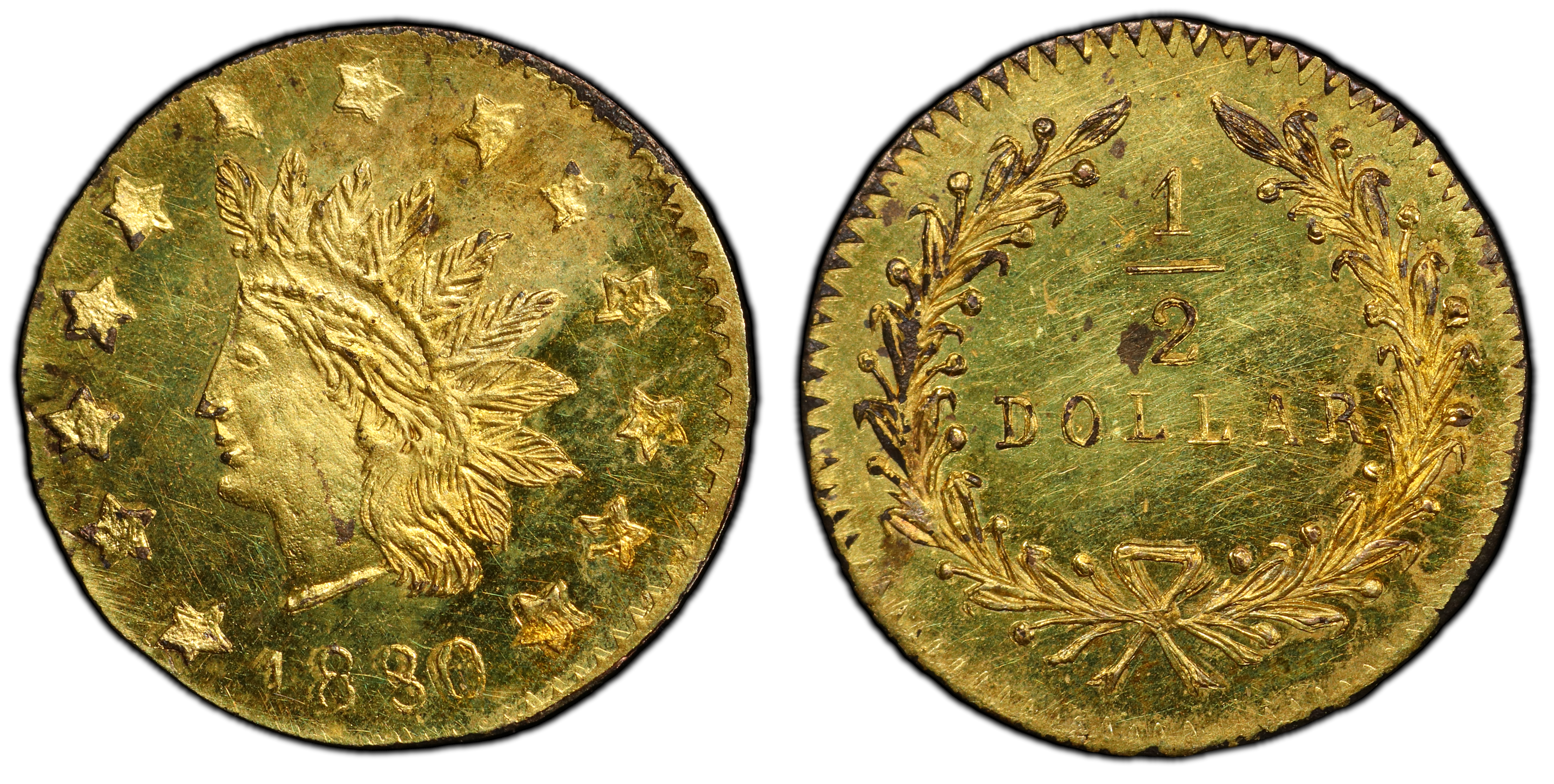
Obverse & Reverse
The 1880 50 Cents, cataloged as Breen-Gillio 1068, is a product of the second major phase of California Fractional Gold production. This era, known as 'Period Two' (1859-1882), stands in contrast to the earlier 'Period One' pieces that were struck out of genuine commercial necessity to alleviate a chronic shortage of small change during the initial Gold Rush boom. By 1880, the economic landscape of California had matured significantly. The United States Mint in San Francisco, opened in 1854, was producing ample federal coinage, rendering private fractional gold redundant for circulation. Instead, these later pieces catered to a different market: tourism and nostalgia. As the memory of the '49ers faded into legend, a thriving industry emerged producing souvenirs and keepsakes that evoked the romanticism of the Gold Rush. Local jewelers in San Francisco capitalized on this by creating vast arrays of miniature gold coins. These were not intended to pass as legal tender but were sold as novelties, incorporated into jewelry, or collected as mementos of a visit to the West. The Coinage Act of 1864 had explicitly outlawed private coinage, but enforcement by the Secret Service was notoriously lax in California until 1883. This legal gray area allowed jewelers to continue striking denominated pieces like the BG-1068 throughout this period. Often, these Period Two issues were intentionally underweight and of a lower gold fineness than their face value would imply, functioning more as tokens than true coins. Their creation, typically involving hand-cut dies and manual hammer striking, resulted in crude but charming pieces, each with its own individuality. The BG-1068, with its Indian Head motif, represents a classic example of this souvenir-era coinage, a tangible link to the enduring legacy and commercialization of the California Gold Rush.
Associated EventCalifornia Gold Rush (Legacy & Souvenir Period)
Reason For MintingPrimarily struck as a souvenir or jewelry item for the tourist trade, not for general circulation.
Minter HistoryThe specific minter of BG-1068 is unrecorded, a common trait for Period Two fractional gold. Production was dominated by a community of San Francisco jewelers, many of French origin, who operated small, private workshops. These craftsmen, such as Robert B. Gray & Co., Frontier & Deviercy, and others, produced a wide variety of designs. They hand-engraved their own dies and used simple screw presses or even just sledgehammers to strike the coins, leading to significant variations in strike quality. Their business was not in creating a circulating medium but in satisfying public demand for gold novelties before federal authorities finally clamped down on all private issues in 1883.
Historical SignificanceThe BG-1068 is significant not as a coin of commerce, but as a cultural artifact representing the commercialization of the Gold Rush legend. It marks the transition of private minting in California from a utilitarian necessity to a nostalgic enterprise, capturing a moment when the Wild West was becoming a powerful American myth. Its existence highlights a period of lax federal oversight and the persistent allure of gold in the American consciousness, decades after the initial frenzy had subsided.
BG-1068
Denomination50 Cents
Minting Period1880
Assayer/MinterUnknown San Francisco Jeweler
Geographic OriginSan Francisco, California
Obverse DescriptionA medium-sized bust of a Native American princess facing left, often described as having a triangular-shaped head. The portrait is adorned with a feathered headdress. Thirteen stars encircle the bust, representing the original colonies.
Obverse Inscription1880
Reverse DescriptionThe denomination '50' is centrally located within a simple, open-ended wreath composed of two branches tied together at the bottom with a ribbon.
Reverse Inscription50
CompositionGold
Stated Fineness Actual FinenessVariable, typical for Period Two issues, often ranging from 10k to 14k (.417 to .585 fine).
Weight0.25 grams
Diameter10.50 mm
EdgePlain
Unknown
Survival Estimate31-75
Rarity ScaleR-5
Sought after as an affordable and historically interesting example of a Period Two California Fractional Gold piece. Its appeal lies in its miniature size, classic Indian Head design, and direct connection to the romantic legacy of the Gold Rush. The specific BG-1068 variety is scarce enough to be challenging but available enough for determined collectors.
Key VarietiesThe BG-1068 itself is a specific die variety within the vast California Fractional Gold series. The series is broadly categorized into Period One (1852-1857, intended for circulation), Period Two (1859-1882, souvenir issues), and Period Three (post-1882, backdated illegal issues). There are no known proof strikes, restrikes, or special collector issues specifically for the BG-1068 variety from the original period of manufacture.
Authentication TipsGenuine pieces exhibit sharp, albeit sometimes unevenly impressed, details from die striking. Fakes are often cast, showing a soapy, indistinct appearance with porous surfaces. The denomination on genuine Period Two issues is typically clear; tokens made after 1882 often omit a denomination or use phrases like '1/2 CAL GOLD CHARM'. Weight can be a key diagnostic, as many replicas are made of brass or have incorrect gold content. Compare the specific die characteristics—such as the shape of the '8's in the date and the position of the stars—to known genuine examples.
Shopping ConsiderationsA premium quality example for its grade will exhibit a bold, well-centered strike with as much detail as possible in the headdress feathers and the wreath leaves. Original, lustrous surfaces are highly desirable. Many surviving pieces were used in jewelry, so look carefully for evidence of soldering, tooling, or harsh cleaning, which will drastically reduce the value. Minor planchet flaws and strike weakness in certain areas are common and should be evaluated on a case-by-case basis. Eye appeal is paramount for these tiny coins; a choice specimen should be attractive and free of distracting spots or damage.
A coin's grade is its condition, rated on a 1-70 scale. For rare coins, this is the most critical factor in determining value, as a tiny difference in preservation can mean a huge difference in price.
Relevant Grade TypesOriginal 1880 BG-1068 issues were all business strikes, technically intended as souvenirs rather than for circulation, and are found in both Circulated (1-58) and Mint State (MS, 60-70) grades. No Proof (PR/PF) examples were struck during the original period of manufacture, and there are no known later-date Proof restrikes for this specific variety. Any piece described as a 'Proof' would be a modern creation or a misattribution.
Mint State CharacteristicsUncirculated examples of BG-1068 are characterized by their mint luster, which can range from satiny to semi-prooflike. Strike quality varies due to the manual minting process; a well-struck coin will show clear details in the feathers of the headdress and the central numbers on the reverse. Softness in the stars or parts of the wreath is common and not always a detriment. As these were made by jewelers and handled as novelties, even Mint State examples can have small planchet flaws, laminations, or minor contact marks.
Circulated Wear PatternsWear first appears on the highest points of the design: the cheek and feathers of the Indian princess on the obverse, and the numerals '50' and the bow of the wreath on the reverse. On moderately worn examples, the finer details of the feathers will merge, and the stars will begin to lose their definition. In lower grades, the date and legends can become weak or partially obliterated.
Key Factors For ValueThe primary drivers of value for an 1880 BG-1068 are grade and surface quality. An example with original, undisturbed luster will command a significant premium over one that has been cleaned or polished. The sharpness of the strike is crucial; collectors pay more for well-defined details. Eye appeal, encompassing attractive original toning and a lack of distracting marks or spots, is also a key factor. A certification from a top-tier grading service (PCGS or NGC) is standard, and a CAC sticker, indicating premium quality for the grade, adds a further premium.
PCGS Price Guide
| Grade | Price | Population |
|---|---|---|
| 58 | $325.00 | 1 |
| 58+ | $350.00 | N/A |
| 60 | $400.00 | 1 |
| 61 | $450.00 | 3 |
| 62 | $600.00 | 6 |
| 62+ | $700.00 | N/A |
| 63 | $1,025.00 | 6 |
| 63+ | $1,300.00 | N/A |
| 64 | $1,950.00 | 4 |