1876 G50C BG-1065 (Regular Strike)
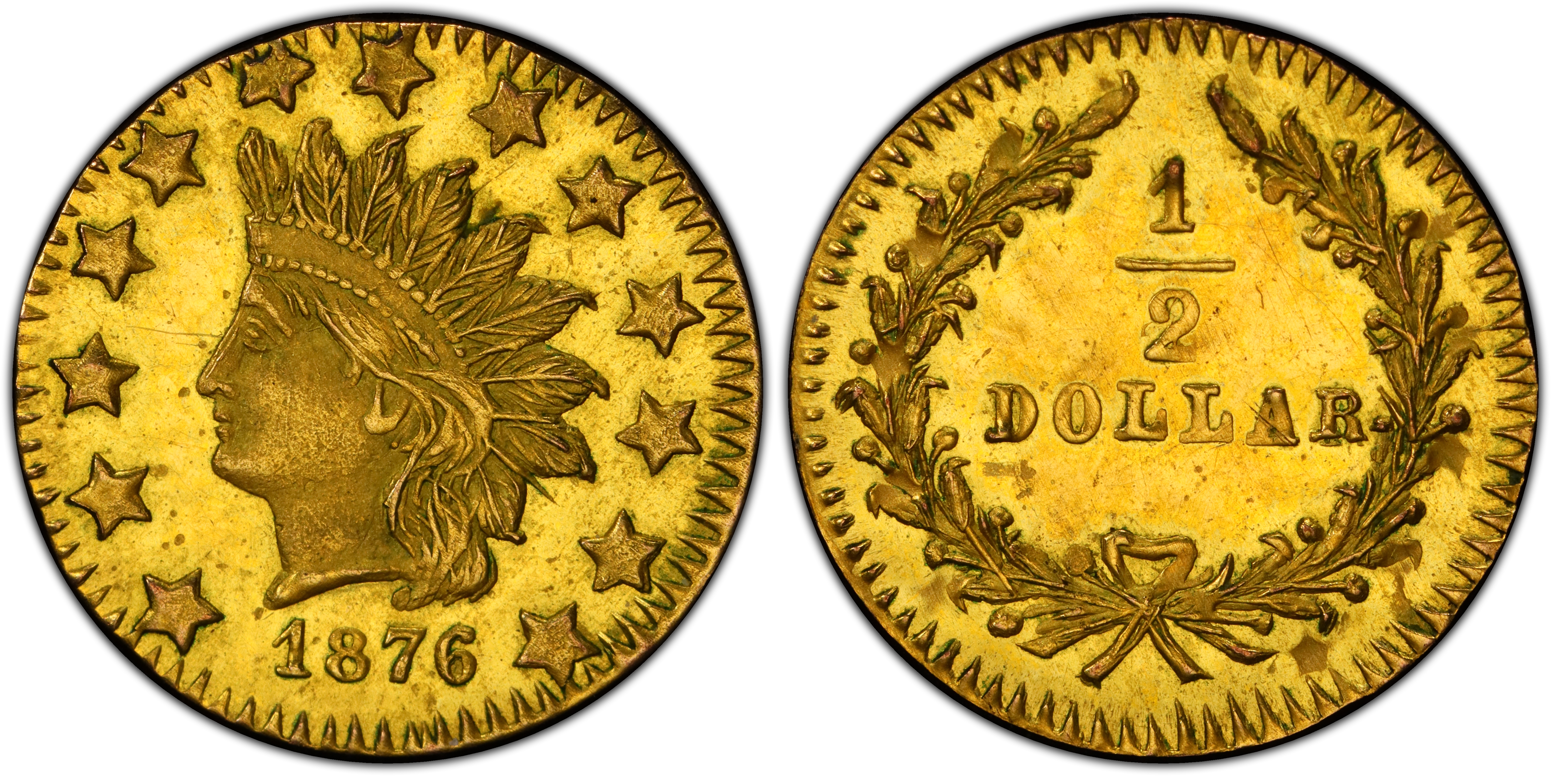
Obverse & Reverse
The 1876 BG-1065 50-cent piece emerges from the second great period of California fractional gold production (1858-1882). Unlike the 'Period One' issues (1852-1857), which were struck out of a genuine necessity to alleviate a severe shortage of small-denomination coinage during the Gold Rush, these later 'Period Two' pieces served a different purpose. By the mid-1870s, the United States Mint in San Francisco was in full operation, and the acute need for circulating private gold had subsided. Instead, these miniature gold coins had become popular keepsakes and souvenirs, tangible mementos of the romanticized Gold Rush era. Jewelers in San Francisco capitalized on this demand, producing a wide variety of these small-denomination tokens for tourists and locals alike. The year 1876 was particularly significant as it marked the Centennial of the United States, an event celebrated with great patriotic fervor nationwide, including at the Centennial International Exhibition in Philadelphia. It is plausible that pieces like the BG-1065 were struck to cater to the increased demand for souvenirs during this celebratory year. These Period Two pieces were not intended to, and did not, circulate widely as money. Their gold content was intentionally less than their face value, making them profitable trinkets rather than functional currency. Production of denominated private coinage was officially prohibited by the Coinage Act of 1864, but lax enforcement allowed jewelers to continue minting these 'coins' for nearly two more decades. The Secret Service finally cracked down on these operations in 1883, bringing the era of California fractional gold to a definitive end. Today, varieties like BG-1065 are collected as part of this fascinating and complex series, representing the transition of a utilitarian coinage into a nostalgic collectible.
Associated EventCalifornia Gold Rush (Later Souvenir Period)
Reason For MintingPrimarily produced as souvenirs and keepsakes for the tourist trade, capitalizing on the nostalgia of the Gold Rush.
Minter HistoryThe specific minter for BG-1065 is unknown, a common trait for many Period Two fractional gold pieces. The work is attributed to the community of anonymous San Francisco jewelers who, following the precedent set by assayers like Moffat & Co. and Kellogg & Co., recognized a commercial opportunity. These craftsmen operated on a smaller scale, often using simple hand-presses or hammer striking methods to produce a dazzling array of designs to appeal to the souvenir market. Their operations ceased following stricter enforcement of the 1864 private coinage laws in 1883.
Historical SignificanceThe BG-1065 is historically significant not as a circulating coin, but as a numismatic artifact representing the commercialization of the Gold Rush legacy. It marks a distinct period when the memory of the gold fever was more valuable than the immediate need for small change, illustrating a key transition in the purpose and public perception of private coinage in the American West.
N/A
Denomination50 Cents
Minting Period1876
Assayer/MinterUnknown private minter. Believed to be produced by one of the several San Francisco jewelers active during this period.
Geographic OriginSan Francisco, California
Obverse DescriptionFeatures a stylized Indian Head facing left, a popular motif in American coinage of the era. The portrait is typically surrounded by 13 six-pointed stars representing the original colonies.
Obverse Inscription[None, design only]
Reverse DescriptionA wreath of leaves, open at the top, encircles the denomination. The date '1876' is positioned within the wreath, below the denomination.
Reverse Inscription1/2 DOLLAR 1876
CompositionGold
Stated Fineness Actual FinenessVariable, but typically less than face value, often ranging from 14 to 22 karats. The primary goal was appearance, not intrinsic value.
Weight0.25 grams
Diameter10.00 mm
EdgePlain
Unknown
Survival Estimate31-75 known specimens. Both PCGS and NGC census data show a combined population of approximately 30-40 graded examples, supporting the R-5 rating.
Rarity ScaleR-5
BG-1065 is sought after for its classic Indian Head design, its connection to the U.S. Centennial year, and its status as a representative of the popular Period Two souvenir issues. As an R-5 variety, it offers a blend of scarcity and relative attainability for specialists in the extensive California Fractional Gold series.
Key VarietiesThe primary issue is the business strike. No proof strikings from the period of issue are known, nor are there any sanctioned restrikes. The die state may show minor changes over its life, but no major, cataloged varieties of BG-1065 are recognized.
Authentication TipsAuthentic pieces should exhibit the correct die characteristics as cataloged in the Breen-Gillio reference. Beware of modern replicas, which are common. Replicas often have a soapy, indistinct look, incorrect weight, or may feature a bear on the reverse (a fantasy element never used on genuine 19th-century issues). Genuine pieces often have a slightly crude, hand-made quality. Weak strikes are common and can be an indicator of authenticity, as many fakes are sharply struck. Any piece not denominated with 'DOLLAR', 'DOL.', or 'CENTS' is a later token, not a Period Two coin.
Shopping ConsiderationsA premium quality example for its grade will exhibit a sharp strike, particularly on the details of the Indian's headdress and the lettering on the reverse. Luster is a key value driver; coins with original, vibrant, prooflike (PL) or deep mirror prooflike (DMPL) surfaces command significant premiums. Look for attractive, original reddish-gold toning. Avoid examples that have been cleaned, which imparts a dull, lifeless surface, or those with evidence of being mounted in jewelry, such as rim damage, solder, or tooling marks. Centering of the strike on the planchet can also be a factor in eye appeal.
A coin's grade is its condition, rated on a 1-70 scale. For rare coins, this is the most critical factor in determining value, as a tiny difference in preservation can mean a huge difference in price.
Relevant Grade TypesOriginal period issues were business strikes. While not intended for circulation, they were not struck with the special care of proofs and are thus found in Circulated (1-58) and, more commonly, Mint State (MS, 60-70) grades. No true Proofs were struck during the original minting period. The terms Prooflike (PL) and Deep Mirror Prooflike (DMPL) are designations added to MS coins that have highly reflective surfaces from polished dies, and these are highly desirable.
Mint State CharacteristicsIn uncirculated grades, the quality of BG-1065 is defined by strike and surface preservation. Many examples are weakly struck, particularly in the center of the obverse (the cheek) and reverse. A well-struck piece with full detail in the headdress feathers is rare and desirable. The luster is typically bright and satiny, though some dies produced PL or DMPL surfaces. Due to their small size and handling as souvenirs, even Mint State examples can have tiny contact marks; the key is finding a specimen with minimal marks and maximum luster.
Circulated Wear PatternsAlthough not meant for circulation, some pieces saw handling. Wear first appears on the high points of the design: the Indian's cheek, brow, and the feathers of the headdress. On the reverse, the highest points of the wreath and the fraction '1/2' will show the first signs of friction. In lower grades, the stars on the obverse will begin to merge with the field.
Key Factors For ValueFor the BG-1065, value is driven by several factors in order: 1) Grade and surface quality – an MS-64 is worth significantly more than an MS-62. 2) Surface characteristics – a coin with a PL or DMPL designation will command a very large premium over a standard MS example. 3) Strike – a sharply struck coin will always be prized over a weakly struck one of the same grade. 4) Eye appeal – specimens with pleasing original color and minimal distracting marks are most sought-after. A CAC sticker, indicating premium quality for the grade, adds a substantial premium for this series.
PCGS Price Guide
| Grade | Price | Population |
|---|---|---|
| 53 | $250.00 | 1 |
| 53+ | $260.00 | N/A |
| 55 | $270.00 | N/A |
| 55+ | $280.00 | N/A |
| 58 | $300.00 | N/A |
| 58+ | $325.00 | N/A |
| 60 | $400.00 | N/A |
| 61 | $450.00 | 1 |
| 62 | $550.00 | 7 |
| 62+ | $600.00 | N/A |
| 63 | $675.00 | 13 |
| 63+ | $750.00 | N/A |
| 64 | $1,000.00 | 14 |
| 64+ | $1,250.00 | N/A |
| 65 | $2,500.00 | 5 |
| 66 | N/A | N/A |
| 67 | N/A | N/A |