1854 G50C BG-1304 (Regular Strike)
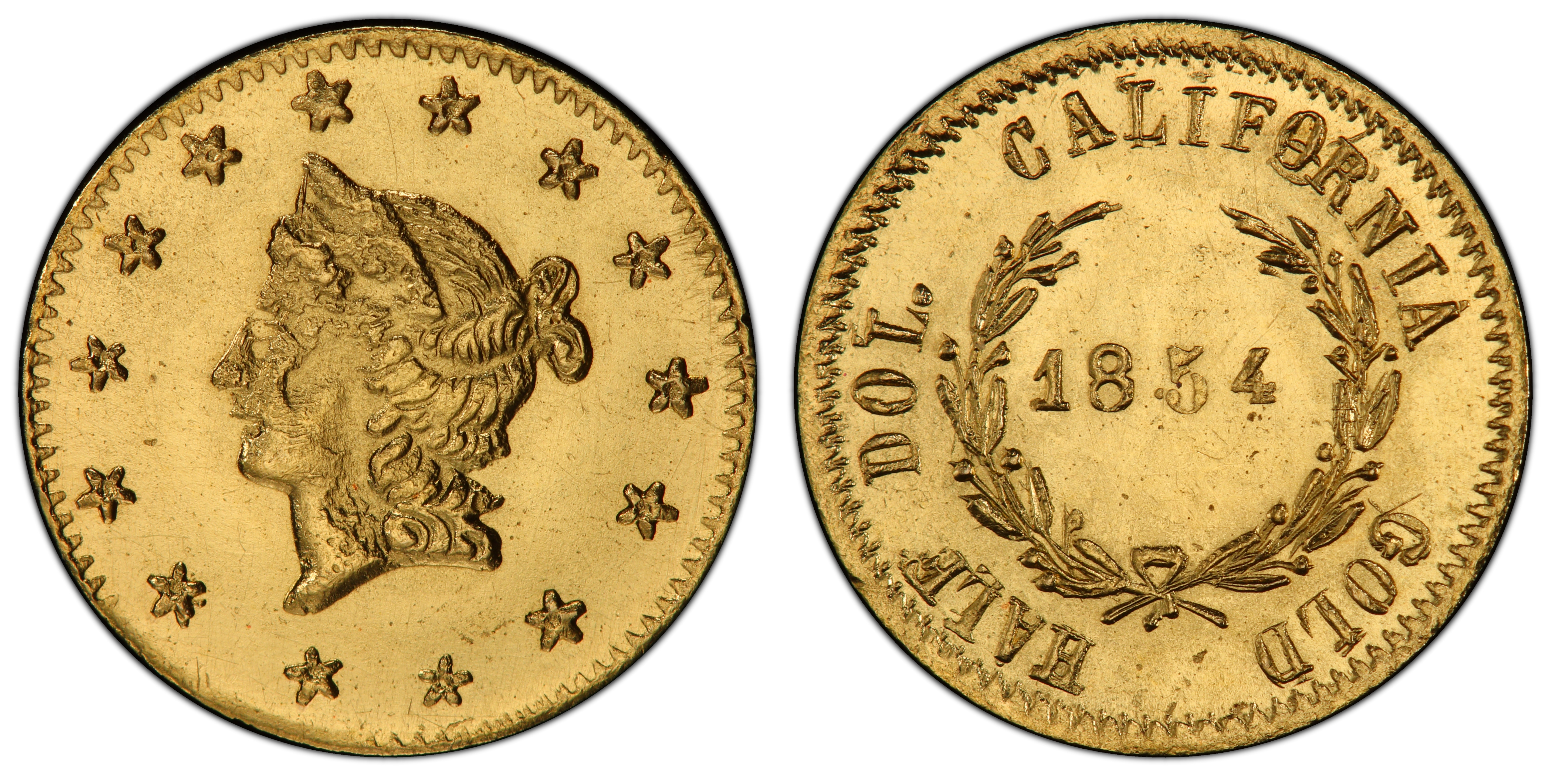
Obverse & Reverse
The 1854 G50C BG-1304 is a fascinating and often misunderstood piece of Americana, belonging not to the frenetic Gold Rush era of its date, but to a later period of numismatic nostalgia. Cataloged as a 'Period Three' California Fractional Gold piece, it was struck decades after the original series ceased to be a circulating medium. The socio-economic conditions that birthed the original fractional gold (1852-1857) were defined by a severe shortage of small change in the gold fields, compelling jewelers and assayers to create their own quarter, half, and dollar gold pieces. These 'Period One' issues were genuine, albeit often lightweight, attempts to facilitate commerce. By the 1870s, as U.S. Mint coinage became plentiful, these pieces transitioned into souvenirs ('Period Two'). The BG-1304, however, emerges from a different context entirely. It is attributed to Herman Kroll, a New York City jeweler operating in the early 20th century. By this time, original California Fractional Gold pieces were scarce and collectible. Kroll capitalized on this burgeoning collector interest by producing a series of well-made but backdated 'copies' or 'tokens' for the numismatic and jewelry trade. He is believed to have acquired some of the original tooling from the California-based minters, which lent his creations a degree of authenticity in appearance. The BG-1304, specifically, is noted by researchers like Mike Locke to be stylistically similar to the genuine Period One BG-428 issue, but with the altered date of 1854. These pieces were not intended to circulate as money, nor were they meant to deceive contemporary merchants. Rather, they were sold as historical curiosities, filling a gap in the market for collectors who could not obtain or afford the rare originals. Their production reflects a moment when the Gold Rush had passed from living memory into romantic legend, creating a commercial demand for tangible relics of that storied time.
Associated EventCalifornia Gold Rush Nostalgia Trade
Reason For MintingTo satisfy collector and jeweler demand for historical souvenirs of the California Gold Rush era.
Minter HistoryHerman Kroll was a New York City jeweler active in the late 19th and early 20th centuries. He is the only positively identified maker of the so-called 'Period Three' California Fractional Gold pieces. Capitalizing on the growing collector market for Gold Rush memorabilia, Kroll produced a series of backdated gold tokens that mimicked the style of the original 1850s issues. It is believed he may have used some of the original dies or hubs, which he acquired after the souvenir trade waned in California. His operation was not clandestine but commercial, catering to a trade that valued the historical aesthetic over intrinsic value or monetary function. His products are well-made and form a distinct, collectible category within the larger series. After the jewelry fad faded, Kroll's remaining stock was sold to collector A.C. Nygren, whose estate was later auctioned by famed dealer Henry Chapman in 1924, cementing the Kroll issues' place in numismatic history.
Historical SignificanceThe BG-1304 is significant not as a product of the Gold Rush, but as an early example of numismatic replica production for a collector market. It represents the transition of California Fractional Gold from utilitarian coinage and souvenirs to coveted historical artifacts, and its existence highlights the burgeoning coin collecting hobby in early 20th-century America.
N/A
Denomination50 Cents
Minting Periodca. 1906-1908
Assayer/MinterHerman Kroll
Geographic OriginNew York, New York
Obverse DescriptionA head of Liberty facing left, her hair tied in a bun at the back. She is surrounded by thirteen six-pointed stars. The date 1854 is below. The portrait style is crude compared to federal issues, a characteristic feature of many fractional gold pieces.
Obverse Inscription1854
Reverse DescriptionThe denomination '1/2' is enclosed within a wreath composed of two branches tied by a bow at the bottom. The legend 'CALIFORNIA GOLD' encircles the top periphery, outside the wreath.
Reverse InscriptionCALIFORNIA GOLD 1/2
CompositionGold
Stated Fineness Actual FinenessTypically a lower fineness gold alloy compared to Period One issues.
Weight0.24 grams
Diameter10.00 mm
EdgePlain
Unknown
Survival Estimate75-125
Rarity ScaleR-4
Sought after as an accessible example of the popular Liberty Head/Wreath design type and as a key part of the collectible 'Period Three' Kroll issues. Its status as a vintage, early 20th-century copy gives it a unique historical appeal separate from the original Gold Rush pieces.
Key VarietiesThe primary variety associated with this issue is the BG-1304A, which is a later restrike from the Kroll-era dies. These restrikes were made well after Kroll's time, possibly in the 1950s or later, after his original tooling resurfaced. They are generally considered to have less historical and numismatic value than the original Kroll strikings (BG-1304) and can often be identified by different surface characteristics or strike qualities.
Authentication TipsAuthentic BG-1304 examples exhibit specific die characteristics. The strike is often somewhat soft, and the surfaces may show fine die polishing lines. Compare the style of the numerals in the date and the lettering to known genuine examples; counterfeits often have poorly formed or incorrectly styled fonts. As a Kroll issue, it should not be mistaken for a Period One piece; its weight and gold fineness are typically lower. Be wary of examples with an unusually sharp, modern-looking strike or tool marks around the design elements, which could indicate a counterfeit or a modern replica rather than an original Kroll piece or a BG-1304A restrike.
Shopping ConsiderationsA premium quality example for its grade will possess a sharp strike for the issue, particularly on the high points of Liberty's hair and the leaves of the wreath. Look for clean, lustrous surfaces free of distracting marks, cleaning, or jewelry mounting evidence (a common fate for these pieces). The original Kroll pieces often have a slightly 'rusty' die appearance, which is a desirable characteristic. Avoid specimens that are bent, heavily scratched, or show signs of having been polished or whizzed, as this drastically reduces value. Eye appeal is paramount; a coin with attractive original color and minimal distracting flaws will always command a premium.
A coin's grade is its condition, rated on a 1-70 scale. For rare coins, this is the most critical factor in determining value, as a tiny difference in preservation can mean a huge difference in price.
Relevant Grade TypesOriginal period issues of the BG-1304 were business strikes intended for the collector and jewelry market, not for circulation. Therefore, they are typically found in Circulated (AU-50 to AU-58, from handling) and Mint State (MS, 60-70) grades. No proofs were struck. The BG-1304A Restrikes are a separate collecting category and should not be confused with the original Kroll strikings.
Mint State CharacteristicsUncirculated examples of BG-1304 are defined by the presence of original mint luster. The quality of this luster can range from frosty to semi-prooflike. The strike is a key differentiator; many Kroll issues are not fully struck up, so a piece with sharp details on Liberty's hair and the wreath's bow is highly desirable. Minor planchet flaws or die polishing lines are common and generally accepted. Contact marks, even small ones, can significantly impact the grade and value due to the coin's tiny size.
Circulated Wear PatternsAlthough not intended for circulation, these pieces often saw handling. Wear first appears on the highest points: the hair above Liberty's eye and ear, her cheekbone, and the leaves and bow of the wreath on the reverse. On lower-grade circulated examples (VF/XF), the finer details of the hair will be flat, and the legends will show slight softness.
Key Factors For ValueThe primary drivers of value are grade and surface quality. An example with original, undisturbed luster and minimal contact marks will command a significant premium. The sharpness of the strike is a major factor, with well-defined specimens being prized. Eye appeal, including attractive original gold toning, is also critical. Finally, authentication by a top-tier grading service (PCGS or NGC) is essential for market acceptance, as it confirms the coin is a genuine Kroll issue (BG-1304) and not a later restrike (BG-1304A) or a modern fake.
PCGS Price Guide
| Grade | Price | Population |
|---|---|---|
| 58 | $500.00 | 2 |
| 58+ | $525.00 | N/A |
| 60 | $600.00 | N/A |
| 61 | $650.00 | N/A |
| 62 | $700.00 | 1 |
| 62+ | $725.00 | N/A |
| 63 | $800.00 | 4 |
| 63+ | $850.00 | N/A |
| 64 | $925.00 | 2 |
| 64+ | $1,025.00 | N/A |
| 65 | $1,300.00 | 1 |