1874 G50C BG-1072 (Regular Strike)
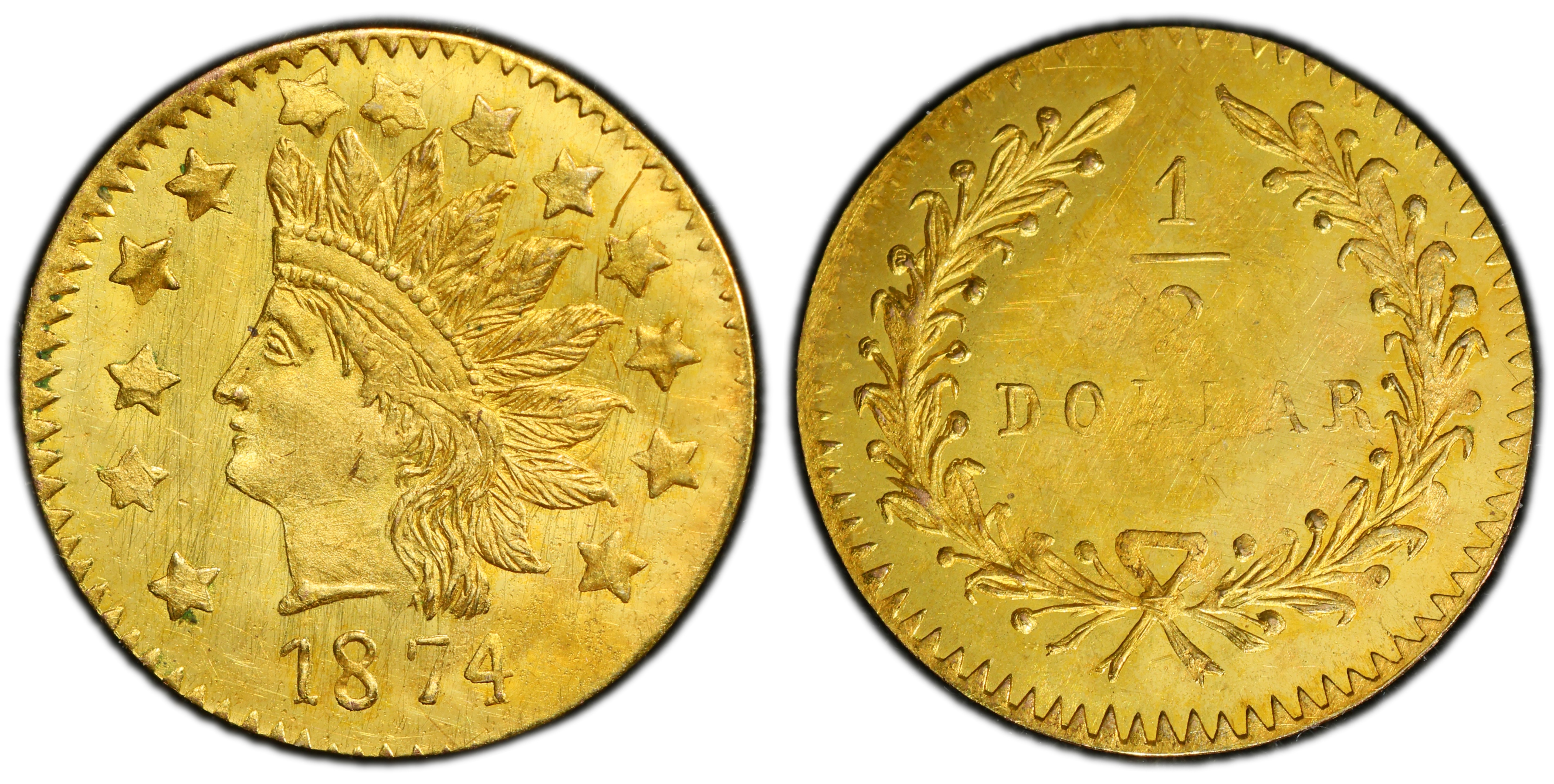
Obverse & Reverse
The 1874 G50C BG-1072 is a product of the second period of California Fractional Gold production (1858-1882), often referred to as 'Jeweler's Issues.' By this era, the acute coinage shortage that characterized the initial Gold Rush had long been resolved by the establishment and high output of the U.S. Mint in San Francisco. The raison d'être for these minuscule gold pieces had shifted from commercial necessity to commercial novelty. Private minters, primarily jewelers and die sinkers like Christopher Ferdinand Mohrig, recognized a robust market for souvenirs and keepsakes that evoked the romanticism of the '49er era. The Coinage Act of 1864 had officially prohibited the private issuance of coinage, but enforcement by the Secret Service was lax until the early 1880s. To circumvent the law, producers often backdated their creations; the BG-1072 is identified by numismatists as one such backdated variety. These pieces were not intended to serve as a primary medium of exchange but were sold to tourists, sent back East as mementos, or incorporated into jewelry. Their production method was typically crude, often involving a sledgehammer to strike the top die, resulting in variable strike quality. Despite their unofficial status and often lower gold content compared to their face value, they represent a fascinating continuation of the private minting tradition of the American West and serve as tangible links to California's golden age.
Associated EventPost-Gold Rush California Souvenir Trade
Reason For MintingPrimarily produced as souvenirs and jewelry items reminiscent of the Gold Rush, rather than to alleviate a shortage of circulating coinage.
Minter HistoryChristopher Ferdinand Mohrig was a German immigrant and a prolific die sinker and producer of California Fractional Gold based in San Francisco during the 'Period Two' era. He operated a workshop that created numerous varieties of these small gold pieces, which were often sold to the public as popular keepsakes. His work is characterized by the Indian Head and Liberty Head motifs common to the period, and many of his issues are identified by researchers as having been backdated to avoid legal repercussions from the Coinage Act of 1864.
Historical SignificanceThis coin is significant not as a tool of commerce but as a cultural artifact. It represents the commercialization of the Gold Rush narrative, demonstrating how the event's legacy was packaged and sold. As a 'suppressed jeweler's issue,' it highlights a period of ambiguous legality for private minters and is a testament to the continued demand for gold items, however small, from a public fascinated with the West.
BG-1072
Denomination50 Cents
Minting Period1874
Assayer/MinterChristopher Ferdinand Mohrig
Geographic OriginSan Francisco, California
Obverse DescriptionAn Indian Head facing left, wearing a feathered headdress. The portrait is encircled by thirteen stars.
Obverse Inscription1874
Reverse DescriptionThe denomination '1/2' is centrally located within an ornate wreath. The word 'DOLLAR' appears below the fraction, still within the wreath.
Reverse Inscription1/2 DOLLAR
CompositionGold
Stated Fineness Actual FinenessVariable, often ranging from 14 to 22 carats for Period Two issues, generally less than their face value in gold content.
Weight0.24 grams
Diameter10.00 mm
EdgePlain
Unknown
Survival Estimate13-30 known
Rarity ScaleR-6
The BG-1072 is highly sought after due to its R-6 rarity, its connection to the romanticized history of the California Gold Rush, and the challenge of completing a set of the diverse Breen-Gillio varieties. Its miniature size and intricate design add to its unique charm.
Key VarietiesThe primary issue is the business strike. No contemporary Proofs were made. However, grading services will designate specimens with highly reflective, mirror-like surfaces as 'Prooflike' (PL), a distinct and desirable variety that commands a significant premium. There are no known official restrikes, as the entire issue is considered a privately made 'jeweler's issue' and was backdated.
Authentication TipsAuthentic pieces should be checked against known genuine examples for die characteristics. The weight should be precise, and the gold composition should be consistent with period pieces, not modern alloys. Counterfeits are often cast, exhibiting a porous or soft appearance, or may be gold-plated base metal. A critical diagnostic for Period Two issues is the presence of a denomination (e.g., 'DOLLAR'); many later souvenir tokens made after 1883 lack a denomination to comply with the law and might say 'CAL GOLD CHARM' instead.
Shopping ConsiderationsA premium quality example for this variety would exhibit as sharp a strike as possible, though some central weakness is common and noted for the BG-1072 die. Look for lustrous, original surfaces that have not been harshly cleaned or polished. Given their use in jewelry, examine the edges and surfaces carefully for signs of solder, removal from a bezel, or excessive scratching. Certification by PCGS or NGC is strongly recommended to guarantee authenticity and provide an objective grade.
A coin's grade is its condition, rated on a 1-70 scale. For rare coins, this is the most critical factor in determining value, as a tiny difference in preservation can mean a huge difference in price.
Relevant Grade TypesOriginal period issues were business strikes, though many were intended as souvenirs and entered collections immediately, hence they are most often found in Mint State (MS, 60-70) grades. Circulated examples (1-58) exist but are less common. No true Proof (PR/PF) examples were struck during the original period. The 'Prooflike' (PL) designation is applied to business strikes that exhibit mirrored fields from being struck with polished dies and is a separate, desirable category.
Mint State CharacteristicsUncirculated examples of BG-1072 are noted for often having a weak strike, with blending or lack of detail on the central devices (Indian's face, center of the wreath). High-grade specimens display a radiant, lemon-gold luster. Due to the softness of the gold and the crude production methods, even Mint State coins will typically show some minor planchet flaws or contact marks; the key is that they are not signs of circulation wear.
Circulated Wear PatternsWear first appears on the highest points of the design: the Indian's cheek and the feathers in the headdress on the obverse. On the reverse, the high points of the wreath's leaves and the bow at the bottom will show the first signs of friction and flattening.
Key Factors For ValueFor the BG-1072, value is determined by several key factors. Rarity (R-6) is the foundation. The numerical grade is paramount, with Gem (MS65 and above) examples being exceptionally rare and valuable. Surface quality is critical; an example with original, undisturbed luster will always be worth more than a cleaned or polished one of the same grade. Strike sharpness is also a major factor; a coin with a stronger-than-average strike on the central motifs is highly prized. Finally, a Prooflike (PL) designation or a CAC sticker will add a significant premium.
PCGS Price Guide
| Grade | Price | Population |
|---|---|---|
| 62 | $1,000.00 | 3 |
| 62+ | $1,050.00 | N/A |
| 63 | $1,200.00 | 7 |
| 63+ | $1,300.00 | N/A |
| 64 | $1,550.00 | 4 |
| 64+ | $1,700.00 | N/A |
| 65 | $2,000.00 | 1 |
| 65+ | $2,250.00 | N/A |
| 66 | $2,650.00 | 1 |