1875 G$1 BG-1125 (Regular Strike)
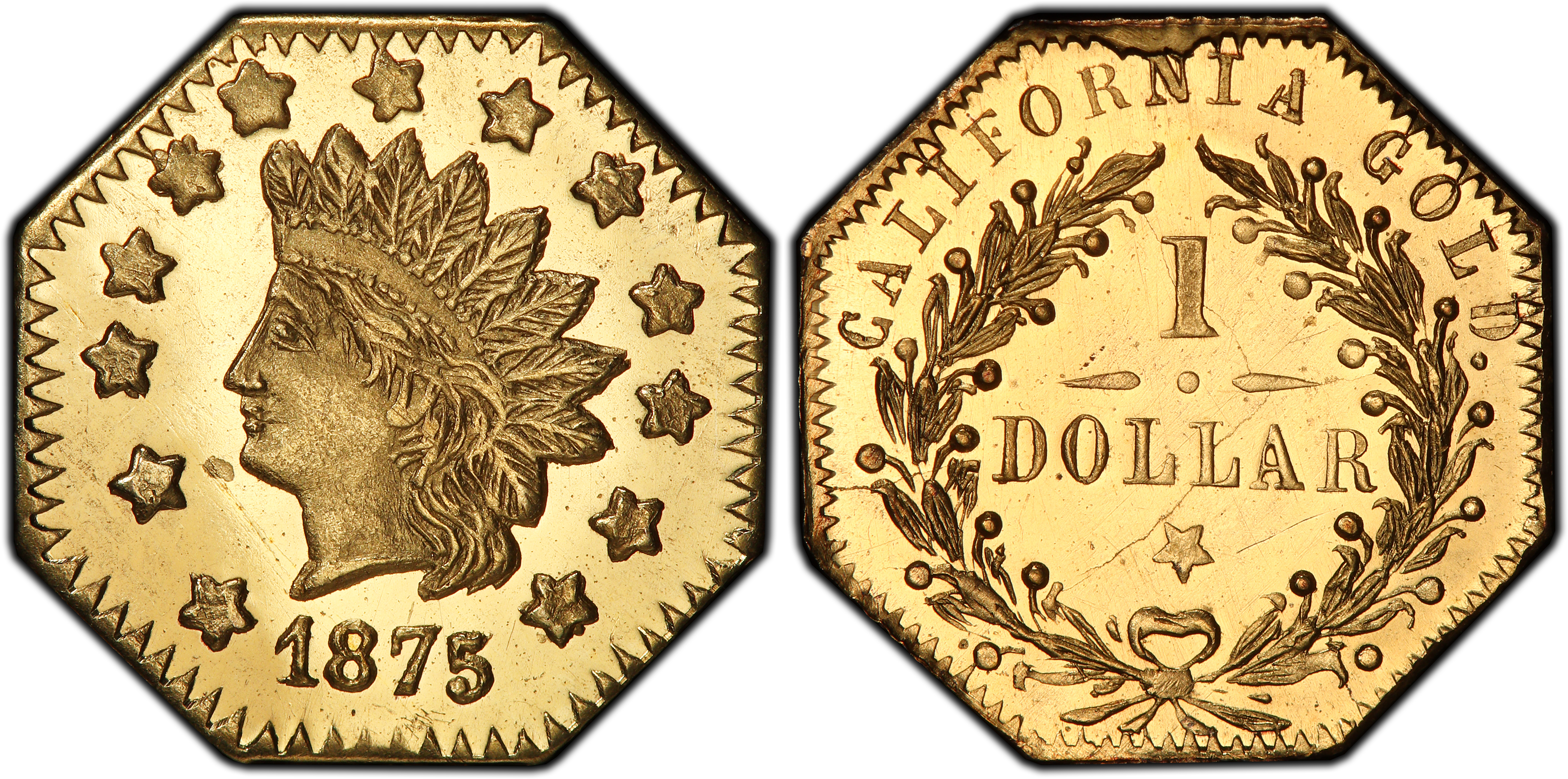
Obverse & Reverse
The 1875 BG-1125 Gold Dollar is a quintessential example of a 'Period Two' California Fractional Gold piece, a series born from the unique economic conditions of the American West. The initial California Gold Rush created a desperate need for circulating coinage, especially in small denominations. This led to the 'Period One' (1852-1857) issues, which were privately minted and genuinely intended to facilitate commerce. However, by the time the BG-1125 was struck, the landscape had changed. The San Francisco Mint was well-established, and the immediate need for private small-denomination gold had subsided. The purpose of these 'Period Two' or 'Jeweler's Issues' (1858-1882) shifted from commerce to collectibles. They were primarily created by jewelers and merchants as souvenirs and keepsakes, capturing the romantic allure of the Gold Rush for tourists and those back East. These later issues, including the BG-1125, were often underweight for their stated face value and featured more varied and sometimes cruder designs than their circulating predecessors. The minter, Christopher Ferdinand Mohrig, was a prolific San Francisco jeweler who produced a wide range of fractional gold varieties. His enterprise came to an abrupt end on August 10, 1876, when he was arrested by the U.S. Secret Service for violating the Coinage Act of 1864, which prohibited private coinage. His dies and existing stock were confiscated and destroyed, an event which contributes to the scarcity of his later-dated issues. The BG-1125, therefore, is not just a coin, but a historical artifact representing the transition of fractional gold from a practical necessity to a cherished memento, and a final, defiant act of private minting before federal enforcement ended the era for good.
Associated EventCalifornia Gold Rush (Later Souvenir Period)
Reason For MintingPrimarily struck for sale as a souvenir or keepsake of the California Gold Rush, rather than for circulation.
Minter HistoryChristopher Ferdinand Mohrig was a San Francisco-based jeweler and one of the key producers of 'Period Two' California Fractional Gold. He is credited with a wide array of varieties, typically featuring Indian Head and Liberty Head motifs. His operation was a target of federal scrutiny as the government sought to suppress private coinage. In August 1876, the Secret Service arrested Mohrig and seized his equipment, effectively halting his production and making his extant pieces, particularly those from 1875 and 1876, numismatically significant.
Historical SignificanceThe BG-1125 represents the final phase of private gold minting in California. Its existence as a 'Jeweler's Issue' highlights the national fascination with the Gold Rush and the creation of a robust market for numismatic souvenirs. The circumstances of its minter's arrest underscore the federal government's consolidation of control over the nation's currency, marking the definitive end of a colorful and entrepreneurial chapter in American monetary history.
BG-1125
Denomination$1
Minting Period1875
Assayer/MinterChristopher Ferdinand Mohrig
Geographic OriginSan Francisco, California
Obverse DescriptionAn Indian Head motif facing left, wearing a feathered headdress. The portrait is surrounded by 13 six-pointed stars, representing the original colonies. The date '1875' is positioned below the bust truncation.
Obverse Inscription1875
Reverse DescriptionAn agricultural wreath composed of leaves and berries surrounds the denomination '1 / DOLLAR'. The legend 'CALIFORNIA GOLD' appears along the upper periphery, outside the wreath. Later die states exhibit prominent die cracks.
Reverse InscriptionCALIFORNIA GOLD 1 DOLLAR
CompositionGold
Stated Fineness Actual FinenessVaries (typically 14-22 karats for Period Two issues)
EdgePlain
Unknown
Survival Estimate60-75 (per Low R-5 rating)
Rarity ScaleLow R-5
This octagonal dollar is highly prized for its attractive Indian Head design, connection to a known and historically significant minter (Mohrig), and its status as a late-date souvenir issue. The distinctive reverse die state with heavy cracking makes it a fascinating piece for specialists to study.
Key VarietiesThe primary variety distinction for BG-1125 lies in the die state of the reverse. Later strikes, which are frequently encountered, show a prominent cud (a raised lump of metal from a broken die) above the 'NI' in CALIFORNIA, along with extensive die cracks across the reverse field. No major design varieties, patterns, or official restrikes are known to exist for this specific BG-number.
Authentication TipsAuthenticity can be confirmed by several key diagnostics. Look for the characteristic style of Mohrig's engraving, which is generally of higher quality than many contemporary pieces. Most importantly, examine the reverse for the well-documented die state: a terminal state showing multiple die cracks, especially one bisecting the center, and a cud above 'CALIFORNIA'. Fakes are common in the Cal Gold series; they often have a soapy, indistinct appearance, wrong weight, or feature designs (like bears) not found on genuine period issues. Genuine pieces are typically very thin.
Shopping ConsiderationsA premium quality example of BG-1125 is defined by a sharp strike, particularly on the feathers of the headdress and the details of the wreath. Many surviving examples are found in high grades (Mint State) and often exhibit prooflike or mirrored fields, a common characteristic of these later jeweler's issues. Seek out coins with clean, original surfaces and attractive orange-gold or straw-gold toning. Carefully examine the surfaces for signs of tooling, harsh cleaning, or evidence of having been mounted in jewelry, which was a common fate for these pieces. The presence of the dramatic late-stage die cracks is expected and does not detract from the value; in fact, it serves as a positive confirmation of authenticity.
A coin's grade is its condition, rated on a 1-70 scale. For rare coins, this is the most critical factor in determining value, as a tiny difference in preservation can mean a huge difference in price.
Relevant Grade TypesAll original issues of BG-1125 were business strikes, although they were not intended for widespread circulation. They are found in both Circulated (1-58) and, more commonly, Mint State (MS, 60-70) grades. No true Proofs were struck during the original period of issue. The frequently seen prooflike (PL) surfaces are a result of polished dies being used to strike coins for souvenir sales, and this characteristic should not be confused with a true Proof striking.
Mint State CharacteristicsUncirculated examples of BG-1125 are noted for their typically sharp strikes and highly reflective, prooflike fields. The quality of luster can range from satiny to deeply mirrored. Due to the very small size and the nature of production, even high-grade specimens may show minor planchet imperfections or wispy handling marks. The most desirable Mint State coins exhibit a full strike, vibrant luster, and minimal distracting marks on the central design elements.
Circulated Wear PatternsOn circulated examples, wear will first appear on the highest points of the design. For the obverse, this includes the cheek of the Indian and the highest feathers in the headdress. On the reverse, the high points of the wreath's leaves and the numerals of the fraction will show the first signs of friction. In lower grades, the stars and legends will begin to weaken and merge with the fields.
Key Factors For ValueFor the BG-1125, value is driven by several factors. Grade is paramount, with Gem MS-65 and finer examples commanding significant premiums. Surface quality is critical; coins with original, uncleaned 'skin' and deep, mirrored fields are highly sought after. Eye appeal, enhanced by attractive toning, adds to the desirability. The sharpness of the strike is also a key differentiator. Finally, certification by a top-tier grading service (PCGS or NGC) is essential for market acceptance, and a CAC sticker indicating premium quality for the grade will often result in a higher price.
PCGS Price Guide
| Grade | Price | Population |
|---|---|---|
| 50 | N/A | 1 |
| 55 | $750.00 | 3 |
| 55+ | $775.00 | N/A |
| 58 | $800.00 | 5 |
| 58+ | $825.00 | N/A |
| 60 | $1,000.00 | N/A |
| 61 | $1,250.00 | 4 |
| 62 | $1,500.00 | 6 |
| 62+ | $1,650.00 | N/A |
| 63 | $1,750.00 | 7 |
| 63+ | $2,000.00 | N/A |
| 64 | $2,400.00 | 13 |
| 64+ | $2,850.00 | N/A |
| 65 | $3,350.00 | 2 |