1875 G50C BG-1057 (Regular Strike)
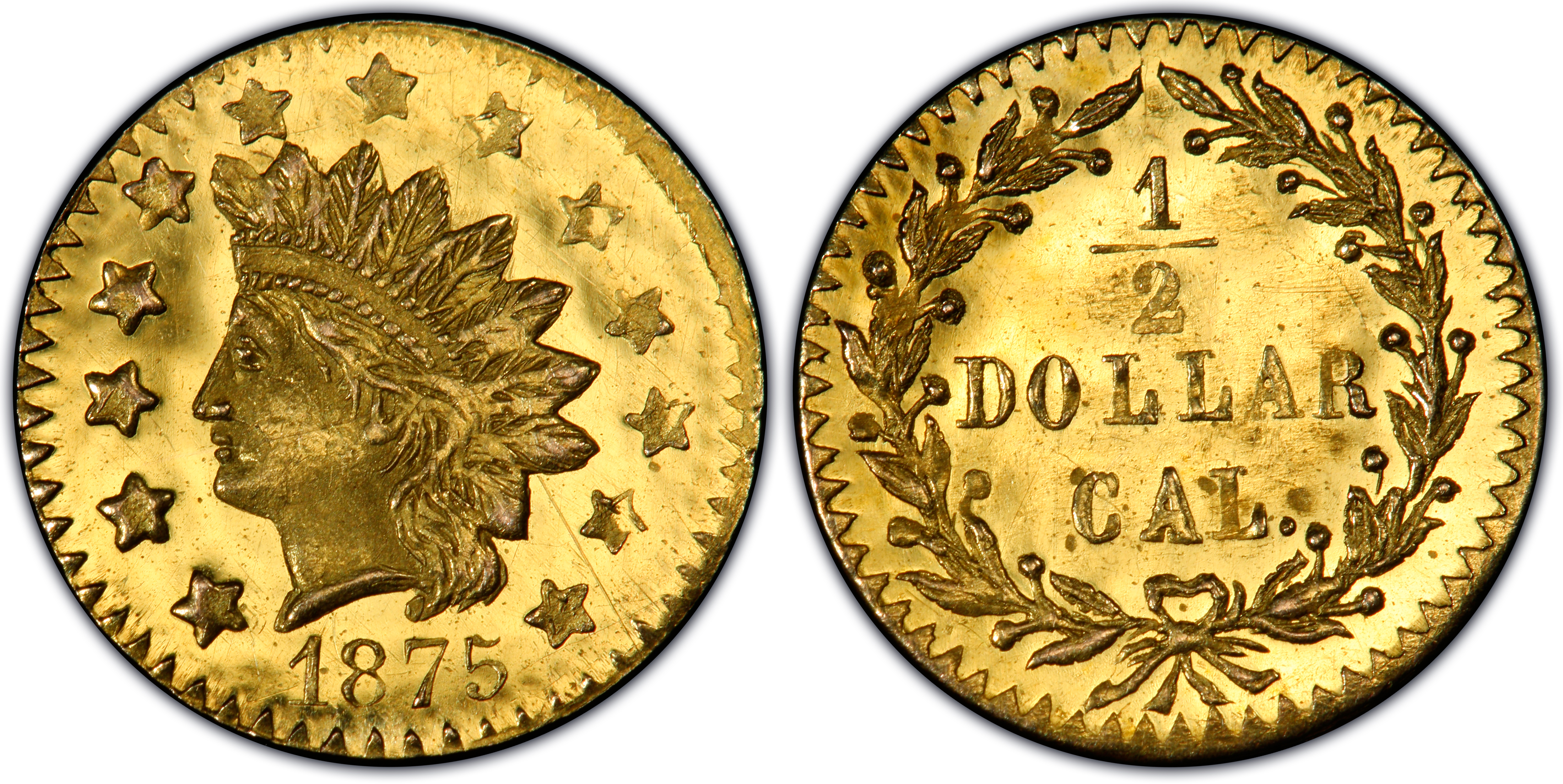
Obverse & Reverse
The 1875 G50C BG-1057 is a product of the third and final period of California Fractional Gold production (1872-1882), an era defined by a shift from quasi-circulating currency to charming keepsakes and souvenirs. The initial gold rush necessity for small-denomination coinage had long since passed. The United States government had established a branch mint in San Francisco in 1854, which produced ample quantities of federal silver and gold coins, satisfying the region's commercial needs. However, the allure of California gold and the romance of the '49ers persisted, creating a robust market for miniature gold tokens, particularly among tourists and those sending mementos back East. Enterprising jewelers and manufacturers in San Francisco, such as Herman J. Brand, stepped in to fill this demand. Unlike the earlier, often anonymous issues of the 1850s, these later pieces were openly advertised and sold as charms or souvenirs. The Act of 1864 had criminalized the private issuance of coinage, but manufacturers circumvented this by either omitting the word 'DOLLAR' or using an alternative like 'DOL,' as seen on many Period Two pieces. Period Three pieces, like this 1875 example, often feature a denomination such as '1/2' but lack the word 'DOLLAR,' a subtle but legally significant distinction that categorized them as tokens rather than illegal coins. The BG-1057, specifically, was struck from dies prepared by the prominent San Francisco die-sinker, John C. Hise, and manufactured by Herman J. Brand. It was then sold through firms like Robert B. Gray & Co., a well-known jeweler and watchmaker. These pieces were machine-struck with a high degree of precision, featuring popular motifs like the Indian Head, which mirrored contemporary federal coinage and appealed to Victorian aesthetic sensibilities. While never intended to serve as the hard-money currency of the Gold Rush, they are a vital part of the story, representing the commercialization of the Gold Rush legacy itself.
Associated EventPost-Gold Rush California Economic Expansion
Reason For MintingPrimarily created to be sold as souvenirs, jewelry, and keepsakes for tourists and locals capitalizing on the romantic legacy of the California Gold Rush.
Minter HistoryHerman J. Brand was a German immigrant and manufacturing jeweler active in San Francisco from the 1860s through the 1880s. He was one of the most prolific producers of California Fractional Gold tokens during the third period of their issue. Rather than being a true 'minter' in the vein of the pioneer assayers, Brand operated a sophisticated workshop that produced a wide variety of jewelry and specialty items, including these popular gold tokens. He often contracted with skilled die-sinkers like John C. Hise to create the designs. His business model focused on wholesale distribution to other jewelers and merchants, such as Robert B. Gray & Co., who would then retail them to the public.
Historical SignificanceThe BG-1057 represents the final evolution of the California Fractional Gold series, where the pieces transitioned from a practical, albeit illegal, circulating medium to a commercial souvenir. It demonstrates the continued fascination with gold and the enduring mythos of the Gold Rush in American culture, even decades after the initial frenzy. These Period Three pieces are a tangible link to the burgeoning tourism industry and mercantile economy of late 19th-century San Francisco.
N/A
Denomination50 Cents (Half Dollar)
Minting Period1875
Assayer/MinterHerman J. Brand (manufacturer); Robert B. Gray & Co. (distributor)
Geographic OriginSan Francisco, California
Obverse DescriptionA stylized head of an Indian princess facing left, adorned with a feathered headdress. Thirteen stars encircle the portrait along the rim.
Obverse Inscription(Thirteen stars arranged in an arc above the head)
Reverse DescriptionThe denomination '1/2' is prominently displayed within a wreath composed of two oak branches tied together at the bottom with a ribbon. The date '1875' is positioned above the wreath, and the inscription 'CALIFORNIA GOLD' is below it.
Reverse Inscription1875 / 1/2 / CALIFORNIA GOLD
CompositionGold
Stated Fineness Actual FinenessTypically ranges from .500 to .750 fine, but can vary.
Weight0.25 grams
Diameter10.00 mm
EdgePlain
Unknown, but considered relatively common for the type.
Survival Estimate500-750
Rarity ScaleR-4
The 1875 G50C BG-1057 is popular due to its classic Indian Head design, affordability relative to earlier issues, and its status as a representative example of the souvenir period of California Fractional Gold. It offers collectors a tangible piece of Gold Rush legacy merchandise from a major San Francisco manufacturer.
Key VarietiesThis is a regular business strike. No proof or special presentation strikings are known for the BG-1057 die marriage from the original period of issue. The Breen-Gillio catalog documents numerous die states (from early, sharp strikes to later, degraded strikes with cracks and clash marks) which are collected by specialists. There are no major varieties in the traditional sense, but die state is a key consideration for advanced collectors.
Authentication TipsGenuine examples have a sharp, well-defined strike from machine presses. The stars and letters are typically clear and evenly spaced. Look for a small die crack that often develops from the rim to the 'F' in 'CALIFORNIA' on the reverse, a known diagnostic for this variety. Counterfeits are common and often have a cast or soapy appearance, with poorly defined details, incorrect weight, and a brassy color. Many fakes are made of gold-plated lead or brass. Precise weight and specific gravity tests are highly recommended for authentication.
Shopping ConsiderationsA premium quality example for its grade will possess a sharp strike, especially on the feathers of the headdress and the details of the wreath. Seek out pieces with smooth, lustrous surfaces and minimal distracting contact marks. Original, unconserved 'skin' with a slightly reddish-gold patina is highly desirable and commands a significant premium over cleaned, polished, or harshly dipped examples. Avoid coins with evidence of being mounted in jewelry, such as solder marks, rim damage, or excessive polishing on one side.
A coin's grade is its condition, rated on a 1-70 scale. For rare coins, this is the most critical factor in determining value, as a tiny difference in preservation can mean a huge difference in price.
Relevant Grade TypesOriginal period issues of BG-1057 were business strikes produced for commercial sale as tokens and are found in Circulated (1-58) and Mint State (MS, 60-70) grades. No proofs were struck during the original period of issue. Any piece described as a 'Proof' is either a modern fantasy piece or a misattributed high-grade business strike with reflective surfaces (Prooflike or PL), which would be noted by the grading services but is not a distinct striking method for this issue.
Mint State CharacteristicsAn uncirculated BG-1057 will exhibit full, unbroken mint luster, often with a slightly satiny texture. The strike is typically sharp, though minor weakness on the highest points of the feathers or the wreath's bow is not uncommon. Due to their small size and handling as souvenirs, even Mint State examples can show tiny ticks or marks; a 'gem' (MS-65 or higher) example would be virtually free of such imperfections and possess outstanding eye appeal.
Circulated Wear PatternsWear first appears on the high points of the design: the cheek and the feathers of the Indian princess on the obverse, and the leaves and bow of the wreath on the reverse. On moderately worn examples (VF-XF), the finer details within the feathers will merge, and the cheek will flatten. In lower grades, the stars and legends will become soft and may start to merge with the fields.
Key Factors For ValueBeyond the numerical grade, value is driven by surface quality and strike. An example with original, undisturbed surfaces is far more valuable than a cleaned or polished one of the same grade. A bold, complete strike is highly preferred over a soft or weakly struck coin. Eye appeal is paramount; coins with a pleasing, uniform color and minimal distracting marks will always sell for a premium. For this issue, a CAC sticker signifies superior quality for the grade and typically adds a significant premium.
PCGS Price Guide
| Grade | Price | Population |
|---|---|---|
| 50 | N/A | N/A |
| 58 | $275.00 | 1 |
| 58+ | $285.00 | N/A |
| 60 | $310.00 | 1 |
| 61 | $345.00 | 1 |
| 62 | $550.00 | 9 |
| 62+ | $575.00 | N/A |
| 63 | $750.00 | 7 |
| 63+ | $850.00 | N/A |
| 64 | $1,000.00 | 11 |
| 64+ | $1,150.00 | N/A |
| 65 | $1,700.00 | 2 |